The Lone Survivor: How a Stubborn Pack Horse Defied Wyoming's Wilderness
Mouse, a pack horse raised in Wyoming's rugged high country, was never one for affection. Described by his caretakers as a 'firecracker on legs,' this independent American Quarter Horse with a distinctive gray grulla coat always preferred his own company. That very stubbornness, however, may have been the key to his incredible survival story.
Disappearance into the Wild
In July 2025, during a fishing trip to Moon Lake, the 11-year-old horse wandered from his owners and vanished into the formidable Wind River Range. This area represents one of the most remote, snowbound regions in the contiguous United States, a landscape where predators like bears and wolves pose constant threats. For seven long months, Mouse was missing, presumed lost to the harsh elements.
The Chance Sighting and Determined Search
The breakthrough came on January 18, when snowmobile mechanic Tighe Krutel spotted the dark-coloured horse by chance. Mouse was standing at approximately 10,000 feet elevation, surrounded by up to seven feet of snow in an area known for wildlife, about 80 miles east of Jackson Hole.

'That horse could've been a couple hundred yards off the trail and nobody would ever see him,' remarked Tim Koldenhoven, owner of Union Pass Rentals where Krutel works. 'But once the snow came, that dark-colored horse stood out.'
This sighting triggered what would become an extraordinary rescue mission. Buster Campbell, a 30-year-old cowboy from Cody, was among the first to respond. 'We went in by snowcat and then searched on foot,' Campbell told the Daily Mail. 'I see a set of tracks – probably two to three-and-a-half, maybe four feet of snow – and I knew they had to be his. I literally followed his tracks.'
A Race Against Time and Weather
Ten miles from the nearest road, Campbell finally found Mouse standing alone on a wooded ridge. 'Lo and behold, there's Mouse standing right there,' Campbell recalled. 'He's looking right at me. I was like, holy cow – by God, he's alive.'
The team immediately recognized their challenge: they could reach the horse, but extracting him presented serious difficulties. 'Ain't no way that horse was gonna post-hole through that snow,' Campbell explained. 'He'd sink. And we sure weren't tying him to a snowmobile.'
With a severe cold front approaching that locals believe would have been fatal, the rescuers knew they were racing against time. Campbell left hay for Mouse, petted him down, and made a promise: 'I told him, 'We'll be back – for good.' And I swear, he looked pretty happy about that.'
Improvised Rescue Operation
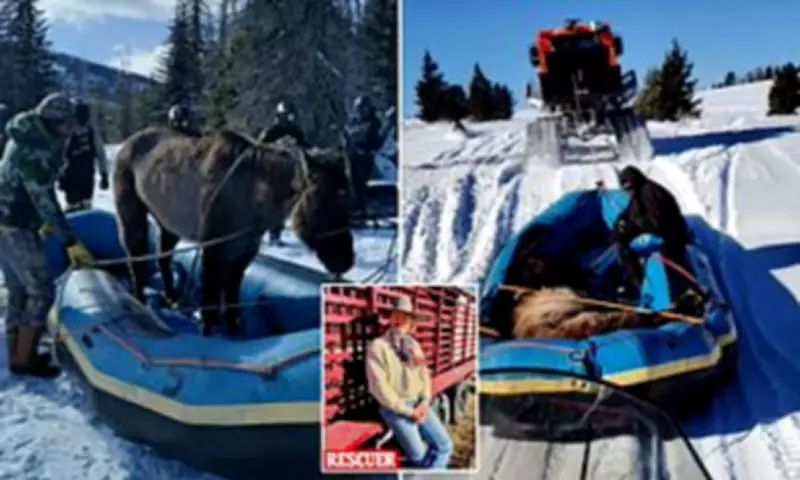
Back in Dubois, Campbell, Mouse's primary caretaker Preston Jorgenson, Krutel, Koldenhoven and three other cowboys gathered at the Lineshack Lodge to devise a plan. The 14-and-a-half hand horse needed creative solutions. After considering options like dragging him out on a car hood, someone suggested using a river raft.
'We needed something that would float him,' Campbell said. After driving four hours to Cody to retrieve the raft, a six-man team returned to the mountains early on January 25. Koldenhoven navigated a snowcat through deep snow for four hours while others followed on snowmobiles, all concerned about getting stuck themselves.
The Dramatic Extraction
Using speed, expert horsemanship and a restraint method called the 'flying W,' the team secured Mouse without sedation – deemed too dangerous in his condition – and loaded him onto the inflatable raft. 'It happens fast if you know what you're doing,' Campbell noted. 'And he didn't fight us. Not at all.'
The group then towed the raft approximately 4,000 yards through deep snow to a waiting snowcat, which transported Mouse back to Dubois with cowboys trailing behind on snowmobiles.
Remarkable Resilience and Community Spirit
Despite his ordeal, Mouse was thin but standing upright – an achievement Campbell believes few domesticated horses could manage. 'Most arena horses would have gone up there, stood under a tree, and died,' he observed. 'You gotta understand the true grit in this horse.'

Preston Jorgenson, a 42-year-old horseman and member of the Eastern Shoshone tribe who had feared the worst after months of fruitless searches, was astonished. 'I was relieved when I saw him,' Jorgenson said. 'No bite marks. No scratches. Still standing on four feet. Still alive.'
Now back in a warm stall with his fellow pack horses, the once-standoffish Mouse appears delighted to be home. Jorgenson has scrapped previous plans to sell him, declaring Mouse a 'keeper.'
Reflecting on the operation, Koldenhoven remarked: 'Never underestimate a bunch of cowboys and rednecks and one cool horse.' Campbell added a broader perspective: 'This was about a group of guys saying, 'We're gonna do what it takes.' In a time when everything feels divided, this is just how Wyoming works. People come together. And they get it done.'