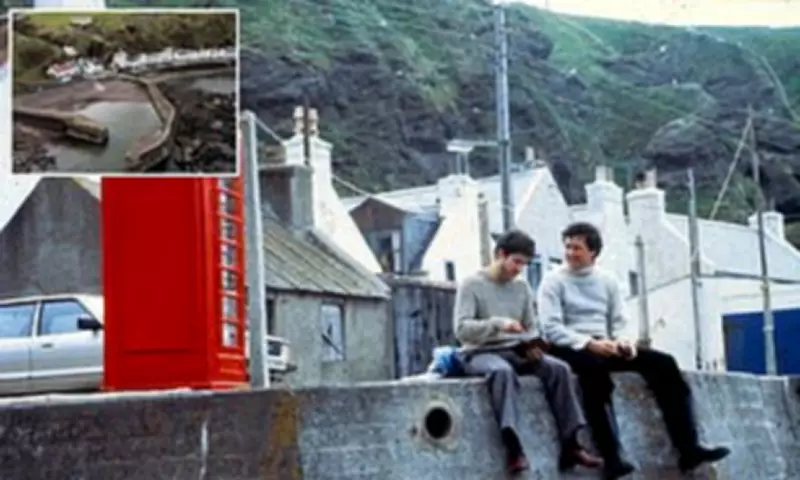
Pennan's Heritage Battle: Residents Challenge Conservation Rules in Coastal Village
Descending the steep, winding road into Pennan feels like traveling through a portal to another era. Nestled tightly against towering red sandstone cliffs, this Aberdeenshire coastal village presents a picturesque scene of whitewashed houses strung along its single street like freshly laundered garments. Even in early spring sunshine, the buildings appear braced against the constant assault of stiff winds and pounding seas that define this dramatic location.
A Village of Many Identities
Pennan's history is layered with multiple identities. At one end of the crescent-shaped bay sits the 19th century harbour, a reminder of the village's past as a thriving fishing port that once sustained 300 residents. A five-minute walk brings visitors to the brightly painted village hall, originally rebuilt from a First World War aerodrome accommodation hut. Midway along stands the iconic red telephone box and the Pennan Inn opposite, both immortalized in Bill Forsyth's beloved 1983 comedy film Local Hero.
In the movie, Pennan doubled as the fictional Highland community of Ferness, whose residents unknowingly negotiate with an American oil company planning to replace their village with a massive terminal. This cinematic fame has brought tourism but also contributed to what residents describe as an unrealistic preservation of a particular moment in time.

Conservation Controversy
Designated a conservation village in 1977 under legislation protecting areas of "special architectural or historical interest," Pennan now finds itself at the center of a growing conflict between preservation and practicality. Aberdeenshire Council is currently reviewing specific guidance for Pennan and 37 other conservation areas in its jurisdiction, describing the village as having "one of the most distinctive and recognisable views in Aberdeenshire."
However, many residents view the proposed conservation rulebook as overly restrictive and disconnected from modern living requirements. "They talk about conservation, but who's it being conserved for exactly?" asks Shona Stephen, 53, one of just eight full-time residents. "We want more people living in the village to boost the community, and if you're not allowed to do things to the houses, the young crowd particularly won't come as they want modern conveniences."
Practical Challenges and Restrictions
The council's proposed guidelines detail numerous restrictions, including requirements for cast-iron gutters instead of uPVC alternatives, prohibitions against modern windows, and limitations on roof modifications. Even satellite dishes and solar panels would be "frowned upon" according to the document, though none currently exist in the village.
Residents report facing absurd bureaucratic hurdles for simple improvements. Ms. Stephen, who runs the Coastal Cuppie food shack at the harbour, was forced to replace her original bright blue shed with a smaller, creosoted black version to comply with heritage requirements. "They wanted it to look like a shed, not a business," she explains, despite the obvious commercial nature of her venture.
The Reality of Coastal Living
Maintaining properties in Pennan presents unique challenges beyond aesthetic concerns. The porous sandstone buildings require constant heating year-round to combat the dampness from their cliffside location. With no mains gas available, residents rely on expensive storage heaters costing £300-400 monthly in electricity bills.
"Somebody installed an air source heat pump but it lasted two years," notes Ms. Stephen. "The salt killed it. Salt kills everything here." The village faces genuine threats from its geography, including potential flooding from the sea and instability from the cliffs behind, highlighted by a major landslip in 2007 that required emergency evacuation.
Seeking a Sustainable Future
Retired second homeowner Alistair Mackenzie, 73, argues for a shift in focus from preservation to sustainability. "I want a sustainability plan, not a conservation plan," he states. "Something that looks to the future, to protect Pennan for future generations, not something that looks backwards in the rear-view mirror to 1953."

Mr. Mackenzie points out that while conservation rules obsess over details like plastic guttering and window styles, the village faces significant risks from coastal erosion and cliff instability that could "wipe out properties completely" if not addressed.
Historical Accuracy vs. Modern Needs
Residents question which version of Pennan conservationists are trying to preserve. The current village represents a "hotchpotch of change" according to local photographer Fiona McRae. "The houses were never whitewashed before," she notes. "That's quite a new thing that happened after Local Hero when they thought, 'Make it look pretty.'"
Ms. McRae challenges the emphasis on preserving "a perceived idea of a fishing village" when the fishing industry has long disappeared due to changing boat sizes. "This is the sanitized version of a fishing village," she observes, questioning whether living in an 18th century village requires 18th century living standards.
The De-Designation Movement
Frustrated residents are now pursuing the unusual step of seeking removal of Pennan's conservation status, following the precedent of Aberchirder, another Aberdeenshire village where planners recommended de-designation after finding its historic core no longer worthy of protection.
David McRobbie, renovating what was once the village bakehouse, represents the practical challenges of balancing heritage with modern requirements. He has replaced a small window with a uPVC double-glazed unit because "if I put in single-glazing, it would probably crack when the first wave hit it."
"Conservation simply assumes the skills and money are there to sustain our heritage," Mr. McRobbie observes, highlighting the difficulty of finding traditional craftspeople and materials in the modern era.
Looking Forward
As residents navigate the tension between preservation and practicality, they emphasize their commitment to Pennan's future rather than merely its past. "We don't want to live in a museum," summarizes Ms. Stephen. "We want to be able to maintain our houses and be able to afford to maintain them."
The debate continues as Aberdeenshire Council considers its conservation guidance, with residents arguing that true preservation means addressing real threats to the village's existence while allowing for sensible modernization that enables community growth and sustainability for generations to come.