When Nicole Austin was growing up in Oshawa, Canada, her Jamaican family couldn't find the foods they enjoyed back on the island. No callaloo, garden eggs or okra. Austin's grandmother grew certain things in her backyard, but only if she had the necessary seeds.
"It's often small-scale farmers, farmers of color, Black farmers that make sure that these foods that are culturally significant to us are available, that we grow them, that we share them," Austin said. "It wasn't until I'm in these spaces now that I realized how important the place is of farmers of color and Black farmers to make sure that these food histories are maintained and celebrated and shared."
She had planned to become a registered dietitian after getting a degree in geology but, while working part-time at the Toronto Metropolitan University's (TMU) Centre for Studies in Food Security, Austin realized that she was most drawn to food justice, security and advocacy. Today, Austin is one of those small-scale farmers of color, something she never expected.
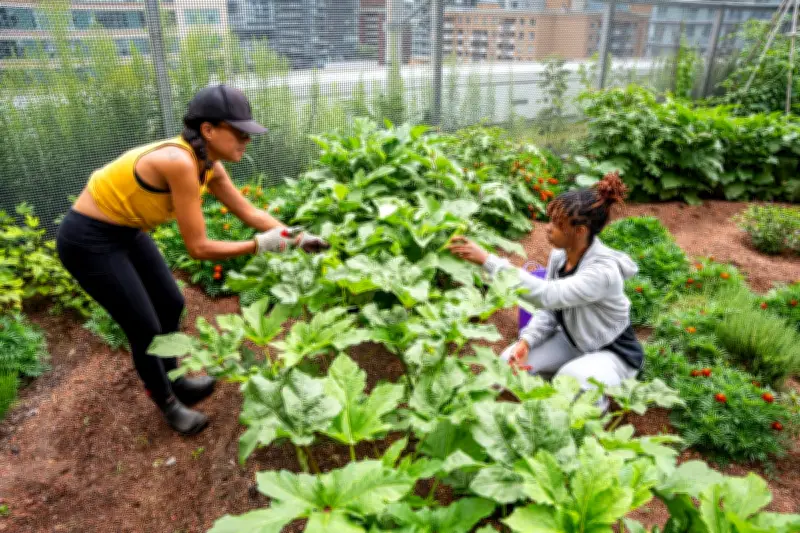
And she's growing a very old variety of okra on a downtown Toronto rooftop, connecting Africa, the Caribbean, Canada and the American south. As an heirloom passed from person to person, white velvet okra connected the farm with generations of growers around the world. Thanks to Austin and seed growers, this variety has made a long journey across space and time, traveling about 1,000 miles and a 100 years, to be cultivated and enjoyed in Toronto.
In 2021, Austin joined TMU's Urban Farm to develop the Black Food Sovereignty Initiative and its Harvest Collective and Learning Circle programs. Part of the initiative's mission is to foster self-determination, community and good health in Black residents via the cultivation of culturally relevant foods. The programs engage both the TMU and greater Toronto area's Black communities through sharing farm-to-table foods.
Austin wanted to start by growing five culturally significant crops with roots in the African diaspora. She knew okra should be on the farm's list. The vegetable probably originated or was domesticated somewhere in Africa. It stars in many West African and Jamaican stews or soups, and it is an essential ingredient in their American cousin, gumbo. Its fried form is a staple on southern and soul food menus.
It's less common in Canada, which has a smaller Black community (some 4% compared to about 14% in the US) and a colder climate that's not a natural fit for this warm-weather plant. But a University of Guelph study found it tops the list of the 13 most sought-after vegetables for the three largest ethnic groups in the Toronto metropolitan area.
Every season, Austin buys seeds from Truelove Seeds, a U.S.-based seed company that curates an African diaspora seed collection. Through its site, she found white velvet okra, named for its fuzzy pods and a lack of spines common to many varieties of the vegetable.
A story of resilience
"I was really drawn to and really inspired by the history of this heirloom," Austin said. "[Which] is carrying the genetic makeup of the generations before it". Heirlooms are "open-pollinated seed varieties that have been in existence and saved continuously since usually pre-World War II", said Chris Smith, author of The Whole Okra.
"When [people] talk about heirlooms or think about heirlooms, it's something that has maybe a people or a place attached to it and has, in some ways, survived the test of time in that they're still around today," he said.
Historically, according to the Slow Food Foundation for Biodiversity, white velvet okra was cultivated around Mississippi, Louisiana, Georgia and Alabama. It was so popular that citizens called for its commercial cultivation.
Austin sees white velvet okra as a way to "reach out across time and space". She's not from the American south nor is she Black American, but the plant connects her to those parts of the African diaspora. Initially introduced in 1890 by Peter Henderson & Company of New York, white velvet okra is a distinctly southern vegetable, grown and consumed by many people in the region.
But, despite how prized it once was, the unique, fuzzy white velvet okra was cast aside for more traditional green varieties, following a trend of regional food plants being pushed out by globalized agriculture. By 2015, white velvet okra was not commercially produced in the United States, never having been grown on as large a scale as its green cousins.
"White velvet okra is fuzzy. It's tender. It's delicious. To me, it's a variety that's worth celebrating, saving and telling the story of our people's resiliency in food sovereignty, sharing knowledge," Austin said. "I like what this food item can symbolize in terms of resiliency, in terms of celebrating heritage."
The variety, whose notable characteristics made it a beloved vegetable in deep southern states, has been added to the Ark of Taste, which, since 1996, has operated as a "living catalogue" of foods facing extinction.
The seeds are now available through a number of small US-based specialty growers, like Truelove Seeds and Sistah Seeds, where founder Amirah Mitchell grows the crop. Mitchell also likes the unique texture of white velvet okra's pod and its flavor, which she said "is maybe a touch less vegetal than some of the green okras".
She has grown the variety for several years, since she ran a seedkeeping program in which students identified and grew a crop or variety they connected to their heritage. White velvet okra made the cut.
"Okra is one of the African vegetables that has survived, that has kept a cultural connection to African-descended peoples that survived the Middle Passage," she said. "There were a lot of crops that were not able to adapt to the climate of North America and were not able to thrive here and, therefore, were lost to the diets of African people who were brought here. Those crops that were able to survive that journey and were able to survive in cultural memory and cuisine and continue to be part of the diets and the food culture of African Americans are really quite special."
Sharing seeds, sharing history
Preserving and sharing the seeds is engaging in a way of "practicing our living history", Austin said. She is committed to making sure that others have the chance to grow the crop, something that is both a cultural and scientific mission.
"A big, big part of food sovereignty is actually saving seeds and sharing seeds across our community," she said. "There's only about four companies that basically have propriety over about 80% of commercially available seeds, which is insane. The fact that you can even put a patent and own seed production is bizarre to me. It's part of that broken food system."
Okra is also a crop that is near-essential for cultural reconnection work, given its significant history in the US south, African diasporic communities, and also in south-east Asia and India.
"People are in a moment of trying to reconnect with the foods of their cultures, and okra belongs to a lot of people," said Smith. He's sent okra seeds to growers in Scotland, England and the American west coast.
The white velvet okra Austin will grow this year comes from seeds she saved from last year's crop. Growing and preserving seeds is like magic, she said. The seeds, once harvested, are dormant; they may look as if they're not doing anything. But ultimately everything about the plant, from the fruit to the seeds, is living. Even all the way up in Toronto, those same seeds can grow many more white velvet okra plants.
And they will. "I brought [these seeds] up from people that grow them in the American south. I was able to grow them in Toronto. And now I'm able to share those seeds to my network," Austin said. "They can then do that in turn. It's just one component of building a food sovereignty movement, but I really love what white velvet okra symbolizes for history, heritage, resiliency and self-determination."