In Uganda's Kyaka II refugee settlement, about 500 people now work in 32 insect-farming groups, raising black soldier flies, crickets, and mealworms to feed their families and earn income, while reducing pressure on land.
A few minutes' walk from his home in the settlement, Kanane Bikanyale feeds black soldier fly larvae to chickens in a coop above a fishpond. The larvae disappear in a scrum of chickens. Nearby, more larvae grow in modified jerrycans, while adult flies are kept in netted boxes.
Bikanyale kept chickens before he fled to Uganda from the Democratic Republic of the Congo (DRC). But the cost of conventional feed and shortages of ingredients made them increasingly difficult to raise – a widespread pressure for millions of smallholder farmers whose margins are tight.
From jerrycans to family meals
In 2019, he began farming black soldier flies in the settlement, giving the larvae to his chickens and tilapia fish, and using the insects' debris and excrement, known as frass, as fertiliser. The insects themselves feed on organic material, from household food scraps to crop residues.
Kavira Musabingo, also from DRC, arrived at the settlement in 2018 with her husband, daughter and five grandchildren. The family had almost no possessions and struggled to find enough food. She joined a women's group learning to raise black soldier flies. She initially sold her share of the larvae for urgent household expenses. Later, she began rearing insects at home. Today, she provides chicken, eggs and vegetables for her family and earns an income from selling what they do not need.
Uganda harbours one of the world's largest refugee populations; Kyaka II alone, in the west of the country, is home to nearly 140,000 people, most of them, like Bikanyale and Musabingo, displaced by years of conflict and instability in neighbouring DRC. Women and children make up 78% of people in the camp. As the settlement expanded, land allocations got smaller: by 2018, new arrivals received plots of about 30 by 30 metres. Split between a home and crops, and with humanitarian support declining, families had to secure enough food from less and less space.
Nutrition and school feeding
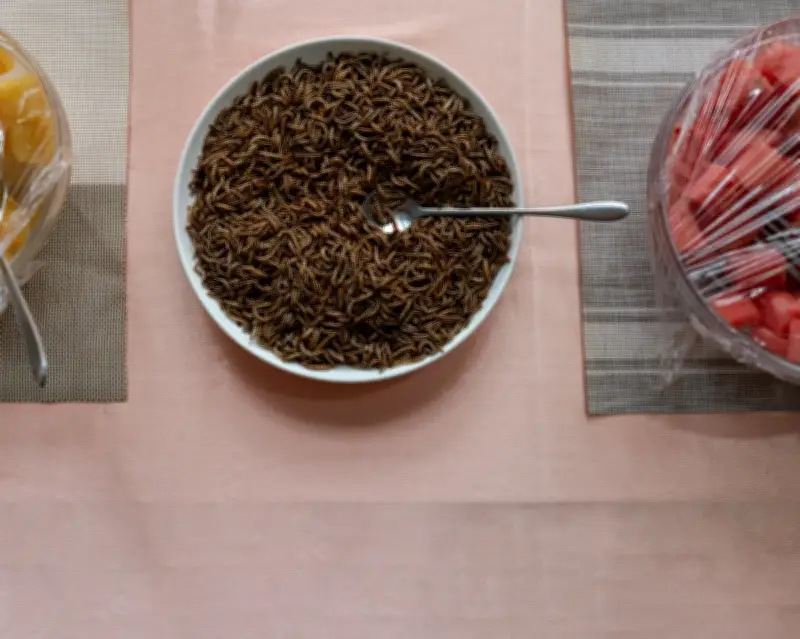
Insect rearing requires less space and water than conventional livestock farming, and trays of insects can be stacked vertically. Alongside black soldier flies, they raise crickets and mealworms, both consumed as food in many parts of the world. Traditionally, including in Uganda, insects have been gathered from the wild, making supply seasonal and uncertain. Urbanisation and western food habits have also changed perceptions: dismissed as rural or backward, insects disappeared from diets.
“Their nutritional potential is particularly relevant for vulnerable groups such as women of reproductive age and children under five, since some species are particularly rich in proteins and micronutrients such as iron and zinc,” says Dorothy Nakimbugwe, an associate professor in the food technology and nutrition department at Makerere University in the capital, Kampala.
Nakimbugwe has also led Refugee Insect Production for Food and Feed (RefIPro), a project organised by the Danish non-profit organisation Raise, which has worked with local groups to train and support farmers in Kyaka II and neighbouring communities since 2018. Rearing insects has also been introduced to more than 10 schools through RefIPro. Among them are Bukere primary school and Kako primary school, which now run their own insect farms and were involved in a randomised trial involving 342 children testing the effects of mealworm-enriched porridge. The University of Copenhagen, another partner in the project, reports that children grew taller and showed improved body composition.
Challenges and scaling up
But before insects can become feed or food, the rearing system has to work. Edward Ssebbombo, working on RefIPro in Kyaka II, has trained farmers and provided technical support over the years, while also designing equipment for their farms, including a pedal-powered sieve, sorters made of recycled motorcycle-wheel spokes and Bikanyale's rail-mounted shelter, which protects the breeding unit from rain and excessive sun, and covers it overnight.
However, making it work in practice remains challenging. “In a food-insecure setting such as a refugee settlement, households produce very little food waste,” Ssebbombo says. “Farming black soldier flies therefore often requires collecting organic material from markets or other sources,” he says, noting that even when the waste itself is free, “sorting, collecting and transporting it can still be costly for small-scale producers.”
Mealworm production faces similar constraints: larvae are fed organic residues and dry feed such as maize and wheat bran. At Bukere, families contribute banana and sweet-potato peels, but the dry feed remains costly.
Violet Gwokyalya leads Mothers Against Malnutrition and Hunger (Mamah), which coordinates RefIPro's work on the ground. She hopes to involve families through a model in which “parents can rear mealworms at household or community level and supply them to schools, helping sustain school feeding while creating an income opportunity for themselves”.
Waste to value across Uganda
Where organic residues instead accumulate beyond what local systems can handle, black soldier fly farming takes on a different role. Outside Kampala, the Kollekt Village, a recycling centre run by a local environmental organisation, works with food markets and waste pickers to separate organic material before it reaches dumpsites, integrating insect farming into a zero-waste system.
In Jinja, Bioconvision turns organic waste from food processors and markets into black soldier fly larvae for animal feed and frass-based fertiliser for farmers, including those farming fish on Lake Victoria. In 2025, the company processed nearly 1,000 tonnes of organic waste, producing about 60 tonnes of fresh larvae and 83 tonnes of fertiliser. Both are connected to Bugs-Africa, a project that promotes black soldier fly waste processing in Uganda and elsewhere in Africa.
Uganda is also Africa's second-largest coffee producer, after Ethiopia, and processing the crop results in large amounts of organic residues. In Kasese in western Uganda, Proteen, a Ugandan social enterprise, turns coffee pulp into feed protein and frass-based fertiliser used by coffee farmers, which returns nutrients to the soil.
Insect farming is a rapidly growing industry – the market for insects as food and animal feed is estimated to be worth up to $8bn (£6bn) by 2030. Increased investment has led to industrial-scale ventures in wealthier countries in Europe, Asia and North America but the practice is also spreading across rural tropical regions, where the climate favours insect growth, helping keep the practice affordable and accessible.
According to the UN Food and Agriculture Organization (FAO), feed can account for up to 70% of the cost of keeping livestock, leaving small-scale farmers particularly exposed to rising feed and fertiliser costs. At the same time, as populations increase and concentrate in megacities, the organic waste they generate can outgrow the systems built to manage it.
Insect farming ranges in scale from a single cut-open jerrycan to automated industrial facilities. Wider adoption could reduce the use of soya meal and fishmeal in animal feed, lowering agricultural demand for land and reducing pressure on marine ecosystems. Frass can return nutrients to the soil. But to become a lasting part of agricultural systems, insect farming needs more than individual projects.
In Uganda, a recent conference on insect farming brought together Ssebbombo, Gwokyalya, researchers such as Nakimbugwe and members of refugee communities, alongside representatives from Bugs-Africa, FAO Uganda and public institutions. Speaking at the conference, Ronald Kaggwa, of Uganda's National Planning Authority called for insect farming to be seen not as an isolated farming practice but as part of a broader system linking waste management, livestock, aquaculture, income generation and food security, and to be integrated into the country's agricultural system.
“For this sector to contribute meaningfully to Uganda's development, we must understand the entire value chain,” he said. “It's about transforming innovation into productive enterprises, turning research into practical solutions, creating opportunities for communities and contributing to more nutritious, resilient, circular and competitive food systems.”