
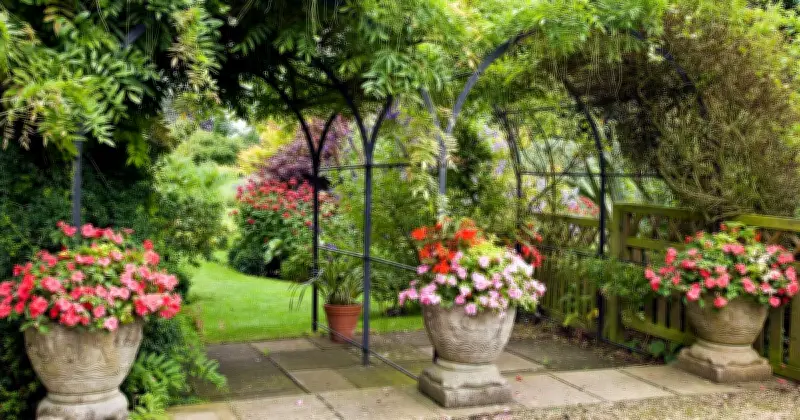
Every garden benefits from something to make you pause and take it all in. It could be a flower-covered arch, a pot next to a doorway, a bench at the end of a winding path, or a standout plant at the centre of a border. By mid-August, when the garden is rich with growth, these focal points can be crucial for giving the space shape, rhythm, and a strong, intentional look.
Frame a view
A focal point doesn't need to be large or costly. Sometimes it's simply a well-framed view. An arch over a path, a gate at the end of a border, or a bench placed beneath a small tree can draw you forward through the space. Climbers help to soften these structures. In August, repeat-flowering roses, honeysuckle, summer clematis and star jasmine can all bring flowers, scent, or foliage to arches, fences, and entrances.
Use plants with presence
Some plants create a natural stopping point thanks to their shape, height, or colour. Dahlias are excellent in August, giving bold flowers to catch the eye from across a garden. Salvias, agapanthus, cannas and crocosmia can also provide strong seasonal colour, whilst ornamental grasses add height, movement and lightness. For a softer look, use pale flowers in places you see in the evening. White cosmos, nicotiana, phlox, and pale dahlias can brighten the garden as light levels fall, making a seating area or path feel more inviting.
Create container highlights
Containers are useful where you need instant impact, or perhaps have limited soil. A pair of pots near a doorway, gate, or set of steps can make the space feel more structured. Use dahlias, pelargoniums, fuchsias, salvias, or compact grasses for late-summer colour, depending on the light available. Large pots work better than small ones this season, as they hold moisture for longer. Keep them watered, feed flowering plants regularly, and deadhead faded blooms to keep the display fresh.
Add objects with purpose
A focal point can also be a birdbath, sculpture, obelisk, water bowl, or planted urn. The key is to give breathing space, as if everything competes for attention, then nothing stands out. Surround a feature with simpler planting, repeated colours, or lower foliage to allow it to shine. Scale is also important. A small ornament can disappear in a large border, whilst an oversized feature could overwhelm a smaller space.
Keep it practical
Think about where the eye naturally travels from the house, patio or main path. Place focal points where they draw you into the garden, mark a change in direction or finish a view. With a little thought, mid-August planting and simple garden features can bring shape, charm and purpose to even the busiest summer border.
Focus Plant - Agastache
Agastache is a brilliant August perennial, bringing upright flower spikes, aromatic foliage, and a relaxed, prairie-style feel to sunny borders. The flowers appear from midsummer to autumn, making it a wonderful transitional plant as other perennials begin to fade. Bees and other pollinators are drawn to the tubular blooms, so it's a lovely choice for wildlife-friendly planting too. It works well among ornamental grasses, salvias, echinaceas, rudbeckias and dahlias, where its vertical stems add lightness and rhythm. Agastache 'Blue Boa' offers rich violet-blue flower spikes, whilst Agastache 'Blackadder' is a strong, dark-toned choice. For warmer colour, try Agastache aurantiaca 'Apricot Sprite' or Agastache rupestris 'Apache Sunset', which brings apricot-orange flowers and aromatic grey foliage.
Agastache grows best in full sun, in fertile but very well-drained soil. It suits gravel gardens, Mediterranean-style borders and sunny containers, but dislikes sitting wet, especially in winter. In heavier soils, add grit to improve drainage, or grow it in a pot where conditions can be controlled more easily. Care in August is simple. Water during prolonged dry spells while plants establish, but avoid overwatering. Deadhead fading spikes to encourage more flowers, or leave some seedheads later for structure. Some types can be short-lived or frost-tender, so taking cuttings in late summer can help keep favourite varieties going. Fun fact: Agastache is often called anise hyssop or giant hyssop, thanks to its scented foliage, but it is actually part of the mint family.
Gardening Jobs
1. Continue to blanch celery varieties that need it. Place paper between the stems and soil before you earth up, helping to keep the stems clean and pale. Keep the plants well-watered, as celery needs steady moisture to produce crisp, tender growth. 2. Prune rambling roses once flowering has finished. Remove some of the old, flowered stems at the base, then tie in strong new shoots to replace them. This keeps the plant vigorous, reduces congestion, and helps create a good framework for next year's flowers. 3. Raise marrows slightly as they swell, especially if they're resting on damp soil. A tile, piece of wood, straw, or similar supports can help to prevent discolouration and reduce the risk of rotting underneath. Check regularly, as large fruits can mature quickly in warm weather. 4. Mow wildflower areas once most flowers have set and dropped seed. Leave the cuttings in place for a few days so remaining seed can fall, then rake them away. Removing the cut material keeps fertility low, helping wildflowers to compete with stronger grasses. 5. Check drying or newly stored onions, removing any with soft patches, mould, or signs of rot. One damaged bulb can quickly impact others nearby, so vigilance is key. Keep onions somewhere cool, dry and airy, and only store firm bulbs with papery skins and well-dried necks.
Did you know?
Dahlias have a rich history rooted in Mexico and Central America. Known to the Aztecs as Acocotli and Cocoxochitl, they were later renamed in honour of Swedish botanist Andreas Dahl. Chicory flowers have a daily rhythm. Their blue blooms open in sunshine, close in wet weather, and often close by early afternoon, making them beautifully responsive to the day. Saffron crocuses are effectively sterile, so they are not grown from ordinary seed. Instead, Crocus sativus is multiplied by corms, meaning this precious spice crop depends on continued human propagation. The Isle of Arran has produced remarkable whitebeams through natural crosses involving rowan and rock whitebeam. Some of these rare trees are unique to Arran and occur nowhere else in the world.




