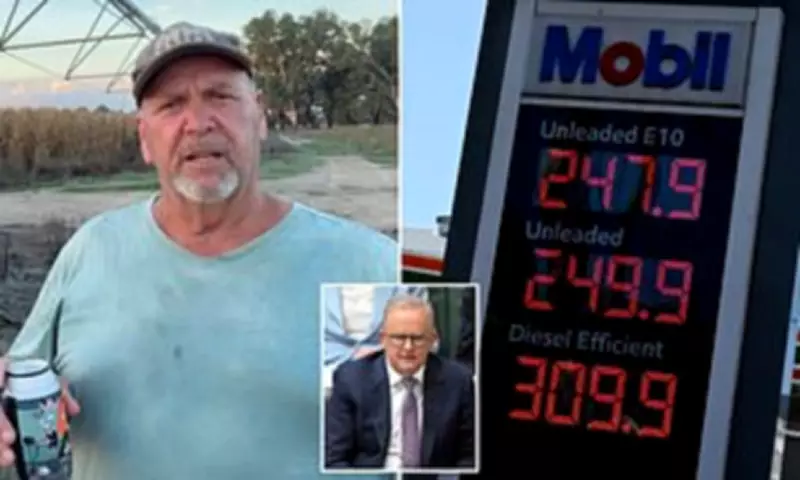
An Australian farmer has issued a stark warning that ongoing fuel shortages are now directly threatening the nation's food supply, as he struggles to secure enough diesel to complete his harvest. The crisis has been triggered by a sharp surge in fuel prices following Iran's decision to block the Strait of Hormuz, a critical maritime chokepoint responsible for approximately twenty percent of global seaborne oil shipments.
Regional Australia Bears the Brunt of Fuel Crisis
More than five hundred service stations across Australia have already reported running out of at least one type of fuel, with regional areas and diesel supplies being particularly hard hit. Maize grower and aspiring political candidate Paul Funnell stated that the lack of fuel in these areas is severely impacting farmers. Standing before his crop, Funnell explained that the maize, planted in October, is ready for harvest but cannot be completed without additional diesel.
'This maize crop behind me will produce around two thousand tonnes,' Funnell said. 'It has already taken ninety thousand litres of diesel to grow the crop, powering irrigation pumps, tractors, seeders and other machinery. I now need another five to ten thousand litres to finish harvesting.'

Supply Chain Disruptions and Rising Costs
Funnell highlighted that the pressure does not end once harvesting is complete, as fuel is also essential for transporting grain to mills and food manufacturers. 'Empty fuel tanks cannot harvest product,' he emphasised. 'Growers have already spent all their costs upfront. If they cannot get the crop off, you cannot get your food. It is not rocket science.'
He warned that his crop represents only a tiny fraction of the hundreds of thousands of tonnes of maize required nationwide, illustrating the scale of the challenge facing the agricultural sector. Funnell attributed the crisis to decades of policy decisions, stating, 'We are starving for fuel in this country, all because for five or six decades we have shut down our fuel refineries.'
Government Response and Industry Warnings
Energy Minister Chris Bowen has repeatedly insisted that the shortages are being driven by a sudden spike in demand caused by panic buying, rather than a collapse in supply. 'We have as much fuel in Australia today as we had on the day Iran was attacked,' Bowen said. 'We have had real issues, particularly in regional Australia, getting fuel to where demand has been very high.'
Meanwhile, Norco chief executive Michael Hampson has sounded the alarm, predicting that milk prices could jump by up to fifty cents per litre if global shipping disruptions persist. Hampson warned that the economic fallout from the escalating crisis could eclipse the pandemic if key energy and trade routes remain blocked in the Middle East.
'If it is not resolved promptly, as in the next week or two, the fallout for this event is going to make Covid look like a tea party,' Hampson told The Guardian. 'We will not be worried about running out of toilet paper – we will be worried about not having food.'
Broader Implications for Food Prices and Supply
Supply chain management and logistics expert Elizabeth Jackson noted that every kilojoule of food from an Australian farm is moved by a diesel-powered vehicle. 'Even the most basic of foods - fresh fruit and vegetables that do not go through any sort of processing - right through to the most processed exported foods, are dependent upon transport systems,' Dr Jackson explained.
She predicted that price rises are likely to begin with fresh produce due to its constant need for transport, with increases possible within two to three weeks. 'The fresher the produce, the quicker we are going to see the prices increase,' Dr Jackson said, describing a 'slow burn' effect rather than one sudden spike.

Historical Context of Australia's Refining Sector
Australia's refining sector has shrunk dramatically over the past fifteen years, with several plants closing due to competition from large Asian refineries and the high cost of upgrades. Port Stanvac closed in 2009, followed by Clyde in 2012, Kurnell and Bulwer Island in 2014, and BP's Kwinana and ExxonMobil's Altona refineries in 2021.
Only Ampol's Lytton refinery in Brisbane and Viva Energy's Geelong facility remain, supplying just a fraction of national fuel demand. This reduction in domestic refining capacity has left the country more vulnerable to international supply disruptions.
Funnell urged metropolitan Australians to understand the pressures farmers are facing, stating, 'Please, metropolitan areas, listen and take note. This is what puts food on your shelves and on your table.' His warning underscores the interconnected nature of global energy markets, regional agriculture, and everyday food security for millions of Australians.