
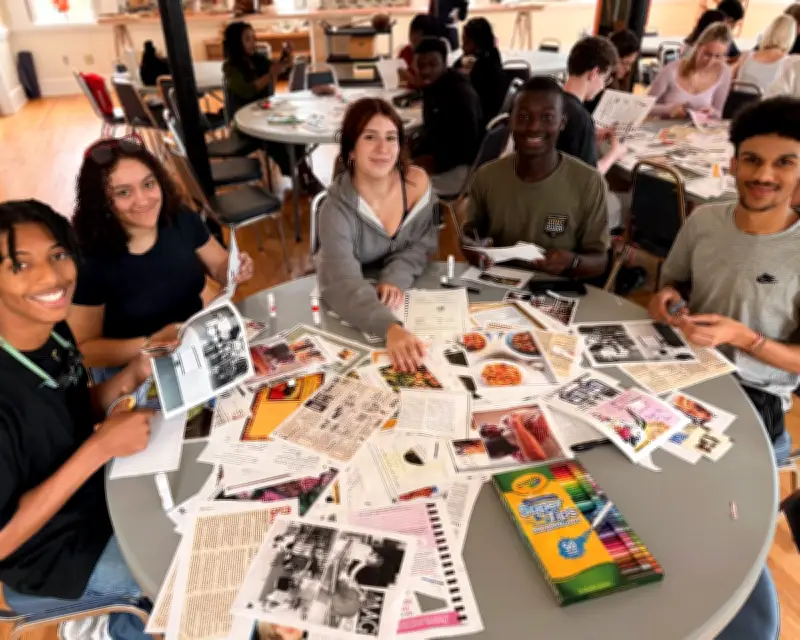
More than 50 high school seniors from Charleston County School of the Arts visited the Avery Research Center for African American History and Culture. The field trip at the College of Charleston’s Avery Research Center was the culmination of a six-week English course about memoir. Students learned about the culture of Gullah Geechee people through the lens of food such as okra, red rice, and beans.
Learning Through Food
The students leafed through pamphlets on local food festivals, advertisements from the 1960s, and Gullah Geechee cookbooks spanning more than 30 years. A few Gullah students found information about their families in the center’s archives. During the visit, Gullah Geechee chef Reggie Miller prepared a meal of Carolina gold rice, broccoli grown on nearby John’s Island, and locally sourced chicken. The visit culminated with students creating a zine about Gullah Geechee foodways built on archives from the center.
“These cultural foodway legacies have been part of the Charleston and the southern United States culture for hundreds of years, and students may have just not learned about it in school,” said Patrick Martin, an English teacher at the school. Martin received a $1,000 memoir grant through the National Council of Teachers of English, Penguin Random House, and the Anne Frank Fonds to teach the course, which he hopes to repeat every year. “Here’s an opportunity to see the historical value of some of these dishes that students have consumed their entire lives and never had any idea.”
Expanding Beyond the Classroom
High school and college students throughout South Carolina this past school year have learned about Gullah Geechee history and culture in the context of food. These classes mark a shift in the past decade in which educators are increasingly teaching about Gullah Geechee culture in classrooms. Coastal Carolina University students created multimedia projects about Gullah foodways through support from the Charles Joyner Institute for Gullah and African Diaspora Studies and the student-driven publishing lab The Athenaeum Press. Twelve students contributed articles, photography, and graphic design to the project, funded by a $150,000 Mellon Foundation pilot grant. Students wrote about the history and cultural significance of rice, hibiscus, peas, watermelon, and collard greens within the Gullah Geechee community.
“Food sticks with you,” said Zenobia Harper, the Joyner Institute director. Soul food, an umbrella term that emerged in the 1960s to describe Black southern cuisine, includes Gullah Geechee food. But the term “doesn’t really speak to the origins of the people,” Harper said. “Soul food disconnects, and it makes sense when you think about the fact that that’s what the institution of slavery did to enslaved African people, it sought to disconnect them from a history beyond America, place of origin.”
New Tools for Teachers
Recently published literature such as Natalie Daise’s Okra Stew: A Gullah Geechee Family Tradition and Rita Woods’s The Last Dreamwalker serve as new tools for teachers to introduce Gullah Geechee culture to their students, said Dr. Tamara Butler, the executive director of the Avery Research Center. Teaching about Gullah Geechee foodways is one way that classrooms can connect to the community’s history and heritage, particularly in the face of environmental changes.
“Gullah Geechee folk’s struggles are included in environmental sciences. We’re expanding beyond the English classroom and social studies classroom and into the science classrooms as well,” Butler said. “Foodways are one of the ways you can get at that: what foods are available to us in the face of climate change? What’s available to us as people are being displaced? What recipes can we still hold on to and adapt, especially now as prices are going up, and fertilizer is not available. How are people still making or still having access to those foods?”
As part of the Coastal Carolina University project, it was important to Harper and Alli Crandell, the director of the Athenaeum Press, to give back to the Gullah Geechee community. The students helped five Gullah makers increase their social media presence and designed packages for their products. Along with learning about Gullah Geechee culture, Crandell said collaborating with the makers also helped students unravel the deep history in commonplace items and activities, such as crocheting. Throughout the project, students also ate many Gullah Geechee staples, such as rice and beans or meat.
Many West Africans were brought to the area for their skills and expertise in cultivating rice, which was the cash crop of colonial South Carolina. “In learning about any culture, food is a really important way to do that, and it sticks with you over a long period of time,” Harper said. “It would be hard to forget those lessons because you’ll always be remembering what you ate.”




