
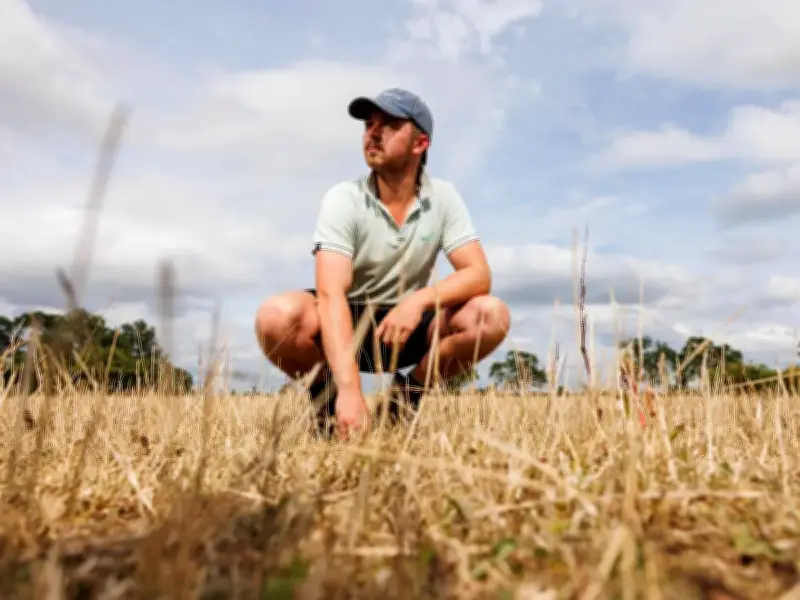
Margaret Lees, whose family has farmed Park Farm in Walmersley since 1957, says the situation is unlike anything she has seen in over three decades. "Everything's running dry basically," she explains. "At the moment, we're having to feed the winter silage, feed that is made for the winter, because we've not got enough grass."
She adds: "We've always tried to look ahead and make sure that we've got enough silage for every year, but we're feeding this winter's feed now. We've never done this before, as far as I can remember. It's pretty dire really."
Livestock farmers face daily challenges
Across Greater Manchester and the wider North West, the impact of the UK's driest July on record is driving local agriculture to breaking point. For livestock farmers like Margaret, who runs a dairy herd alongside a small beef herd and sheep in Bury, every day is spent hauling water to dry fields and keeping cattle in the shade. They are also watching the horizon for a rain forecast that fails to materialise, and bracing for the northward spread of the Bluetongue virus.
"It's just a matter of day to day, making sure everything's fed, making sure everything's got plenty of water," Margaret adds. "I mean, the other issue at the moment is the Bluetongue virus. Last year it was confined to the south, but this year it's coming north."
Her warning is echoed by Becki Fielding, NFU Lancashire County Chair, who represents farmers across Greater Manchester and Lancashire. On her own family dairy farm, Becki has been forced to take drastic measures to protect her livestock from the blistering weather. "For the first time in the last 50 years, we've kept the cows in during the daytime in summer and then turned them out at nighttime," she explains. "They're much happier just because they were getting so much heat stress."
Water storage and political leadership
Becki stresses that Britain's drought problem is not a total lack of rainfall over the year, but a critical lack of storage capacity when dry spells hit. "There's definitely enough water in this country to supply all the food that we need, but it doesn't always come at the right time," she says. "So we need to be able to store it, and then we can use it when we need it."
She also believes local political leadership has a crucial role to play in protecting regional food security. "Andy Burnham came in and I quite like him," she adds. "I think he's a problem solver. That's what he used to come across as, a problem solver. I think he needs to solve the problem and I think he can do it. I hope he will anyway."
Just over the Cheshire border in Mobberley, the story is identical. Standing in the middle of Dairy Farm, the fields are scorched a brittle brown, and the ground beneath your feet is baked as hard as concrete. Jack Ancell, an NFU Student and Young Farming Ambassador, has been a livestock farmer here since he was ten years old. He's never seen a year this dry, he says. "So far this year, it's probably been the worst year I've ever had in my lifetime."
Harvest losses and diversification
To protect his herd from the sun, Jack has been waking before dawn to let his livestock graze in the cool morning air. "For us, as livestock farmers, the welfare of our cattle comes first," he explains. "We've had to be very selective about what fields we graze, making sure they have shelters, shade, and access to water."
"Harvest was definitely a lot earlier this year," he says. "Crops have ripened prematurely in some cases. Going into next year, it's hard to get ground preparation ready, just because of the sheer sullenness of the ground."
For other growers across the region, the financial hit has made traditional agriculture practically unsustainable without alternative income streams. Olly Harrison, 45, who documents his farming life on his popular YouTube channel Olly Blogs Agricontract, says his crop yields in the region are down to a fraction of normal levels. "The yield is a third of what we should have had, and a quarter of what a good harvest would be," Olly says. "Put it this way: it's the first year I've not ordered wheat seeds. I bought a shed for storing straw, expecting a normal harvest, and now I'm using it for two padel courts to increase cash flow."
In nearby Cheshire, Dan Thornicroft, who runs Libby's Patch Farm, offering pick-your-own pumpkins and sunflowers, warns that these regional crop failures will soon hit consumers directly at supermarket checkouts. "I've been speaking to some of my farming friends and they've completed harvest super early, their earliest harvest ever, and the sheds are half full," Dan says. "That's half of the amount of food that's been combined. And that will go on to the price of your bread, the price of your beef, the price of everything."
Government response and emergency funding
NFU Deputy President Paul Tompkins said: "With no meaningful rain forecast in the coming weeks, the situation facing farmers and growers is increasingly concerning. Many farmers have completed the earliest harvest on record, with poor yields in key crops reported in some areas of the country. Livestock and dairy farmers are already using winter feed because grass has stopped growing, while growers are working hard to keep fruit and vegetables watered, but many are struggling to access the water they need."
Responding to the growing crisis and calls from the NFU, the government announced an emergency £65 million funding package this week following a COBR meeting on drought and extreme weather. Visiting farms in the South West alongside Farming Minister Stephen Morgan, Prime Minister Andy Burnham pledged that homegrown food production would be treated as a matter of national security. "I am meeting with farmers here who brought in the earliest harvest of their working lives and watched the yield come in well down on what it should be," Burnham said. "Lower income, higher costs, and no rain in the forecast. I understand the worry that comes with that."
The emergency measures include: £15 million for on-farm reservoirs to help growers store water locally, an extra £50 million for the Sustainable Farming Incentive 2026, boosting its total budget to £290 million, environmental scheme flexibilities allowing farmers to graze or cut protected habitat land for livestock feed without losing government support payments, and planning reforms to streamline permitted development rights and planning rules for farm reservoirs.
A spokesperson for Defra added: "We know how hard this summer has been for our farmers. We are working closely with farmers, the Environment Agency, and the water sector during this exceptionally dry weather to find additional ways to support the sector."
Back on Park Farm in Bury, Margaret Lees knows that emergency funding must be backed by immediate action if local family farms are to survive. "I think the government needs to step in and they need to talk to some farmers," Margaret says. "There's no grass growing at the moment. It's just a matter of just hoping for the rain."




