
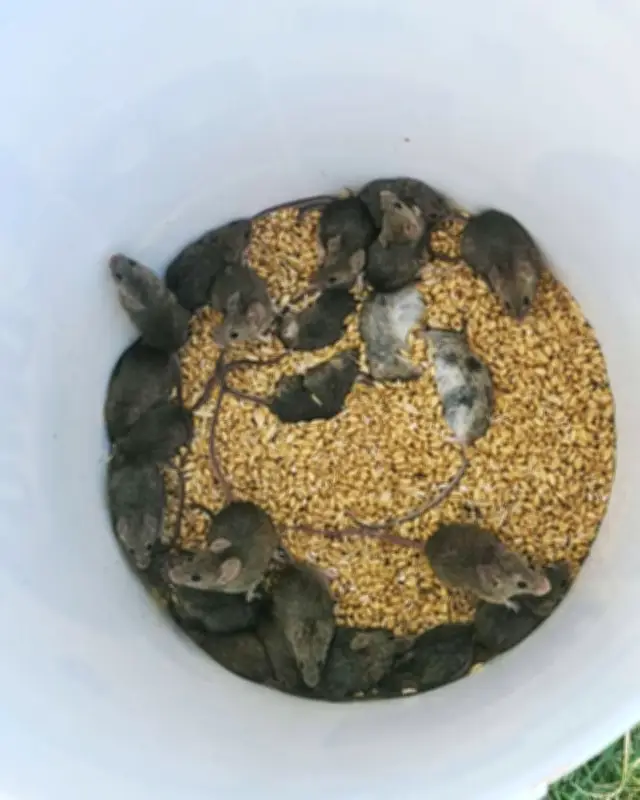
There is a smell that settles over a town in the middle of a mouse plague. It clings to supermarket milk cartons and lingers in school classrooms. It thickens the air and follows people home.
“It’s a combination of urine, faeces and decaying bodies,” grain grower Geoff Cosgrove says. “You can smell them everywhere.”
Plague Proportions
For months, communities across Western Australia’s grain belt have been living through a mouse explosion so severe it has shocked even seasoned farmers. “The CSIRO rate 40 live burrows (800 mice) per hectare as a plague,” Cosgrove says. “We were counting 400. We were 10 times plague proportions.”
In Morawa, 350km north of Perth, the signs of a mouse plague are everywhere – in the walls and ceiling, beneath the floorboards, in food stores and even in beds. At night, rodents pop under car tyres like bubble wrap as they flow “like a river” across roads near his home in Mingenew, Cosgrove says.
Workers loading export grain have reported rodents pouring from machinery and storage areas. Dead mice litter the ground.
“The smell in town is horrendous when you go in the shops,” Morawa councillor and grain farmer Grant Chadwick says. “We’ve got a smell in this house here and we haven’t been able to get rid of it. I’ve had to take the walls off the side of the house to find the dead mice and get rid of them.”
The region has been overrun with record-high mice numbers since March. Plagues have also hit the state’s south, around Esperance. In South Australia’s Adelaide Plains and Yorke Peninsula, skyrocketing mice populations are close to plague proportions, putting authorities on alert.
Perfect Conditions
WA farmers say they started warning officials of increasing rodent numbers in December last year, but the seeds were sown long before. According to CSIRO mouse ecologist Steven Henry, WA had experienced the perfect conditions for a rodent explosion: heavy grain crops, combined with summer hailstorms that knocked seed to the ground, created an abundant food source for mice. Then came a hot, dry autumn – the final ingredient for a population boom.
Limited Arsenal
A farmer’s arsenal against fast-breeding mice is limited. In ordinary years, when rodent numbers begin to climb, growers spread a wheat baited with zinc phosphide across paddocks. But this year, farmers needed a stronger, faster-acting poison. With food plentiful, mice that survive an initial dose are unlikely to return to the bait.
The higher-strength zinc phosphide bait, known as ZP50, is a Schedule 7 “dangerous” poison that releases toxic phosphine gas when it reacts with stomach acid or moisture. Federal regulators approve its use only in emergencies, because it can kill wildlife alongside mice.
Permit decisions are a numbers game, according to Adelaide University toxicologist Ian Musgrave. “You have to evaluate whether it works and balance the likelihood of it working against the likelihood of it causing damage to endangered species,” Musgrave says. The crucial consideration is mouse numbers. If there are not enough mice to consume the bait, the risk to birds and other non-target species increases.
Permits were granted for ZP50 before mouse populations reached plague levels in South Australia. But in WA, plague numbers had already been reached and farmers say bureaucratic delays meant the poison arrived too late to prevent substantial crop damage.
“We were emailing in November saying you’ve got to get ready, there’s all the ingredients here for a mouse plague,” the general manager of chemical supplier 4Farmers, Cameron Beeck, says. “We submitted our own emergency permit application in February, but it was denied. Another company in WA also submitted an emergency permit application in February and they were also denied.”
Scott Hansen, CEO of the Australian Pesticides and Veterinary Medicines Authority, which controls use of the toxin, says the agency prioritises emergency permits, but that does not mean taking shortcuts in the examination of products that have the potential to affect human health, wildlife and the environment. APVMA records show Grain Producers Australia applied for a ZP50 permit on 25 April 2026 on behalf of seven chemical suppliers and it was issued on 18 May.
Musgrave says criticism about delays overlooks the complexity of the decision facing regulators. “It is a race between how long the poison lasts and how much is available,” Musgrave says.
Beeck says WA’s plague compares to a similar outbreak in eastern Australia in 2021, where farmers in NSW, Queensland, northern Victoria and the Yorke and Eyre peninsulas in South Australia suffered crop losses of more than $100m. He estimates the losses to WA farmers will top $50m.
Chadwick says he has spent more than $150,000 on rodent baits alone since December, and every farmer he knows has had to continually bait their farms. The WA government has provided $200,000 to affected shires for baiting and cleaning.
Environmental Impact
This week, Bluebush Wildlife Sanctuary carers discovered 96 dead or dying birds at a golf course and school oval in Coorow, about an hour away from Morawa. The WA Department of Primary Industries and Regional Development said it was investigating the bird deaths to exclude disease and test for toxins.
Swiss-Cheese Fields
Grain is the largest agricultural sector in WA, producing 18m tonnes a year and exporting about 80% of its yield to 50 countries worldwide. Any crop loss is absorbed by the farmer. Plague-affected paddocks look like Swiss cheese, Henry says, describing a damaged field of canola. “Each of those holes represents an area where mice have stolen canola plants shortly after they’ve germinated or stolen seeds before it has germinated, so you can see anything from 5% to 50% loss,” he says. “We see in some cases farmers having to replant entire crops.”
The damage is such that many farmers in the region may struggle to break even this year, Cosgrove says. But, he adds, the greatest burden is psychological.
Psychological Toll
Scientists describe mouse plagues as uniquely invasive disasters because there is no refuge from them. Unlike drought, which remains outside the front door, mice follow people inside. Henry says sometimes people abandon their homes in desperation. In the shire of Morawa, businesses have been forced to remove food from shelves each night and store it in sealed containers. Community facilities are struggling to keep rodents out. It is exhausting work.
Then, in late May, students at the WA College of Agriculture Morawa were sent home for two weeks after zinc phosphide, which is not approved for use in residential areas, was accidentally spread on school grounds. Cosgrove says many residents are showing remarkable resilience, supporting local businesses and helping neighbours where they can. “It’s been such a long battle,” he says.
Waiting for the Crash
Experts say there is a moment in every mouse plague where the tide ebbs, the scratching in the walls stops and, almost as suddenly as they arrive, the mice vanish. “There is a one-year trajectory where they go really high and then crash away dramatically,” Henry says. “Or there’s a two-year trajectory where they build, go high and stay high across a couple of seasons.”
Whether WA is nearing the end of its mouse crisis – or merely the halfway point – is unknown. Henry says once mouse populations reach extraordinary levels, the social order that normally governs their behaviour dramatically breaks down. Competition for food intensifies. Disease spreads rapidly. Cannibalism increases. Breeding rates fall.
In the meantime, farmers across WA and SA’s grain belts are laying bait and hoping for the same sudden disappearance that has ended outbreaks before. The mice arrived almost overnight. The question now is whether they will leave the same way.




