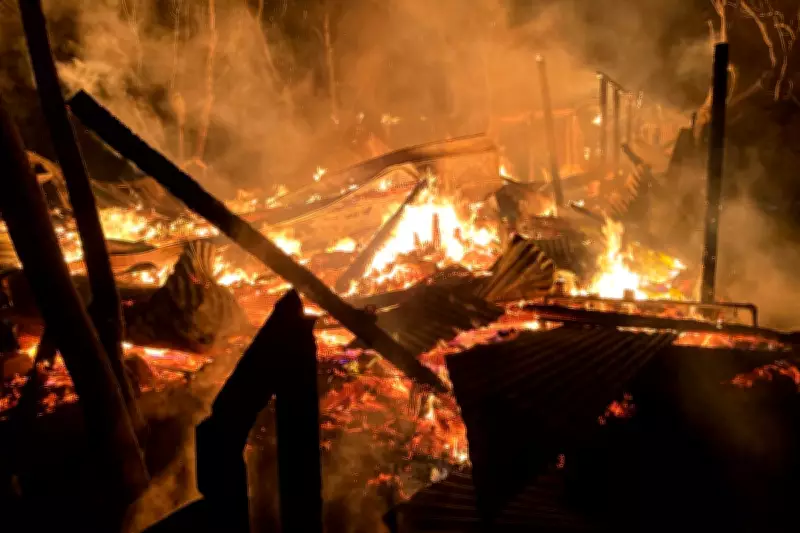
Zen Retreat's Meditation Hall Destroyed by Fire as Monks Contemplate Impermanence
A profound lesson in Buddhist philosophy unfolded in dramatic fashion at a remote California Zen retreat when a fire destroyed the main meditation hall just as practitioners were nearing the end of a three-month program focused on contemplating the impermanence of existence.
Fire Strikes During Deep Contemplation
The March 26 attic fire at Tassajara Mountain Zen Center in Central California consumed the entire wooden meditation structure and damaged the nearby library. The blaze occurred as dozens of spiritual practitioners were in the final stages of a sequestered retreat dedicated to examining the transient nature of all things.
Remarkably, no one was injured thanks to the timely actions of monks and staff members who are experienced in dealing with fires at the isolated mountain location. The monastery's remote setting makes it vulnerable to both electrical fires and those sparked by the region's gusting winds.

Experienced "Fire Monks" Spring Into Action
Michael McCord, president of the San Francisco Zen Center which operates the retreat, noted the fortuitous presence of David Zimmerman during the emergency. Zimmerman, a former Tassajara director and veteran of previous fires at the site, was leading the retreat when the blaze broke out.
Zimmerman belongs to the celebrated group of "fire monks" who famously stayed to defend their sacred space during wildfires in 2008 and 2021, even after authorities issued evacuation orders. Under his leadership last week, the resourceful practitioners used hoses and buckets to contain the fire until volunteer firefighters could navigate the treacherous one-lane dirt road to reach the remote location.
The Cachagua Fire Department praised the monks' efforts in a social media statement, noting that "their initial fire attack efforts helped keep the fire contained, buying critical time for responding apparatus to arrive and preventing further damage."
A Living Lesson in Buddhist Teaching
For the international community of monks and spiritual practitioners who cherish Tassajara, watching their deeply symbolic meditation center burn was undeniably sad, McCord acknowledged. Yet he emphasized how the event perfectly illustrated the foundational Buddhist principle of impermanence—the understanding that all physical, mental, and environmental phenomena are in constant flux and eventually pass away.
"We'd like the Zen center to always be here, and the people to be here," McCord said. "But Buddhist teachings tell us that everyone we love and everything we appreciate will eventually go away. It's not meant to induce fear or anxiety, but to teach us that we need to treasure and take good care of what we have now."
Priceless Artifacts Potentially Lost
The full extent of the loss won't be known until workers can sift through the rubble. Beyond the building itself, the fire consumed sitting cushions, the altar, and oryoki bowls used by Zen monks for formal, mindful meals. Several invaluable sacred items might also be damaged or lost.
Among the potentially affected artifacts are a 2,000-year-old Gandharan Buddha statue that survived a previous electrical fire at the center in 1978, a century-old Japanese bell, and a wooden fish-shaped drum called mokugyo used during chanting rituals.
"We are eager to see if these items can be salvaged from the rubble and repaired," McCord said. "Right now, we're receiving an outpouring of support from around the world. People are really sad. But we're relieved no one was injured."
The Unique Character of Tassajara's Practitioners
Colleen Morton Busch, author of the 2011 book "Fire Monks" about Tassajara's firefighting monastics, explained that these practitioners are neither trained firefighters nor stereotypical heroic figures ready to charge into danger.
"They are humble people who share a deep love of Tassajara and have this incredible ability to stay calm and clear-headed—to pause and think what's appropriate and possible at this moment," she said. "That's cultivated through the practice of meditation."

A History of Coexisting With Fire
Founded in 1967 as the oldest Japanese Buddhist Soto Zen monastery in the United States and the first Zen monastery established outside Asia, Tassajara has always existed with fire as a looming threat. The center's name derives from an Indigenous Esselen word meaning "where meat is hung to dry."
McCord noted that the Indigenous Esselen people who originally inhabited the Los Padres region practiced controlled burns every 25 years to care for the chaparral landscape. "There are flowers in that land that bloom only after a fire," said McCord, who lived at Tassajara during his monastic training. "The seeds pop out of the pods with the heat of the fire like popcorn. It's part of the ecology of those grasslands."
The natural beauty and extreme remoteness that make Tassajara such a blessing for spiritual practice also contribute to its vulnerability, Busch observed. "When you're there it's all really simple, pared down and fundamental," she said. "You hear the creek, the birds. All your senses get rebooted in a way."
Despite the damage, McCord said they hope to keep the center open this summer when the site's natural hot springs become accessible to the public with reservations. The incident serves as a powerful reminder that even in destruction, there exists potential for renewal—a concept deeply embedded in both Buddhist philosophy and the natural ecology of the California landscape.