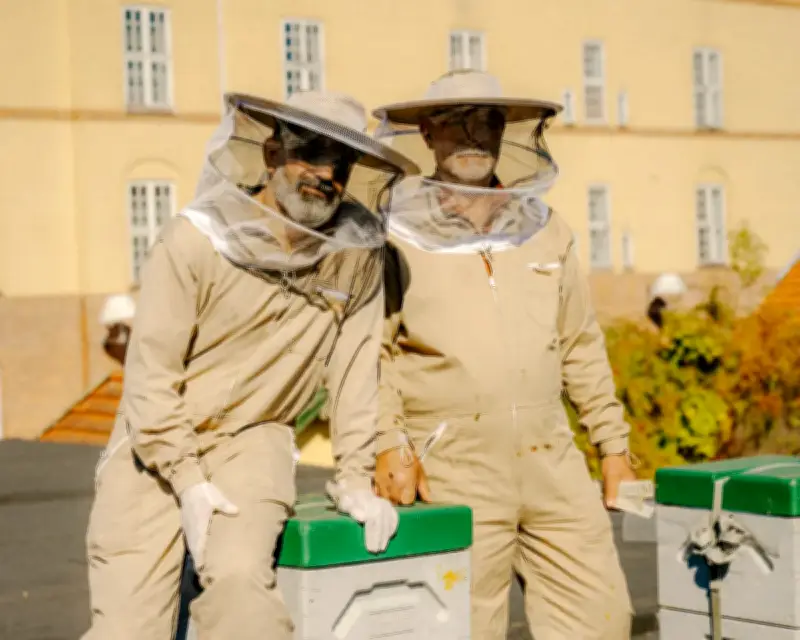
Bybi, a collective of beekeepers in Copenhagen, operates from the rooftop of a Victorian building complex in the city centre, producing honey that is often given away for free. The initiative, founded in 2010 by Oliver Maxwell, an anthropologist originally from the UK, aims to create a community centred on honey production, involving volunteers, marginalised people, and corporate partners.
Maxwell, 48, says the buildings once served as a prison, a workhouse, and a hospital, and now house a homeless shelter, a young offender institution, and until recently, a job centre. He notes that Denmark's Victorian transformation from an "agricultural backwater to industrialised agriculture" was reflected in how people were treated.
A community built on honey
Between 40 and 50 volunteers participate throughout the year, with a core team of 15 handling practical tasks. Bybi maintains 80 to 100 colonies across the city, on businesses, conference centres, schools, municipal buildings, and restaurants, producing four to six tonnes of honey annually. The honey is sometimes given away at weddings and festivals, sometimes sold at boutique delicatessens, and sometimes sold through a reverse haggle where sellers start low and bidders drive the price higher.
Maxwell describes Bybi as "a constellation of time, work, money, community and connection, a place asking an open question: what would it take for bees, people and communities to thrive?" The collective initially planned to employ homeless and other marginalised people, but Maxwell says that approach "just doesn't work". He explains: "The bottom half of the jobs market has fallen out and everyone else has to run faster and faster. The moment you make contact with the market economy, everyone just melts."
Beyond the logic of work
Now, people come voluntarily, not because they are forced by the job centre. Around five people are employed, with more in the summer, and scores of volunteers, including disabled people who pack flower seeds. Maxwell says: "They do it as slowly as they like and we give most of the seeds away for free. It's outside the logic of work."
Despite this, jobs are found, perhaps as a byproduct of the bees. Aref Haboo, 53, the principal beekeeper, is a Syrian Kurd who came to Denmark in 2014. He locates the queen bee with instinct from 18 years of beekeeping in the Afrin province of northern Syria, before being displaced by Islamic State. Haboo says Danish honeybees are less aggressive and more productive than Syrian bees.
Partnerships and rewilding
Bybi's partners include universities, architects, and corporations such as L'Oréal, which took bees for land at the back of a distribution centre. Maxwell says the director became fascinated and stopped cutting the grass, adding bat boxes, bird boxes, and hedgehog boxes, and sponsoring work with schools. Nicolas Hansen, a 27-year-old volunteer and nature management student, says: "You have to be OK with saying: 'Our primary interest is not humans.' You have to give nature its space."
Refugees and people on incapacity benefits volunteer, but Maxwell notes that "corporate refugees" also volunteer, describing those burnt out by high-flying jobs. Andrew Japp, a 52-year-old from Scotland, calls himself "more of a transient".
Rethinking metaphors
Maxwell argues that the industrious language used about bees is "completely wrong". He says: "The relationship they have with a flower isn't toil – it's sexual. It's the reproduction of life in a language of touch, taste, smell, dance, colour; the hair they have on their eyeballs, the way they can hear through their feet. It's an intense sensory experience and it can only be understood as pleasure."
Bybi's mission is sometimes described as "degrowth" or "regeneration", but Maxwell emphasises the urgency of changing metaphors: "We're all living with this cognitive dissonance all the time, that everything bad is being hyperscaled, from AI to El Niño, yet we're meant to exist as if everything works and nothing has changed." The collective often deploys the philosopher Bruno Latour's "parliament of things", expanding democracy to include nonhuman agents, and Maxwell's watch-phrase is "stay with the trouble", referencing Donna Haraway's 2016 book.
Madeline Pugh, 26, a student volunteer from the US, says Denmark is a perfect sandbox for this experiment, as a culture that appreciates slow processes. However, Maxwell points out that Danish society "makes out it's all about sourdough and pretty girls on bicycles, but it's incredibly racist. It wins all the prizes for being livable, but not if you're brown." Haboo's life outside the bees is precarious; a recent speeding ticket could have jeopardised his citizenship application, despite being in Denmark for 12 years.
There is debate in Denmark about honeybees, with 293 species of bee in the country, but only one making honey, and others endangered. Some argue honeybees aren't properly Danish, spread diseases, or are a conspiracy of the EU and industrial agriculture. Bybi isn't taking the honeybee's side in this culture war; it wants to enrich conditions for all pollinating insects, planting more flowers and rewilding spaces.
Pushback to Bybi includes criticism of corporate partnerships and questions about scalability. Maxwell responds: "As if there's a spot on Earth where capitalism doesn't exist. We have to start in the conditions that exist today, which are messy and compromised, but also full of possibilities for improbable collaborations across people, plants and animals." Pugh, as part of an internship at Gehl, is working on a project about the eight components of awe, noting that "a lot of people here are keepers of awe".
There is no blueprint to replicate the precise alchemy of people, place, and nature at Bybi, but an experiment in cooperating across species and within our own, to foster a sense of common purpose and imagine a post-industrial future, must be scalable.