
Some of the largest One Nation supporter groups on Facebook appear to be run from overseas by foreign digital creators who monetise content, a Guardian Australia investigation has found.
Foreign-Run Engagement Farms
Guardian Australia examined 14 of the largest pro-One Nation public groups with at least 8,000 members, finding most were created this year. While some groups appear longstanding and set up by genuine supporters, the majority are full of content overwhelmingly fed by what digital media researcher Timothy Graham described as “a foreign-run, predominantly Indonesian, for-hire engagement farm operation”.
Many administrators and top posters in these groups are tagged as “digital creators” offering subscriptions, potentially earning money through Facebook monetisation programs. “The people who comment, by contrast, are overwhelmingly genuine, established Australian accounts,” said Graham, an associate professor at Queensland University of Technology. “The operation therefore harvests a real Australian audience for engagement and money.”
Monetisation and Outrage Content
One of the largest groups, with over 117,000 members, is run by at least two administrators whose profiles indicate they speak Indonesian and are based in southeast Asia. They are tagged as digital creators. Some administrators post screenshots from Meta’s back-end showing their content’s popularity in Australia or Facebook earnings, lamenting slow months. One creator, who posted about banning the burqa in Australia, shared a screenshot in Indonesian showing Meta would pay US$20 for two posts reaching 50,000 people.
Much content is designed as outrage or “poll bait” – yes/no questions like “Was Pauline Hanson right to scold this journo?” or “Should Sharia law be banned in Australia?” Other posts are reactive, with some accounts posting multiple times about the party’s “Fire the Liar” campaign. In at least one case, text and image promoting the party’s fundraising drive were copied from a verified One Nation page.
AI-Generated Islamophobic Content
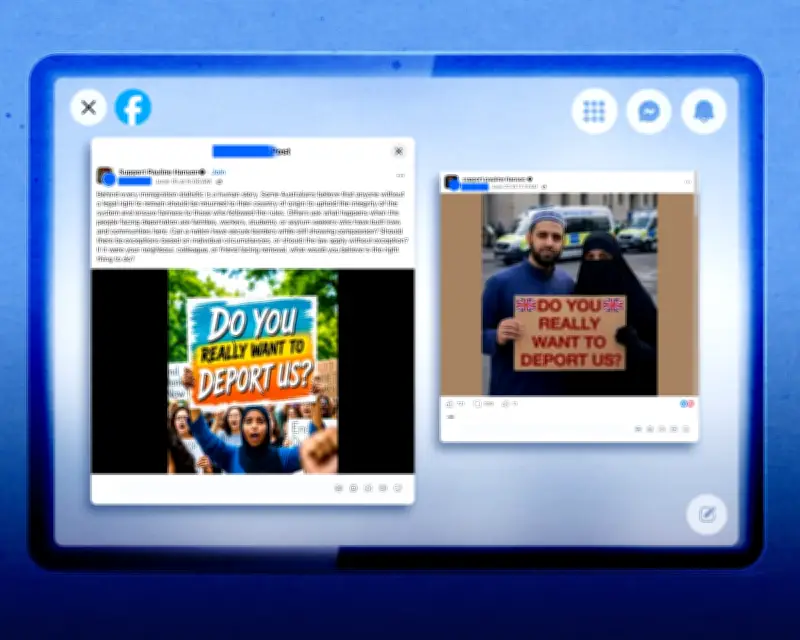
Many posts are replicated across groups, sometimes by the same accounts, and as ABC Verify found, much is AI-generated. A significant theme is Islamophobia. An AI-generated image of a woman in a niqab holding a sign “Do you really want to deport us?” appears across multiple groups.
Two accounts running another pro-Hanson group with almost 40,000 followers appear based in India. Before posting Australia-centric content, they shared Hindi content on Indian politics and occasional selfies, offering contact details for “brand promotion”.
Expert Insights on Meme Factories
Crystal Abidin, a professor of internet studies at Curtin University, said: “For a lot of the south-east Asian meme factories, the politics are entirely divorced from the profit making. They are for hire.” She noted these accounts may use political posts to demonstrate reach for brand contracts or profit via monetisation schemes from Meta, TikTok, and other platforms. “Meme factories might be one enthusiastic person with dozens of devices, or dozens of people working coordinatedly,” she added. “It could be someone working out of their bedroom, just getting informal cash, but it could also be a bona fide digital media company.”
Impersonation and Meta’s Response
An administrator for “One Nation Supporters Australia🇦🇺” (over 135,000 members) purports to be federal MP David Farley, who won the Farrer byelection in May. The account, created on 30 May, uses photos from Farley’s campaign page but promotes a financial scheme advising withdrawal of assets from “crashing banks” to invest in cryptocurrency, alongside AI-generated content supporting Hanson. The account moderates at least eight One Nation-related groups, including two of the largest analysed. One Nation media adviser Richard Henderson said party members had been impersonated on Facebook for “years and years”. The “Farley” account was removed after Guardian Australia approached Meta for comment. A Meta spokesperson said: “We are reviewing the content that was shared and will remove anything that violates our policies.”




