
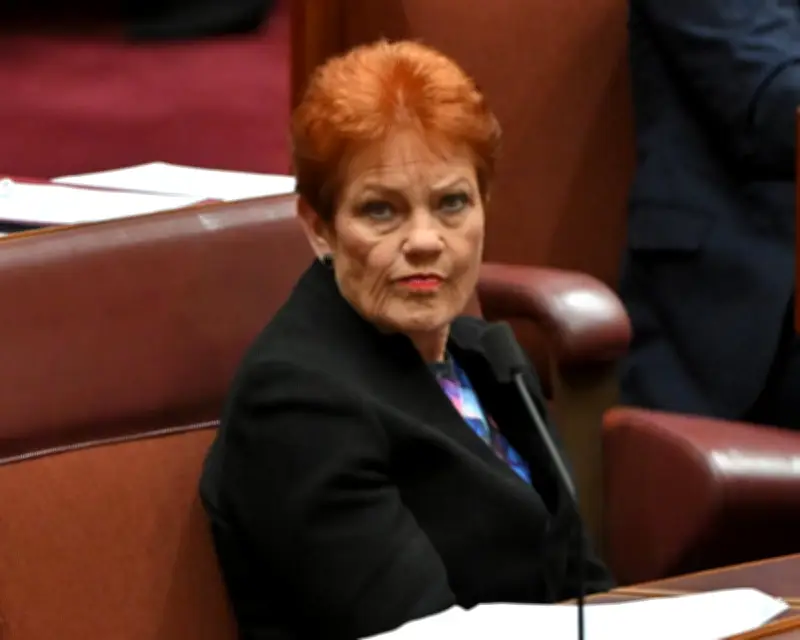
For a decade, Pauline Hanson has been beating the same drum. Her comments this week – suggesting domestic violence was a “two-way street” and questioning why women did not simply leave abusive relationships – have caused significant concern and been labelled “dangerous” by experts and other commentators. But they are not, as they’ve been portrayed, another “gaffe” by the stumbling One Nation leader as she attempts to stabilise her party’s polls that show it might become a new electoral force in Australia.
Consistent pattern of allyship
The comments make plain something that has been a driving force for the populist leader since her return to parliament in 2016. One Nation’s political ascendancy in recent months has been built on replicating anti-immigrant and hard right pivots in the United States and the UK. Hanson’s own second coming was built on an allyship with groups of anti-feminist men and heavily influenced by domestic violence allegations against her son, Adam Hanson, which she says were false.
In 2019, Hanson used parliamentary privilege to call her former daughter-in-law “nasty” and accuse her of making false claims about her son. She has consistently – inside and outside parliament – made claims, rejected by experts and evidence, that suggest women routinely make false allegations of violence for advantage in the family law system.
False allegations trope
Speaking in 2017, on domestic violence orders, Hanson said: “Women, mostly women, are going around throwing them around left, right and centre.” In 2021 on Sky News, Hanson said: “There are men who have been accused of these things that didn’t, it didn’t happen. It shows you how lies and perjury are leading to the failure of Australia’s family law system and contributing to the death of 21 men by suicide and the murder of one woman each week.”
The “21 men” figure has been repeatedly cited by Hanson, her colleague Malcolm Roberts, and others in One Nation as a campaigning point. The figure comes from a men’s rights organisation, the Australian Brotherhood of Fathers (ABF), and has been debunked by factcheckers. The ABF have been among Hanson’s biggest cheerleaders since her re-election. Roberts has been particularly close to the group, visiting several times, and recording a special video message for a gathering.
Political influence and inquiry
After the 2019 election, the Morrison government, four seats short of a senate majority, needed Hanson’s support to pass legislation. The government’s sop to Hanson was to accede to her request for a family law inquiry, and to make her the deputy chair (she introduced herself at hearings as the “co-chair”). It is particularly instructive to understand that the last time Hanson was in a position to ask for something, she chose an inquiry that became a formal platform for misogynists and groups pushing unsupported claims that the system is loaded against men.
Hanson livestreamed the hearings to her Facebook page. Commenters called expert witnesses and MPs things like “man-hater” and “dirty snake”. The hearings in March 2020 took place less than a month after the murders of Hannah Clarke and her children. When an expert witness, the Griffith University law professor Zoe Rathus, mentioned the case, Hanson responded: “I totally agree that what happened to Hannah and her children was horrendous and should never happen. But it’s on both sides. … Do you admit that there are men facing domestic violence?” Rathus responded: “I would prefer if you didn’t ask me whether I ‘admit’ things. … The statistics are very clear that domestic violence is something that is very gendered and that violence in the home happens more often by men towards women.”
Hanson carried on undeterred. Her comments this week, in the shadow of four more alleged domestic violence homicides, have understandably triggered more backlash because of One Nation’s political ascendancy. As a fringe politician needing only to win a senate quota every six years, Hanson’s views only needed to appeal to a small, angry cohort. The common wisdom is that as One Nation heads for the mainstream – its founder will need to temper her more extreme ideas to keep her coalition of disengaged and aggrieved voters together. But that’s not Pauline Hanson.




