
In recent months, a production line of victorious DSA candidates has cranked into gear – in New York, and beyond. Pennsylvania Democrats picked Chris Rabb, an unflinchingly progressive state representative, as the party’s candidate for its third congressional district. Janeese Lewis George is slated to be the next mayor of Washington DC. And on Tuesday in Colorado, Melat Kiros, a democratic socialist, unseated Diana DeGette, the long-serving US representative, in the state’s deep-blue first congressional district, centered on Denver. The momentum for democratic socialists is unlike anything the US left has seen before.
Surge in Membership and Primary Wins
The morning after nine of the 10 New York City candidates backed by the DSA seized a stunning sweep of victories in the state’s Democratic primary elections last week, the city’s chapter wrote in an email: “For the second year in a row we SHOCKED the political establishment and the millionaires who tried to stop our movement.” But some of the organization’s veterans seemed just as surprised as the establishment they had stunned. “We always want to set out to organize to win, but with an understanding that it’s going to be a long shot,” said Ashik Siddique, national co-chair of the DSA.
Hours earlier, the race for New York’s 13th congressional district had been called for Darializa Avila Chevalier, a pro-Palestinian political newcomer who defeated a veteran incumbent who outspent her by millions in the most astonishing upset of the night. “Going into it, I was prepared for any range of outcomes, personally – but to have such a solid sweep is incredible,” said Siddique.
From Mayor Mamdani to a Growing Movement
Last November’s history-shattering election of Zohran Mamdani as New York City’s first immigrant, Muslim and DSA member mayor was both a victory and a challenge for the democratic socialist movement. Was this a one-off fluke, or an indication that something more seismic was transforming US politics? “It’s not enough to just elect one charismatic mayor,” Gustavo Gordillo, co-chair of the city’s DSA chapter, said in a recent interview. “We need to continue to contest for power, and grow our numbers.”
The numbers are indeed growing, and fast. The DSA’s New York City chapter – by far its largest and most active – counted 5,900 dues-paying members in the fall of 2024, when it backed Mamdani’s then-improbable campaign. Before last month’s primary, it was up to 14,000. In the first day after the results came in, at least 900 more people had joined.
National Expansion and Grassroots Growth
The organization has also been growing across the country – mostly in large cities, but also in more surprising places, according to Siddique. There are now more than 200 local DSA chapters, 20 of them with more than 1,000 members, and more than 100,000 members nationwide. Growth has been significant in the south and the midwest, he added, naming Macon, Georgia; Sonoma county, California; Corpus Christi, Texas; and Kansas City, Missouri, among the fastest-growing chapters. “We have the correct theory of change,” Siddique said. “It’s really resonating.”
‘Left Wing of the Possible’
When the DSA was founded in 1982, merging two pre-existing organizations at a political moment that was hardly promising for the left, Michael Harrington, its co-founder and first co-chair and a writer and activist, described its goal as being “the left wing of the possible”. In its founders’ vision, the DSA combined the aspirations and values of radical leftwing politics of the time with a pragmatic and realistic approach, said Maurice Isserman, a historian of the left and another DSA co-founder.
Isserman left the DSA after the 7 October 2023 Hamas attacks in Israel over his criticism of the organization’s response to the attacks, including an 8 October pro-Palestinian rally in Times Square endorsed by the city’s DSA chapter, during which some attendees appeared to celebrate the violence. After an injection of young new members and organizing energy following the presidential campaigns of self-described democratic socialist Bernie Sanders in 2016 and 2020, the DSA ranks dwindled. After the elections of Alexandria Ocasio-Cortez and Rashida Tlaib in 2018, the elections of Cori Bush and Jamaal Bowman in 2020 boosted the DSA’s profile in Congress, but Bush and Bowman lost their seats in 2024 to establishment candidates in what at the time were the most expensive congressional campaigns in US history.
Isserman believed that what he described as growing sectarianism within the DSA, as well as divisions over Israel and intransigence with DSA-backed elected officials when they strayed from some of its priorities, would plunge the organization into a “death spiral”. He has since changed his assessment. “I was wrong in that sense,” he reflected. “I did not anticipate Zohran.” Mamdani’s election was a “game changer”, Isserman said. NYC-DSA’s wins indicate that the chapter “has indeed become the left wing of the possible”, he said. “It has proven again that it’s serious, it’s capable, it runs a great ground game, it’s attracting young and talented candidates and organizers. It’s really a model for a future American left.”
Governing – as opposed to finding themselves always in the opposition, where the left has historically remained – will also be a good experience for democratic socialists, he suggested, pointing to Mamdani’s early wins and ability to build support for his policies as a roadmap. “One thing about actually governing is that it’s very different than simply being an echo chamber with your 20 closest comrades and trying to please them,” said Isserman. “It’s going to be a maturing experience for a generation of young socialists.”
Next Election Tests
With primaries in full swing, a few more races are set to test just how widely the DSA’s message is resonating – and how much its organizing prowess can stand up to deep-pocketed establishment candidates. In Missouri, Bush is running to win her seat back. In Michigan, the DSA’s local chapter has backed Donavan McKinney’s congressional run. And in Wisconsin, Francesca Hong, a democratic socialist state legislator, is polling strongly in the gubernatorial contest. Should Hong win her Democratic primary, the Wisconsin governor’s seat would be the highest level of government held by a DSA candidate. In a swing state, it would also be a test of how a democratic socialist candidate can perform against a Republican.
Buoyed by the wins, some DSA leaders have become increasingly vocal about wanting to support a democratic socialist candidate for the 2028 presidential election. It’s a long shot, many understand, and a decision the organization expects to deliberate at length. But the recent wins were also a long shot, those in favor say, and the organization is growing bullish about pushing the boundaries of what’s possible.
The old guard of the Democratic party has not taken this well. Several establishment figures have reacted with a mix of scorn, panic, and outright hostility. “If you hate the Democratic Party, then please don’t run for our nomination,” Jaime Harrison, former chair of the Democratic National Committee, wrote on social media. DSA members are undeterred. “What’s a party if not its voters?” Mamdani pushed back.
“They have to choose who they want to stand with,” said Siddique, adding that the leadership of the Democratic party should take a cue from democratic socialists’ wins and back the issues those wins show matter to a growing number of voters. “These races show that we have people on our side.” “If they want to keep catering to tech oligarchs, fossil fuel executives, the 1%, then there is a basic conflict,” he added. “We’re going to keep standing up for what we want. We do not intend to compromise with the people whom we see as standing in the way of a real working-class agenda.”
Ground Game and Pro-Palestinian Activism
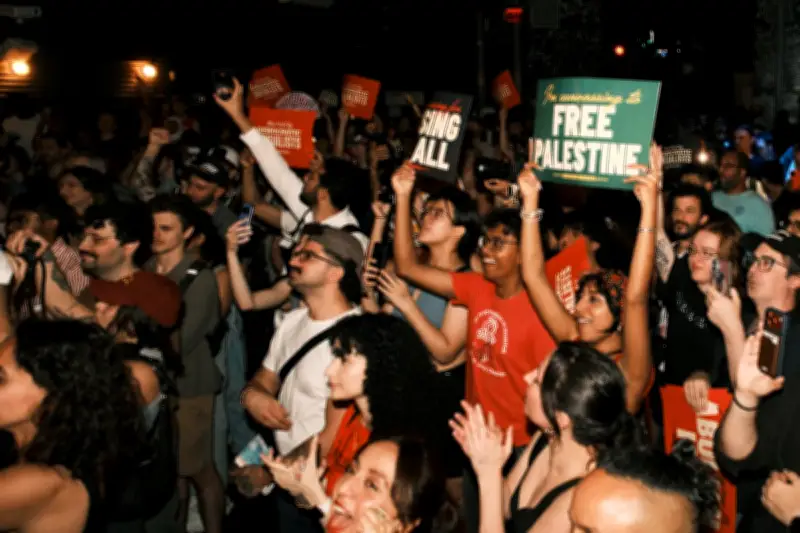
“They have cash, we have canvassers,” the political commentator and DSA member Emma Vigeland told the crowd gathered inside the Brooklyn industrial garage last month. With Chelsea Manning at the DJ booth, attendees scanned bar codes to sign up for shifts. The streamer, Hasan Piker, took to the stage to rally participants, as he has increasingly done in an effort to turn out the leftist vote. The crowd repeatedly burst into chants of “tax the rich” and “free Palestine”.
After a tumultuous time for the DSA in the early days of Israel’s war on Gaza, there was little doubt that its support for Palestinian liberation was setting DSA candidates apart from some of their progressive opponents – some with similar platforms when it came to affordability, housing and getting ICE out of New York. Attacks on DSA candidates’ pro-Palestinian activism seemed to have the opposite effect and only earn them broader support. “Palestine has been really front and center,” said Siddique. “It’s really become a shorthand for having moral clarity. It used to be that politicians on the broader left could be progressive on many issues except for Palestine, but that’s really not the case anymore.” Directly condemning genocide and apartheid, he added, had become “a mark of credibility”. Mamdani had shown that one could do that and win an election – despite it or even perhaps because of it.
Still, Mamdani’s win would not have been possible without an army of people like them knocking on more than a million doors to support his campaign. Rallying the crowd, Piker urged them to seize on “the urgency and the opportunity” of the moment. “I hope that, although Zohran was the first in New York City, by the end of these midterms, Zohran will seem unremarkable,” he said. “Because by then, we will have elected so many.”




