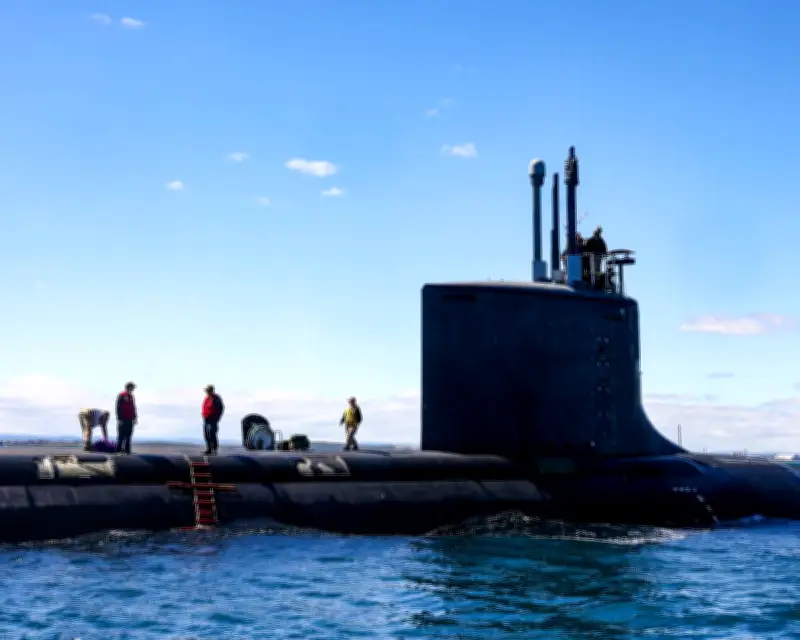
Australia's proposed nuclear submarine fleet will leave behind tonnes of weapons-usable uranium-235, radioactive for hundreds of millions of years and capable of being processed into scores of warheads, nuclear experts have told a public inquiry into Aukus.
A former White House national security adviser has told the Guardian that Australia's Aukus deal – involving the transfer of highly enriched uranium to a non-nuclear weapons nation – sets a dangerous proliferation precedent that other countries such as Iran could try to exploit.
Lethal legacy for millennia
Associate Prof Tilman Ruff, founding chair of the Nobel prize-winning International Campaign to Abolish Nuclear Weapons, told the Aukus public inquiry that the legacy of Australia's nuclear submarine fleet – each vessel with a service life of about three decades – will be hundreds of kilograms of high-level radioactive waste. Even as waste, the submarines' spent reactor fuel will be highly enriched uranium (HEU), usable to build nuclear weapons.
“No nation has resolved the huge problem of how to manage this material and there's no guarantee – given the timeframes involved and the hazards of the material over geological time – that any arrangement that we come up with could reliably isolate that material for hundreds of thousands, or millions of years,” Ruff said.
“The additional complication here is that it needs a really high level of security because, in 10,000 years, somebody could still go and dig that stuff up and build nuclear weapons with it.”
Enrichment levels comparable to Hiroshima bomb
The uranium left behind by Australia's nuclear submarines at the end of their working lives will likely still be enriched to about 80%: the same level as the atomic bomb dropped on Hiroshima.
Leading global experts on non-proliferation have estimated each nuclear submarine decommissioned by Australia – beginning in the 2050s – will contain about 400kg of HEU, enriched to about 80%, containing about 320kg of uranium-235 (U-235). The International Atomic Energy Agency states a “significant quantity” of highly enriched uranium – enough to make a weapon – is 25kg of contained U-235.
U-235 has a half-life of 700m years: it will be a weapons proliferation risk for millennia. The HEU left behind by each of Australia's three second-hand Virginia-class submarines bought from the US would be sufficient for more than a dozen weapons.
Proliferation precedent
Dr Frank von Hippel, senior research physicist and professor emeritus at Princeton University, who served as an assistant director for national security in the Clinton White House, told the Guardian “by the IAEA's metric, 0.4 tons of 80% enriched uranium would be sufficient for 13 implosion bombs”.
“That's a lot of weapons potential there. And that's just one submarine. That is going to change the situation in Australia with regard to the proliferation potential.”
Von Hippel said successive US administrations had spent decades bringing thousands of kilograms of HEU on to American soil to reduce the risk of nuclear terrorism. Since the 1990s, about 30 countries have reduced their HEU stocks down to less than 1kg. Countries such as France and China run nuclear-powered submarine fleets on low-enriched uranium, a far lower proliferation risk.
“The worry is not so much Australia as the precedent,” von Hippel said, citing countries such as Iran which has previously justified enriching uranium to 60% by saying that in the future it might want to have naval reactors.
“My concern is the proliferation example that the US and Australia and the UK have established by legitimising the use of weapons-grade uranium for attack submarines by non-weapons states: they have lowered the barriers to acquisition of nuclear weapons by this action.”
Australia's responsibility
The Aukus agreement mandates that Australia is responsible for the disposal and storage of all of the nuclear waste left behind by its nuclear-powered submarines in perpetuity. By the end of the century, when all eight of Australia's planned nuclear powered submarines have been retired, Australia will be responsible for the management of “at least 3 tonnes” of U-235 in the highly enriched uranium spent fuel waste, Ruff told the Guardian. “That's enough for 120 nuclear weapons using the International Atomic Energy Agency standard.”
Australia has spent decades reducing its HEU stocks. There is presently less than 3kg of HEU in the entire country, held for research purposes.
A spokesperson for the Australian Submarine Agency told the Guardian the government was committed to the “highest levels of nuclear stewardship”, including responsibility for “management, storage, and disposal of spent nuclear fuel and radioactive waste generated from its conventionally-armed, nuclear-powered submarines”.
But Australia won't need to dispose of high-level nuclear waste until the 2050s, when the country's first nuclear-powered boats are decommissioned, the spokesperson said. “That means we have time to get this decision right, including through a thorough process informed by technical advice and extensive consultation.”
The ASA reiterated Australia would not accept intermediate or high-level radioactive waste – including spent nuclear fuel – from any country, including the UK or US.