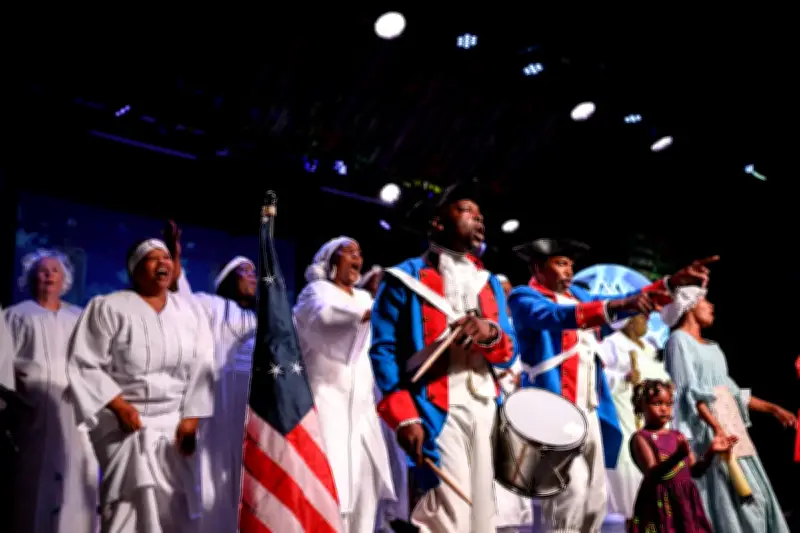
Da' Gullah American Revolutionary Experience, a traveling play by Gullah Kinfolk Traveling Theater Inc, retells the American Revolutionary War from the perspective of the Gullah Geechee, descendants of formerly enslaved Africans in the southeastern US. The performance premiered in July 2025 and will be performed again on 18 July 2026 in Bluffton, South Carolina.
Play's Premise and Characters
The play features formerly enslaved Africans in heaven deciding whether historical figures like George Washington can enter the pearly gates. Anita Singleton-Prather, CEO & artistic director, narrates as Priscilla, a Sierra Leonean child enslaved by South Carolina's Ball family. She wrote the play to highlight Black contributions often omitted from history.
In one scene, a beam of light illuminates Singleton-Prather as she addresses the audience: 'War was on the way. Folks was asking us, what side we was going to fight: red or blue?' referring to the Continental Army's blue uniforms and British red coats. Both sides promised freedom to enslaved Africans but rarely granted it. 'Both sides lie,' she adds.
Funding and Purpose
The play was commissioned by the SC American Revolution Sestercentennial Commission (SC250), receiving about $150,000 in funding. SC250 CEO Molly Fortune stated: 'Part of our charter from the legislature is to ensure that all voices are told in the story of South Carolina’s role in winning the American revolution.' Fortune highlighted the Gullah Geechee's contributions: 'The reason that South Carolina was one of your wealthiest colonies … is due to the labor, the rice, the indigo. And it’s not just the labor, it’s the food, it is the culture.'
Research and Historical Accuracy
Singleton-Prather found scant information about Black South Carolinians in the 1700s. She worked backwards from white enslavers like General Francis Marion and Eliza Lucas Pinckney to identify the Africans they enslaved. She discovered that an enslaved man, John 'Quash' Williams, helped Pinckney produce indigo. 'Behind every great man is a great woman,' Singleton-Prather said, 'but behind every so-called great American revolutionary war hero, there’s some Africans somewhere.'
One challenge was capturing the complex feelings of Black people who remained enslaved after US independence. Singleton-Prather, a Gullah woman born and raised in South Carolina, noted: 'The first Fourth of July, we probably weren’t enjoying no picnic. We were probably still working in the alligator swamps of the rice fields, or picking the long fiber Sea Island cotton until our fingertips were bleeding.' She asked: 'How do you tell the story and honor the 250th without trying to sugarcoat stuff?'
Highlighting Hypocrisy
The play depicts European immigrants who fled persecution only to oppress marginalized groups in the US. One scene features Paris O'Ree, a boy of African descent enslaved by a French Huguenot family. The fictional O'Ree says: 'Master, you remember you and your family was French Protestants come here from a foreign country to escape cruelty, violence. Come right here and do the same things to we colored people.' In real life, O'Ree escaped slavery at 15 and fought for the loyalists; after their loss, the British evacuated him and others to Canada.
Robert Adams Jr, executive director of South Carolina's Penn Center and an O'Ree descendant, said: 'They were on the losing side. They didn’t feel like there was a real opportunity for them.' He added: 'Canada probably needed some of these bodies to help develop what had been a really vast territory.' Willie O'Ree, the first Black NHL player, is another descendant.
Personal Connections
Keonda Grant Taylor, who plays the enslaved woman Ona Judge, said the performance connected her to her Gullah roots. Grant Taylor and her family still live on Oaks plantation on St Helena Island, where her ancestors were enslaved. 'It really brings me back home,' she said. 'I get a chance to speak my dialect in a way that I can’t do from nine to five.' Judge served as Martha Washington's maid until she escaped on 21 May 1796. In the play, Martha Washington seeks heaven but is questioned; Judge recounts being promised as a wedding gift to her granddaughter.
After performances, audience members tell Grant Taylor they are inspired. 'The children come up to me and say, “I’m going to be strong too, and I’m not going to let anybody treat me in any kind of way,”' she said. 'It’s a really beautiful experience, someone knowing their worth.'
Alison Chambers, who plays Pinckney, grappled with her family's ties to enslavement. During her undergraduate studies, she learned Pinckney was a successful businesswoman who popularized indigo. Later, census records revealed that one of her own ancestors enslaved Africans. 'I was very upset with the things I learned about [Pinckney],' Chambers said, 'and also upset with the things I learned about my own family.' She sees the performance as a cautionary tale: 'It needs to be told, because we need to know where we come from. We also need to make sure we don’t repeat any of this.'
True Patriots
Singleton-Prather said the play holds the US accountable for past wrongdoings while celebrating resilience. 'When I look at the true patriots of the American revolutionary war, it’s not George Washington, it’s not Francis Marion,' she said. 'It’s those Blacks and Native Americans that fought for freedom knowing that they themselves would be denied. They are the true patriots.'