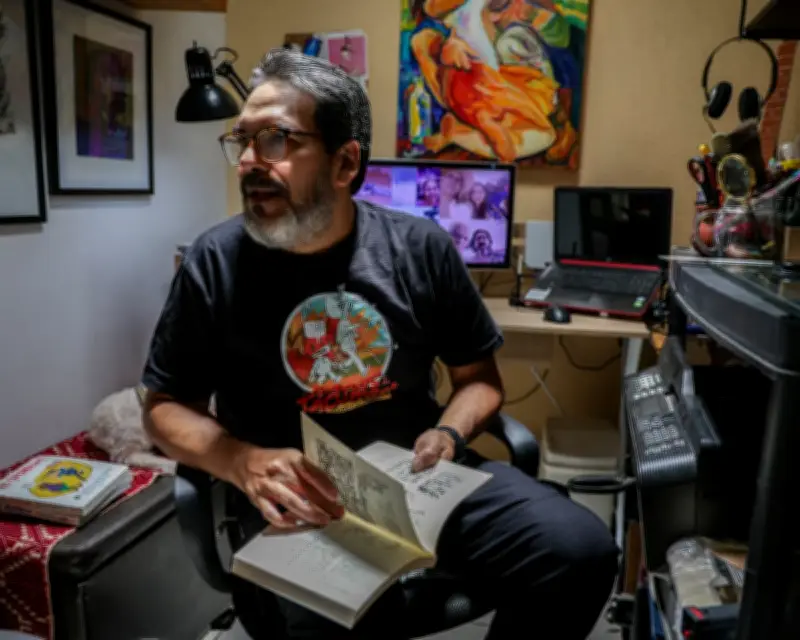
Ricardo Sánchez Bobadilla has spent two decades casting a satirical eye over Sinaloa's escalating narco wars, creating characters inspired by the region's violence and drug trafficking. His cartoon follows the struggles of El Ñacas and El Tacuachi, two sicarios (cartel gunmen) who navigate the absurdities of the underworld, from hiding bodies to finding corrupt cops.
Laughing Through the Violence
“Here in Sinaloa we’ve always lived with drug trafficking – you know if you honk your horn at the wrong truck someone with an AK-47 might get out,” said Bobadilla. “Still, like good Mexicans, we laugh at the situation we live in.” The drug trade first took root in Sinaloa over a century ago, and today its homegrown cartel ranks among the most powerful organized crime groups globally.
Bobadilla grew up in the state capital, Culiacán, making the subject matter ideal for social commentary and black humor. The cartoon debuted almost 20 years ago in the magazine La Locha, with El Ñacas and El Tacuachi figuring out where to hide a body, ending up wedging it into a seat in Congress. When La Locha disappeared after nine issues, the cartoon was picked up by the local newspaper Ríodoce, where it has run weekly ever since.
A Cast of Narco-Archetypes
Over the years, Bobadilla has populated his cartoon universe with narco-archetypes, from kingpins and politicians to alucines and buchonas (wannabe narcos and glamorous girlfriends), all speaking vividly vulgar Sinaloan slang. He avoids naming real people, but acknowledges the risks. “Maybe my frontal lobe was a bit less developed back then,” he said, recalling his early work.
El Ñacas was created around the time Mexico’s then-president Felipe Calderón declared a “war on drugs,” sending the army to engage cartels and unleashing a surge of violence. “That’s when decapitated heads started getting left in public,” said Bobadilla.
Personal Tragedy and Its Impact
The violence has touched almost everyone in Sinaloa, including Bobadilla, whose brother Miguel was shot dead outside his home in 2008. At the prosecutor’s office, an official told him: “Are you rich? Do you have powerful friends? No? In that case don’t push this, because they will kill you.” Bobadilla later said, “I knew who killed my brother – and not much later they were killed themselves. I guess justice arrived another way.”
The death of his brother changed his work, as did the murder of his friend and editor at Ríodoce, Javier Valdez, in 2017. “When they kill a journalist, it muzzles all of us a bit,” said Bobadilla, leafing through a notebook with sketches of Valdez and Humberto Millán, a Sinaloa radio host murdered in 2011. “In all the newspapers where I’ve worked, someone has been murdered, or at least shot.”
Current War and Continued Satire
The older generation of the Sinaloa cartel is mostly dead or in US prisons. For the past two years, their sons have been fighting a war that has left more than 6,000 people dead or missing. In April, the US government accused the governor of Sinaloa and nine other officials of ties to the cartel. Bobadilla says the current war is the most “vicious” he has experienced, yet journalists and cartoonists continue to cover it.
“When something horrible happens – which is almost every day – I try not to make fun of it soon after,” said Bobadilla. “Like Woody Allen said, tragedy needs a certain distance for us to find it funny.”