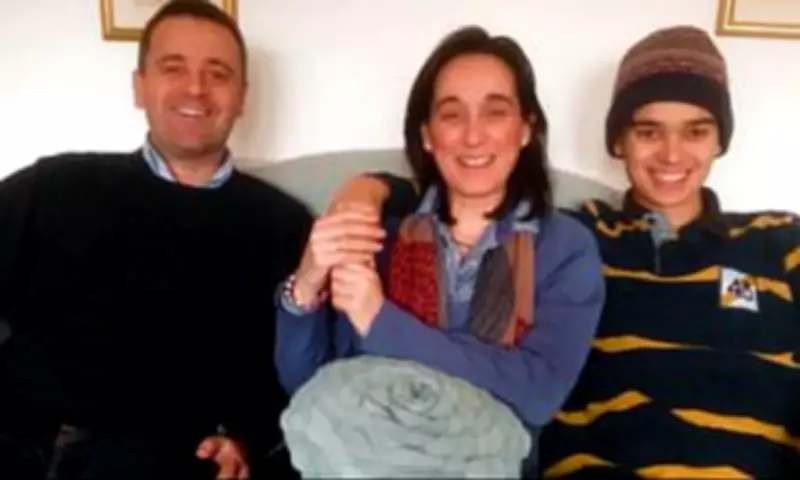
An 'extraordinary' British student who died of cancer has been put forward to become the Catholic Church's first Gen Z saint. Pedro Ballester, from Manchester, died aged 21 in 2018 after being diagnosed with aggressive pelvic cancer. Now, eight years later, the Roman Catholic Diocese of Salford has opened the 'cause for the canonisation' of Ballester, which will examine his life before presenting his case to the Pope.
In a statement, the diocese said: 'We are pleased to announce the opening of the Cause for the Beatification and Canonisation of Pedro Ballester, a young Manchester man whose life of faith and witness continues to inspire many.' The diocese added that since Pedro's passing, 'his reputation for holiness has grown significantly', with Catholics now invited to submit personal testimonies, memories and writings attributed to him, such as letters or diaries.
Specifically, the Catholic Church will examine whether the aspiring chemical engineer lived a life of 'heroic virtue', by which it can be proven he practiced his faith to an extraordinary degree over a sustained period. Ballester was born on May 22, 1996 to Spanish parents, Dr Pedro Ballester Nebot and Esperanza Arenas Arguelles, who are devout Catholics. Alongside his brothers, Carlos and Javier, Ballester grew up in Manchester before the family moved to Harrogate, Yorkshire.

According to his family, Ballester was known for his 'cheerfulness and many other virtues'. They said: 'He had a Latin sociable character mixed with Northern grit. He was both sociable and straightforward, eschewing all fuss and sentimentality, but he greatly enjoyed company and was a great friend to his friends. His faith went deep and he was happy to share it with others, but in a very natural way.'
What are the five steps to becoming a saint?
- Five-year wait: Five years usually needs to have passed after someone's death for the process to begin. This allows for a period of reflection on the case.
- Servant of God: The bishop of the diocese where the person has died investigates whether their life was holy enough to be deemed a 'servant of God'.
- Life of heroic virtue: The Congregation for the Causes of Saints looks at the case. If they approve it is passed onto the Pope, who declares the subject a person of 'heroic virtue'.
- Beatification: A miracle needs to happen to a person who has prayed to the person in question.
- Canonisation: A second miracle is attributed to the person who has been beatified.
His father, also named Pedro, told BBC News: 'Only the Pope says who is a saint, but my son was an extraordinary young man.' Like his parents, Ballester became a member of Catholic organisation Opus Dei, and as a teenager committed himself to God and a life of celibacy. In 2014, he enrolled at Imperial College London to study chemical engineering, while living in an Opus Dei hall of residence in north London.
But after only his first term, Ballester began to feel intense back pain and was later diagnosed with advanced cancer. He transferred his degree to the University of Manchester, with the hope of continuing his studies while receiving treatment from cancer specialist centre, The Christie Hospital. In 2015, he was well enough to meet Pope Francis in Rome. But after three years, he succumbed to his illness and died on January 13, 2018.
More than 500 people attended his funeral, with his grave, in the Catholic section of Southern Cemetery Manchester, since becoming a shrine to 'pilgrims' from around the world. In recent months, more than 60 of Ballester's friends and family have been interviewed by church authorities about the would-be saint, including his father who revealed he was questioned for three hours.
If Ballester's case receives the approval of the Pope, the process would pass on to the next stage, 'beatification', in which church authorities would need to establish if a miracle had happened to a person who had prayed to Pedro. A second miracle would then need to be confirmed before he could be considered for 'canonisation', which would declare him as a saint.

His case resembles that of British-born Italian teenager Carlo Acutis, who recently became the first millennial saint. Computer whiz Carlo, who died of leukaemia in 2006 aged 15, was raised to sainthood by Pope Leo XIV in St Peter's Square at the Vatican, last September. During his short life, Acutis developed a passion for his Catholic faith, attended mass daily and had a reputation for kindness to bullied children and homeless people, bringing the latter food and sleeping bags. Since his death there have been two cases of miraculous healing attributed to Acutis after families prayed for help from the teenager.