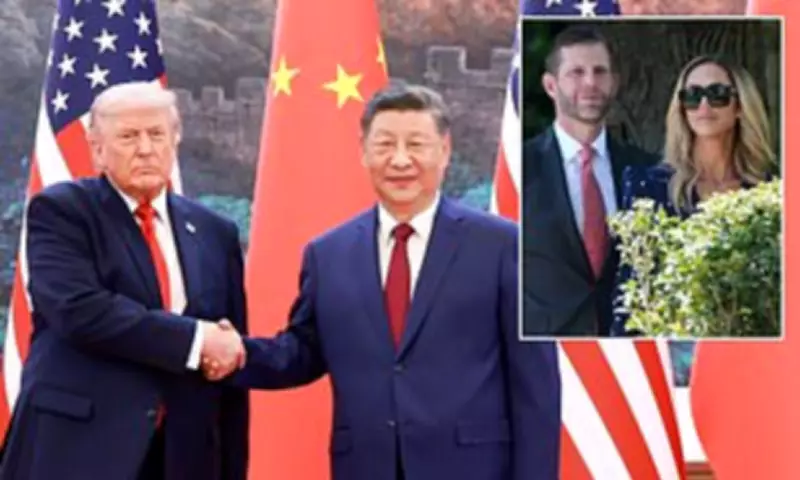
CNN anchor Erin Burnett has claimed that newly surfaced Chinese social media posts critical of Donald Trump are spreading because 'government censors want' them to. Burnett, 76, made the allegation on Wednesday's OutFront program. She had been discussing a Washington Post report based on a confidential US intelligence analysis published this week.
US Intelligence Analysis
The report warned that China is emerging as one of the biggest geopolitical beneficiaries of the war in Iran, as the US president visits Beijing in an attempt to cultivate the two countries' relationship. Burnett noted the stakes of the summit with Chinese leader Xi Jinping before segueing to the posts that either mocked Trump or the current state of the US.
The anchor eagerly read several out as translations appeared on-screen. 'The US is no longer a country that we look up to. We can now compete with them with confidence and strength,' one blared. Another argued: 'The US economy is in bad shape. Trump has been blustering Iran for so long yet hasn't brought them a real victory. America has lost its swagger. They're nothing but a paper tiger.'

Government Censorship Allegations
'Beijing's strict censors are letting the ridicule go viral,' Burnett proclaimed. Other translations touted included: 'Trump, you're welcome to visit China and learn from us'; 'They will all look up to us from now on'; and 'Trump came to China! We won the tariff war!' Burnett read them all before again saying China's government censors 'want this to go viral.'
'And by the tone of the messages, the Chinese government feels they've got the upper hand. It's clear,' she continued. 'They are rolling out the red carpet for the president.' The anchor went on to compare language in the posts to proclamations seen in Chinese state-run newspapers. 'The 21st century is more likely to belong to Beijing than to Washington,' one read.
Global Anti-American Sentiment
Another post, from a spring edition of China's Global Times, quoted a March Politico report that found a majority of respondents in Canada and Germany believed 'it is better to depend on China than the US' since the former is currently more reliable. A similar number of respondents in France (38 percent) and 42 percent of people polled in the UK by the left-leaning publication said the same.
Burnett concluded that Trump was in a weakened position ahead of his meeting with Xi, which entered its second and final day on Thursday. Accompanying the president on the trip is a team that includes son Eric and daughter-in-law Lara. The posts framed this as a show of desperation.
Summit Context
Also in attendance are Secretary of State Marco Rubio, Treasury Secretary Scott Bessent, and Defense Secretary Pete Hegseth, all of whom have been critical of China's government in the past. The exact contents of the current discussions remain unknown, but Trump said he does not expect the war with Iran to come up as much in conversation as trade.
China's state-run news agency Xinhua reported Wednesday that Xi told Trump that 'China-U.S. economic ties are mutually beneficial and win-win in nature.' The agency also quoted Xi as saying: 'Yesterday, our economic and trade teams produced generally balanced and positive outcomes. This is good news for the people of the two countries and the world. Facts have shown time and again that trade wars have no winner.'
Trade War Background
Trump, 79, began slapping taxes on Chinese imports during his first term in 2018. After his second election win in 2024, he raised import taxes on Chinese goods so high that trade between the two countries nearly froze altogether. Chinese officials, after retaliating with their own tariffs, mocked the standoff as 'a joke.'
Earlier this month, on May 12, both countries reached a truce where the US reduced tariffs on Chinese goods to 30 percent. China reduced tariffs on US products to 10 percent, down from a high of 125 percent. The US's record high rate was 145 percent. The Washington Post report mentioned by Burnett found that Beijing has incorporated popular criticisms of the war into its public messaging in weeks since.