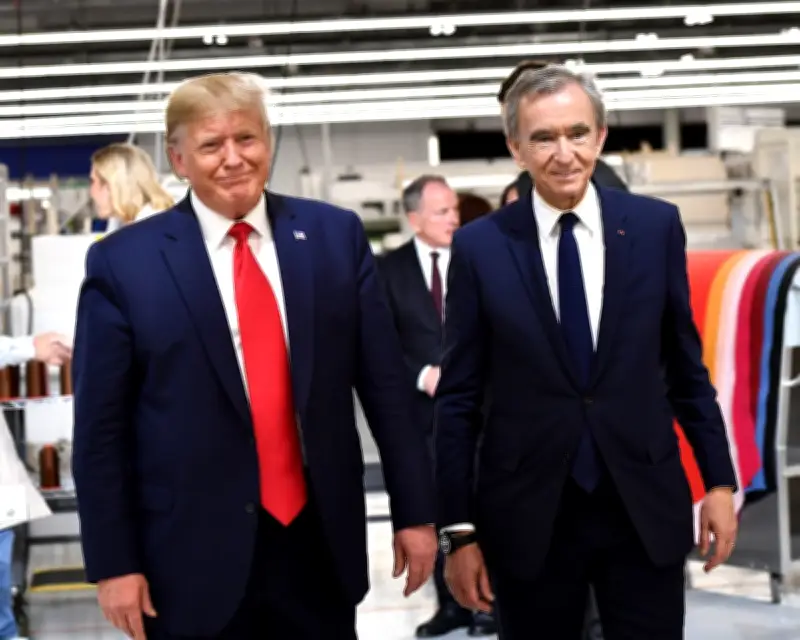
Fashion tycoon Bernard Arnault, known as the "wolf in cashmere," is under fire from journalists' unions in France for buying up almost all the country's business and economic press. The owner of the world's biggest luxury group, whose brands include Louis Vuitton, Dior, and Tiffany, has made him one of the world's richest people. Arnault, a close friend of Donald Trump, added the centrist business weekly Challenges to his stable of publications, prompting concerns about media ownership in France.
Arnault's Media Empire
Reporters Without Borders said Arnault had a "stranglehold" on the main business titles in France after his LVMH group bought Challenges. LVMH, whose brands include fashion, perfumes, champagne, and spirits, already owns an array of business publications, including the leading economic daily paper, Les Echos, and the business information service L'Agefi.
Complaints Filed
Reporters Without Borders and journalists' unions have filed two different complaints over the purchase of Challenges. France's council of state is considering whether authorities failed to properly examine the scope of LVMH's business media ownership, and the competition watchdog is considering union arguments that the group "abused its dominant position" by acquiring Challenges. "This is a textbook example of the loopholes in French law which fail to keep media ownership in check," said Laure Chauvel, the head of the France-Italy desk at Reporters Without Borders.

LVMH did not comment when approached by the Guardian. But Arnault, who also owns the daily newspaper Le Parisien and the celebrity magazine Paris Match, told a senate committee in 2022 that he bought media "in the general interest," to protect key titles and keep them alive.
Growing Debate on Media Ownership
Arnault's expansion comes amid growing debate over the handful of billionaires who dominate media ownership and are reshaping the news landscape before next spring's presidential election. The far right is polling high as Emmanuel Macron's two terms in office near an end. Other prominent billionaires include Vincent Bolloré, a conservative industrialist close to far-right figures, who has been accused of using his media empire to give a platform to reactionary voices. Rodolphe Saadé, head of the world's third largest shipping company, CMA CGM, has a growing media empire that includes BFM TV, La Provence, and La Tribune. Daniel Křetínský, the Czech energy billionaire who owns the parent company of the UK's Royal Mail, is also building a French media and publishing empire. Xavier Niel, the telecoms billionaire, was Le Monde's main shareholder until he placed his stake into a trust. On a smaller scale, the Dassault family owns the daily Le Figaro.
Arnault's Political Stance
Arnault's clearest political stance has always been his opposition to wealth taxes. In the early 1980s, he briefly moved to the US to avoid what he saw as the left's hostile business environment and the socialist president François Mitterrand's tax on the rich. While there, he cultivated a close friendship with Donald Trump. Arnault, his wife, and two of his children were the only French guests on the platform at Trump's second inauguration in January last year. He said after that he had witnessed "the winds of optimism" in the US and returning to France was like a "cold shower." He spoke out last year against calls by the left for a 2% wealth tax on all assets, calling such a move "deadly for our economy."
Independence Concerns
Journalists at Challenges and Les Echos are seeking to ensure they can keep the charters protecting their independence, which they fear is uncertain. The Challenges charter defines its centrist approach to business reporting as social, humanist, and progressive, but there are fears Arnault prefers a more resolutely free-market approach. Unions said Arnault's group had not yet signed the Challenges charter which, unless renewed, expires next year. Les Echos' charter is also up for renewal in 2027. Both titles have held unprecedented strike action. In 2023, journalists at Les Echos protested after the departure of their editor and management's move to replace him.

"Bernard Arnault has in a few years effectively helped himself to the best part of the business press," said Alexis Lévrier, a media historian at the University of Reims. "He has a near monopoly on economic news." Lévrier said Macron, despite election promises, had failed to legislate on media ownership and protections. He said he felt the president feared business leaders such as Bolloré or Arnault: "There is no equivalent in French history of this reversal of the relationship between economic power and political power. Economic power, which owns media, can impose its views on the political power in place."
Past Controversies
In 2022, senators asked Arnault about his attitude to the media. He admitted pulling advertising from the leftwing daily Libération in 2012 after it ran what he called an "aggressive" and "wrong" front page on his alleged desire to flee to Belgium to avoid tax rises. He denied pulling advertising from Le Monde in 2017 because it had named him in Paradise Papers reporting on offshore tax havens. Senators also referenced the trial of the former head of France's domestic security services, Bernard Squarcini, who was convicted for an alleged scheme to spy on journalist François Ruffin while Ruffin was making a documentary about LVMH. The company paid €10m in 2021 to settle allegations, without any admission of wrongdoing. Arnault told a court hearing he had been "completely unaware" of the alleged scheme.
Sophie Taillé-Polian, a Green MP who worked on a bill aimed at safeguarding media pluralism, said it was disappointing that no law had been passed under Macron. "When we have a domain as important as the business press under the care of one of the wealthiest people in both France and the world, that raises questions," she said.