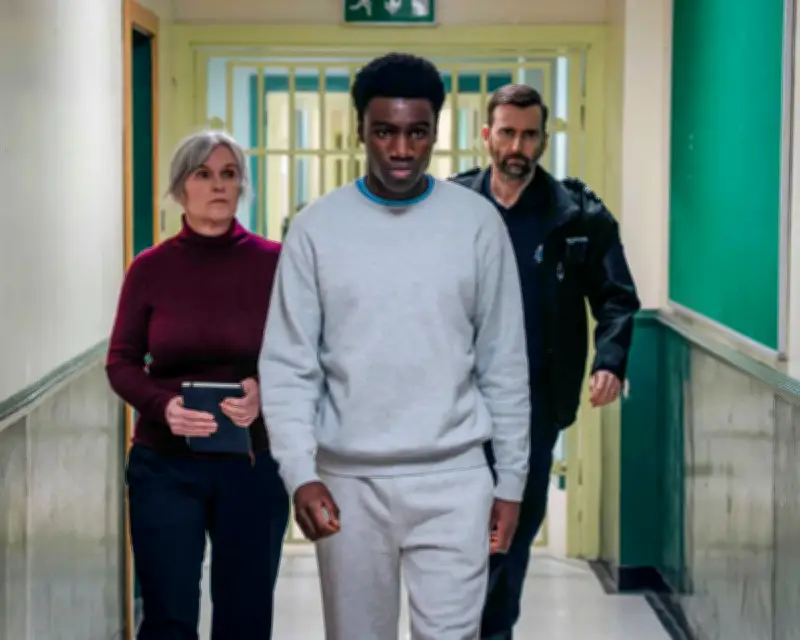
Jimmy McGovern's Bafta-winning prison drama Time returns for a third series on Sunday at 9pm on BBC One, this time set in a youth offending institution for boys. The new episodes, co-written by Samuel Bailey, follow the first two series that covered the devastation of men's and women's prisons.
A harrowing opening
Within 90 seconds, a teenage boy is dragged horizontally by five adult guards to his cell, a hand half-covering his jaw as he screams obscenities. That hand belongs to David Tennant, playing veteran prison officer Bobby Bailey. Tennant is an impressively blank slate as Bailey: a figure who is almost always on screen but has such sparse dialogue and emotion that he is defined by his ordinariness and hard to box as a 'goody' or 'baddy'.
Siobhan Finneran returns as prison chaplain Marie-Louise, the only common thread through all three series and a rare sign of hope. Tennant and Finneran both give stellar performances, but it's the three young actors playing new offenders who will surely be stars of the future. There's Peter (Ollie McNulty), caught between the death of an innocent man and loyalty to his community, and James (Louis McCartney), struggling to face his broken parents after a life-changing act of violence. Then there's Christopher (a heartbreaking Chukwubuikem Molokwu) battling a stammer and reconnecting with his birth mother.
Urgent and prescient themes
As prison overcrowding dominates the headlines, alongside the multifaceted crisis among young men, Time series three is so urgent and prescient that you wonder if the BBC were tempted to change the title to Time(ly). McGovern, long known for tackling social realism and institutional injustice in iconic shows such as Cracker, The Lakes and Hillsborough, is not going to put the viewer through the wringer without proper reason.
One of Time's strengths is its exceptional writing, but it is not afraid to say plenty without a word. The white vans that transport the boys to jail with tiny square black windows for pockets of light. The gates in D-wing that are rarely opened and keep its violent not-yet-men apart ('Gates are dangerous,' Tennant tells Finneran ominously). Cells named 'Room 29', as if the boys are on a hostel break for the week – an illusion that's only broken when you realise there's not a scene that takes place in the wing that's not accompanied by the sound of screaming.
A lesson in tension
The whole thing is a lesson in tension, each minute in the prison dragging the viewer further into the claustrophobia of dread and despair. This is not easy viewing but nor should it be. McGovern is not delivering content that plays in the background while you're scrolling Instagram. It grabs you by the throat, asking you to question whether it's possible to change or if the horrors of the human-made system doom certain people – certain children – before they ever really get a chance. All of us should watch it, not least politicians across the political spectrum. Just maybe stick Bake Off on afterwards to decompress.