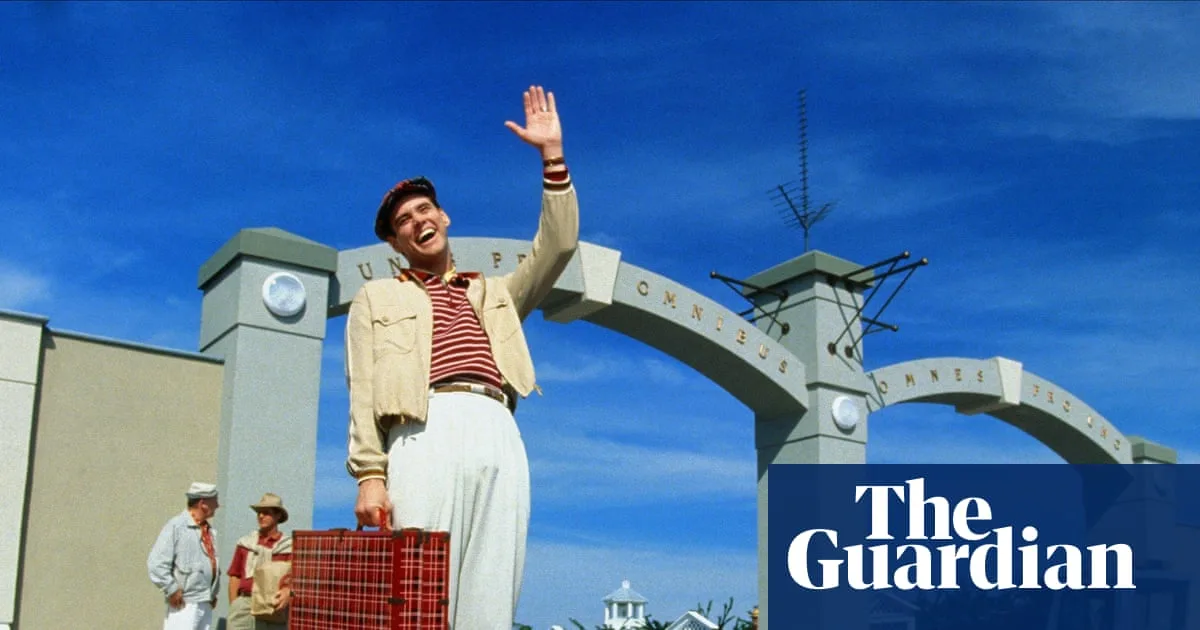
Peter Weir's dystopian comedy The Truman Show, starring Jim Carrey as the unwitting star of his own reality TV series, has taken on new resonance in the techno-capitalist era. Almost 30 years after its theatrical release, the film has only grown in stature and prescience, offering a dark satire on voyeurism and the inexhaustible manipulations of the media.
The film follows Truman Burbank, an insurance salesman whose entire life takes place not on the island of Seahaven as he believes, but on an elaborate film set. His family, including his perky wife Meryl (Laura Linney), best friend Marlon (Noah Emmerich), and even his mother (Holland Taylor), are paid actors desperate to keep the illusion alive. Pulling the strings is the God-like Christof (Ed Harris), who directs the show from the 'moon'.
When the film begins, Truman already longs for a way out while pining for Sylvia (Natascha McElhone), the girl who got away. Seahaven's antiseptic cleanliness and sunny palette obscure its insidious, monocultural grip. As Truman's suspicions grow, and the community conspires to keep him both ignorant and imprisoned, things get very dark indeed. The first sign comes from the heavens: a large stage light falls from the sky, smashing onto the street outside Truman's house.

In a central scene, Marlon placates Truman with the undeniable lure of fraternity: 'Think about it, Truman. If everyone was in on it, I'd have to be in on it too.' But he's being fed his lines directly by the repugnant Christof. The film enters the world of the Stasi, of an authoritarianism that infects the domestic sphere, and Emmerich brilliantly captures the moral price the conformist pays to maintain the status quo.
Carrey is sublime, his cheesy grin and 'good afternoon, good evening and good night' evoking the gee-whillikers optimism of 1950s middle America. His doubt and determination once the veil drops feel almost revolutionary. One of the film's miracles is the way it trades in both the allure and the artifice of cinema; Seahaven still seduces because it plays as much on our fears as our dreams.
Rewatching it now, Weir's masterpiece feels less about voyeurism and the entertainment industry and more about the individual and their relationship to the state. It's no accident Christof has to invoke lifelong phobias in Truman to keep him 'safe'. The film has become a chilling allegory for our times.