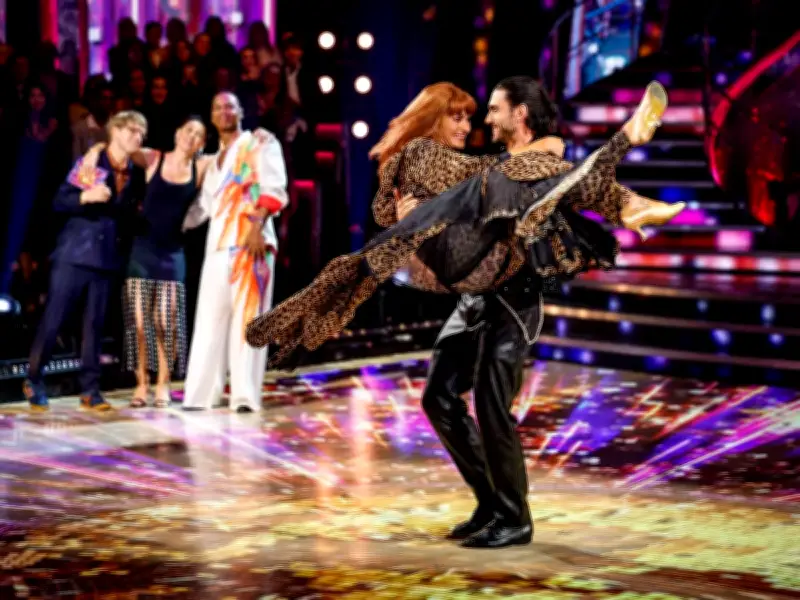
Strictly Come Dancing's fourth episode of the current series attracted 5.18 million viewers, a decline from the 6.27 million who watched the third, according to a report released on Monday. The show trailed behind ITV drama The Blame's fifth episode, Channel 4's The Great British Bake Off's second episode, and the first two episodes of The Celebrity Traitors.
The ratings dip comes after a major revamp of the BBC dancing show, which saw Tess Daly and Claudia Winkleman replaced by Emma Willis, Josh Widdicombe and Johannes Radebe. Ellie Taylor took over from Fleur East and Janette Manrara on spin-off It Takes Two, and the show introduced a brand new studio. Five new professional dancers—Aleksandra Isaeva, Cristian Priori, Lethabo Monametsi, Maddie Ingoldsby and Mark Karmalita—joined, replacing Gorka Marquez, Nadiya Bychkova, Luba Mushtuk and Michelle Tsiakkas.
Presenters and format changes
Former Strictly professional dancer Ian Waite told the Mirror that the scale of change has been a challenge. "It's been a big learning curve for BBC bosses," he said. "Obviously they've not changed quite so much on Strictly before. I think it's a lot to get used to."
The hosting format has also shifted: instead of one presenter anchoring from the ballroom floor, Josh Widdicombe and Emma Willis now host side-by-side. However, Waite suggested the pre-recorded results show lacks the excitement of a live broadcast. "I think pre-recorded is never as exciting," he said. "I do think if we had a live result show, it would probably be better. Run Strictly earlier, maybe 6 o'clock till 8 o'clock, and then run the result show at 9. So you know, so that it's all done before 9:45. It's a shame it's not a live show, and maybe that's what it needs to be."
Criticism of judges and production
A large portion of Strictly is now pre-recorded, including most professional dances, artist performances, and the results show. While this ensures polished output, some viewers prefer spontaneity. Former pro dancer James Jordan, writing in his WhichBingo column, criticised the judges: "They're too predictable, too panto and too scripted. Get the judges judging properly, not worried about upsetting people and trying to be too kind. At the end of the day you need Craig being the tough one, and when he finishes on a positive every time now, I think it dilutes the feel of the whole panel. They all talk for too long as well. I want to watch the dancing and see how they're getting on, I don't want to listen to the judges for that long."
Michael Barrymore, 74, told Radio Times the show is "too controlled and contrived". "It's not what people want any more. Because of years of people watching telly and learning about it, and social media, audiences require more," he said. "It's too safe. When I was hosting Saturday-night TV, there was a bit of an edge. Producers have to be willing to take more risks."
Lack of competition and future outlook
Since 2018, Strictly has faced no true live TV rival on Saturday nights, which may have reduced pressure to heighten drama. Waite remains hopeful for recovery: "I hope that there's a resurgence and it just shoots back up again, and we can start to get some of the audience back that we've lost over the years. In its prime we were getting like 10, 12, 14 million it was just amazing to be part of it. I think it is a fantastic show, and it'll still run for many many years."
The show remains a glitzy Saturday staple, but as Waite noted, "there's nothing to replace it."