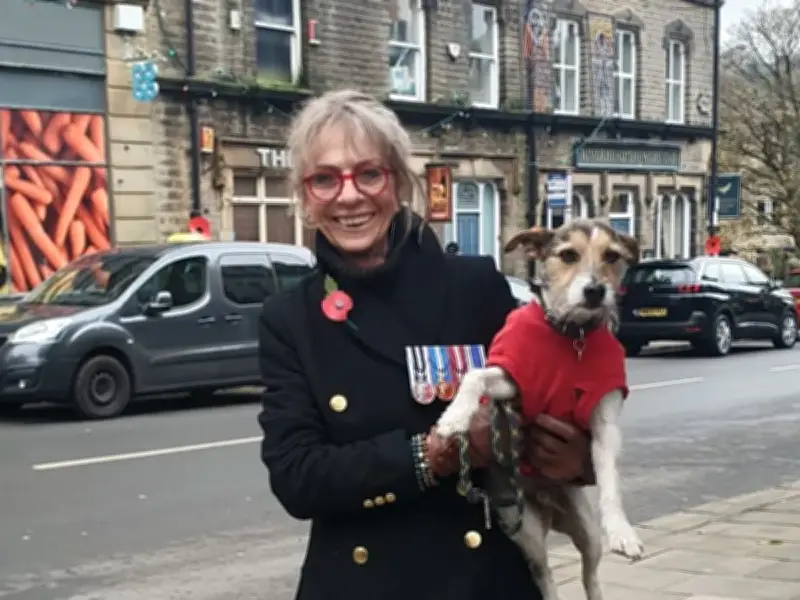
Former West Yorkshire police officer Lisa Casler, who now consults on major TV crime dramas including Happy Valley, Cleddau and The Blame, has revealed that police jargon is often overdone in television productions.
Casler spent 30 years working for West Yorkshire police before retiring to the English village of Marsden to spend time with her grandchildren. Her retirement plans changed when an old school friend, television writer and producer Sally Wainwright, the creator of Happy Valley, asked her to join the series as a police consultant.
From Policing to Television
The 64-year-old said: "It is very different to the world of policing. I'd never been involved in anything like that."
"Once I'd done Happy Valley, a lot of people started to get in touch with me about other productions, and could I have a look at these scripts, could I do this, could I do that. It's sort of just gone on from there, really."
A producer from the series then put Casler in touch with the creator of the S4C series Cleddau, which is also produced in English for the BBC under the title The One That Got Away.
Balancing Accuracy and Storyline
Casler works with writers early in the writing process to ensure series accurately represent police work, how cases are investigated and character relationships.
She said: "I consult on scripts that have already been written, but a lot of the time now I do come in very early with writers going through those draft episodes, highlighting where the writer's vision might not fit in with policing and offering a solution."
"Sometimes it is saying, 'well, that wouldn't happen within this time scale, but if you insert this particular procedure, it allows the other policing element to have time to come.'"
Casler noted that even small dialogue tweaks can help, such as when a toxicology report comes back from a post-mortem within an hour, which she described as "ridiculous." She suggests a one-off line like "well, that's quick" to reflect reality while preserving the storyline.
Striking the Right Balance
Casler said audiences are clever and understand procedural details from shows like 24 Hours in Police Custody, but it is about striking a balance between what the writer wants and how the cast feels saying the words.
"I think there is a tendency sometimes to overdo the police jargon, and there's no need for it," she said.
"It's a drama, it's not a documentary. There has to be that creativity to allow for the depth of the characters, for the brilliance of the writing. Although it has to be as real as possible, a lot of policing is extremely boring. So, you couldn't have it all in a drama, because people would just turn off because it's so boring. Nobody wants to watch somebody standing outside a murder scene on guard for three days."
Casler also praised the writers of Happy Valley and Cleddau for creating storylines that reflect everyday situations and raise awareness of topics like coercive control and violence against women and girls.
She said: "Violence against women and girls is very much in the spotlight at the moment, because finally there's been recognition of that type of behaviour towards women, which is brilliant."
Casler also spoke about seeing powerful female leads in the series, noting that when she first joined the police it was still very male-dominated. She said she gets agitated when female police officers in dramas are portrayed as "neurotic or flaky."
Casler admitted that Happy Valley remains her favourite series, but she has enjoyed every series she has worked on and the relationships she builds with writers.
Series two of Cleddau is available on BBC iPlayer and S4C Clic.