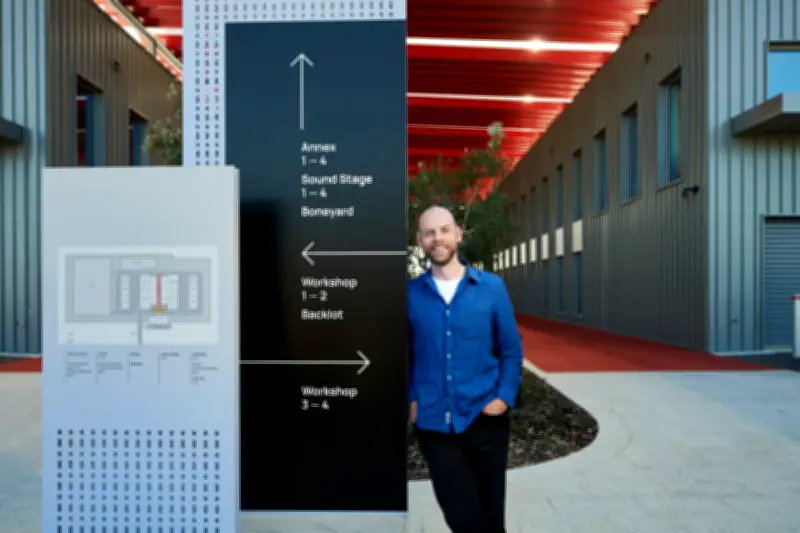
Perth Film Studios chief executive Tom Avison recently returned from a whirlwind sales trip to Los Angeles, where he held approximately 16 to 17 meetings with major studios including Netflix, Universal, Warner Bros, and Disney. The purpose: to put Perth on the map as a viable production hub for international screen projects.
From Cow Paddock to World-Class Studio
The $290 million facility, located in Whiteman on Perth's semi-rural north-eastern fringe, was built on a former cow paddock over three years. The 16-hectare site now features four vast sound stages, production offices, workshops, service roads, and a backlot larger than the playing field at Perth's 60,000-seat Optus Stadium. The construction cost alone was $233.5 million, funded by state taxpayers, with an additional $57 million committed to support the studio's first decade of operation.
Avison, who previously helped open Sky Studios Elstree outside London, discovered the Perth role via LinkedIn. He was drawn to the opportunity to shape not just a facility but an entire industry still defining itself. "Not long ago, this was just a cow paddock," he remarked during a tour of the site.

Economic Bet on Screen Production
The investment aims to lift Western Australia's share of scripted screen production from 1% to 10% over the next decade. This wager comes as Australia attracts record levels of international screen production, with drama production expenditure reaching $2.7 billion in 2024-25, a 43% increase from the previous year. Avison's challenge is to position Perth alongside established east coast hubs like Sydney, Melbourne, and Queensland.
Western Australia offers a competitive production incentive that stacks with the federal location offset, a tax rebate designed to lure film and television projects to Australia, along with additional support for regional shoots. Avison highlights the state's untapped cinematic potential, including south-west forests, the Wheatbelt, Kimberley, the Pinnacles, and "red dirt into a blue sea."
Early Productions and Industry Impact
Production is already underway at the studio. Two Birds, a six-part mystery-thriller for Stan and ITV starring Judy Davis, Sheridan Smith, and Stephen Peacocke, is in its first week of production. The series, which also films on location in Kalgoorlie, employs more than 100 local cast and crew and is expected to inject over $17 million into the Western Australian economy.
Avison acknowledges that Two Birds may seem like a modest start compared to a Hollywood blockbuster, but he views it as part of building credibility. "Melbourne’s had a film studio for 20 years, Sydney for 30 years, Queensland for 40 years," he said. "We’re four months into a film studio here." He emphasizes the need to grow the industry sustainably: "We want to stretch the muscle. We don’t want to tear it."
Beyond the studio gates, Breakers, the first Netflix series to film in Western Australia and billed as the state's biggest production to date, is shooting in Busselton and along the south-west coast. Avison notes that together with Two Birds, this represents the largest concurrent production in Western Australia's history.
Challenges: Crew Depth and Distance
The push to attract international productions comes as Hollywood's share of global production declines. According to entertainment data company Luminate, the share of US scripted series made in Los Angeles fell from 40% in 2019 to less than 25% in early 2026. California Governor Gavin Newsom has described the state's entertainment industry as "on life support."
However, Screen Australia analysis warns that Australia's screen sector remains constrained by "feast and famine cycles," with production peaks straining the limited pool of experienced crew, driving up costs and creating scheduling conflicts. Two Birds serves as an early test case: the British-Australian co-production has a majority Western Australian crew, supplemented by interstate and UK practitioners where local personnel were unavailable, including an east coast line producer, best boy/rigging gaffer, and key grip.

Avison acknowledges that Western Australia lacks trained personnel and specialized equipment in areas such as stunts, special effects, construction, grips, and rigging and lighting, due to the rarity of large-scale productions in the state. Screenwest is addressing these gaps through targeted industry-capacity funding and workforce training.
Matthew Deaner, chief executive of Screen Producers Australia, notes that while Perth Film Studios is an important investment, "a studio alone does not create a sustainable screen industry." The real measure of success, he says, is "not simply the productions attracted, but the capability left behind." Returning series built around local stories and intellectual property tend to stabilize a sector "for years to come."
Kate Separovich, a Western Australian producer and co-founder of Lake Martin Films, is "cautiously optimistic" about the studio but warns that larger productions can pressure independent producers. "If a bigger production comes in and takes all the local crew, then I can’t afford to fly people in from interstate or overseas," she said. "As a producer, I’m like, but where are the crew when I want to make something?"
Distance remains another challenge. Separovich notes, "The challenge of being in Perth is always our distance. It’s 20-plus hours to get from LA to Perth." However, Avison argues that distance is relative in the global production circuit, where creative talent already moves between hubs like Los Angeles, London, Sydney, and Cape Town. Perth's direct 17-hour connection to London appeals to UK productions.
Design and Future Vision
The studio's design incorporates softer elements: a yarning circle, hundreds of thousands of native plants, and an open field visited by grazing kangaroos. "In the UK, film studios are big grey boxes and loads of parking," Avison said. "Here, we don’t want it just to be that." The stages are built for traditional shoots as well as virtual production, real-time rendering, and AI-assisted workflows, requiring the studio to be "kind of eternally flexible."
Avison hopes Perth Film Studios will give Western Australia's screen industry a centre of gravity, comparing the facility to "an artificial reef" meant to help establish and grow an ecosystem. He aims to attract not only big projects but also small ones, "because they all feed off each other." Whether this ecosystem will justify the $290 million investment remains to be seen.