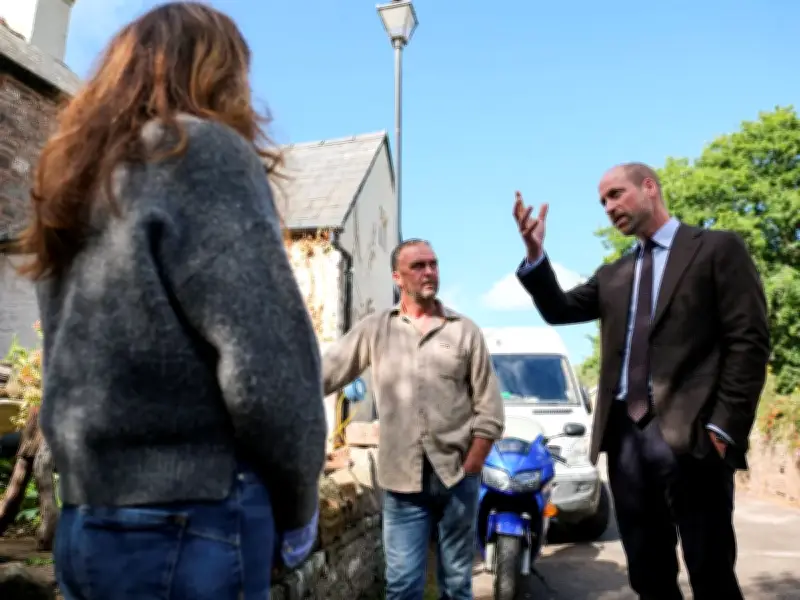
The Prince of Wales was reminded of a childhood memory of selling bric-a-brac at a car boot sale during his visit to Monmouthshire on Thursday, where he met residents affected by severe flooding.
Rod and Helen Wyatt, who live in Skenfrith, spoke with Prince William about how their family has endured four significant floods in six years. During the conversation, Mr Wyatt recalled their first meeting.
"First time I met you, you were this high," Mr Wyatt said, raising his hand to waist height. "In Glanusk Estate – you sold me a CD from a bric-a-brac stall."
Memory of a 'dodgy car boot sale'
William laughed and replied: "Dodgy car boot sale, yes I remember that." Mr Wyatt joked: "Still doing that?" and the future king replied: "No, I don't sell... it's dried up a bit that one, perhaps I should reopen it."
Mr Wyatt's wife revealed they could not recall the title of the CD, to which the prince confessed: "I got up to a lot... we had some fun round there."
Glanusk Estate, near Crickhowell, is the family seat of William's former nanny Tiggy Legge-Bourke, now known as Alexandra Pettifer, and hosts the Green Man Festival. Ms Pettifer looked after the prince and his brother, the Duke of Sussex, throughout much of the 1990s.
Call for holistic flood approach
During the visit, the Prince of Wales called for a "holistic" approach to addressing severe flooding, following his meeting with villagers living under the shadow of the approaching storm season.
William expressed sympathies with residents of Skenfrith, acknowledging that many may feel "anxious" about extreme weather events that he noted were no longer "one in 50-year" occurrences, but appeared to be happening on an annual basis.
Skenfrith has endured four significant floods in six years, with last winter's proving the most devastating, after the River Monnow burst its banks following Storm Claudia, which unleashed a month's worth of rainfall within just 24 hours across parts of England and Wales.
Community impact and tree planting
Mr Wyatt, who has lived in the property for 10 years, told William: "we had to give up really, we got two bottles of Prosecco and went to watch Strictly upstairs".
William responded warmly, saying: "It must be so demoralising for you now, the worry each year you've got to go through that again, potentially, is becoming more frequent." He added: "They keep talking about a one in 50-year event, it doesn't make sense anymore. It might be in the researching and scientific point of view – it's happening every year now, it's mad. So, it's trying to understand how we can do a better holistic view of the whole catchment area, so we're dealing with the whole problem."
He outlined proposals, from "slowing the water down" through agricultural landscape management, tree planting and enhanced monitoring "so we know when things might be getting worse".
William explored these concepts at a meeting with representatives from environmental charity Stump Up for Trees at Great Tre-Rhew Farm in Monmouthshire. The charity, established in 2020, aims to plant one million native trees throughout South Wales and the Bannau Brycheiniog National Park.
Prince William also visited White Castle Farm in Abergavenny, where he joined volunteers in collecting seeds from a field maple tree and planted a sessile oak tree – recognised as Wales' national tree. To reach the trees, William navigated a barbed wire fence using a small step, quipping that he wished to avoid tearing his trousers.
The charity gathered 35,000 seeds last year, cultivated into new trees for planting, and aims to increase this figure to 60,000 this year. William planted the sessile oak, commending the compost from the charity's nursery, and expressed hope that it would thrive. "It's in a good spot, it has some space, it will be alright," he added.
Following the visit, Dr Jenny Knight, director of Stump Up for Trees, praised William for "looking at not just the problems but the solutions as well". Representatives from the Duchy of Cornwall also attended to exchange knowledge on nature recovery and climate-resilient forestry, and to establish a long-term partnership.
Dr Knight highlighted how "knowledge exchange is so valuable" and noted that collaboration across various sectors would yield a greater impact. As the conversation drew to a close, William touched upon his fondness for cider, produced on the farm. "He said 'one pint a day keeps the doctor away'," Dr Knight added.