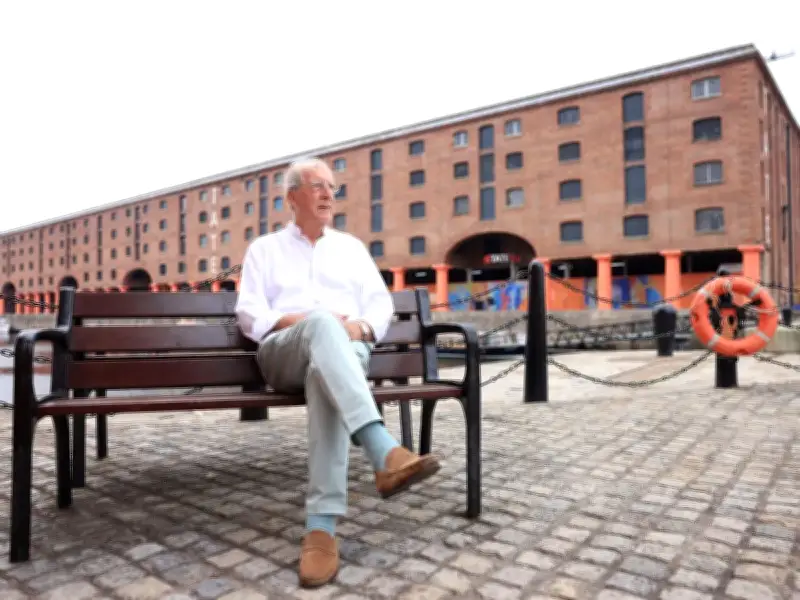
For most people, a visit to the Royal Albert Dock means a day out. It is somewhere to wander around the waterfront, visit a museum, stop for a meal, or watch one of the spectacular events that regularly draw thousands of people to Liverpool. But for Anthony Willats, it has been home for the past 20 years.
The 81-year-old moved to the Colonnades at the Albert Dock with his wife, Anita, exactly 20 years ago this August. Originally from London, the architect had spent years travelling and working abroad when he and his wife, who grew up in Toxteth, decided to swap their large North London home for an apartment to move closer to Anita's family.
From Overlooked to Beloved
They considered properties across Liverpool city centre but initially overlooked the Albert Dock altogether. Anthony told the ECHO: "We thought it was a bit cut off from the city, and it had a reputation for being full of footballers at the time, which was true. So we thought, 'Well, it's probably going to be really expensive as well'."
However, after struggling to find a suitable apartment elsewhere in the city, the pair eventually decided to take a look at what the docks had to offer, and they quickly fell in love. Anthony said: "Once we'd been here, there was no contest. This was it. We had to buy into this. I thought they were brilliant."
A Front-Row Seat to Liverpool's Big Moments
Anthony and his wife moved into the dock in August 2006, two years before Liverpool's year as European Capital of Culture. Since then, he has watched some of the city's biggest moments unfold almost on his doorstep. He said: "That's the other nice thing about Liverpool. All of these big events that happen, the city comes together. Everybody is happy to join in and have a good time for big events."
From the Capital of Culture celebrations and victory parades to the Giants and spectacular art installations, living at the Albert Dock has given Anthony a front-row seat for Liverpool's changing cultural life. One of the most memorable sights was seeing Luke Jerram's Floating Earth installation on the dock. He said: "Things like that are terrific."
Life Behind the Tourist Crowds
But while visitors see the Albert Dock as one of Liverpool's biggest tourist destinations, residents experience a rather different side to life there. Asked whether he ever forgets he lives in one of the city's busiest attractions, Anthony added: "We're not allowed to, simply by the number of tourists that come here. You sometimes have to develop sharp elbows to get through, because people are on a weekend away, or just off a ship, or just coming for a day out, so they're ambling around at their own speed."
Behind the crowds, however, is a residential community that many visitors may not realise exists. The Colonnades is home to 115 apartments, with some residents having lived there since the building was first converted in 1986. Anthony said: "There are a lot of full-time residents who are still happily living here, and then there are a small number who use their apartments as a pied-a-terre. So it's a very mixed community. You don't often meet people in the corridors, strangely enough, but you do come to know people around and spend time with them. And fortunately, we're in a good position here in that there are so many eateries around the dock that we can just step outside and have a meal with our friends who are also neighbours."
Water, Wildlife, and a Changing City
For Anthony, one of the greatest pleasures of living there is also one of the simplest, as each morning, he looks out across the water. He said: "You tend to look at the condition of the water, whether it's windy or not. You look at the water and the sky and see what sort of day it's going to be." His love of living beside water is something that has followed him throughout his life. Originally from Twickenham, he lived near the Thames and later spent six years in Chester overlooking the Dee, where he still rows twice a week.
The view from the dock can also bring unexpected encounters with wildlife. Anthony has watched a family of seven cygnets make their way through the water, while cormorants have become another familiar sight. He said: "They come in in squadrons. I've seen as many as 14 of them come in. They literally go across the dock in parallel with each other, and fish and fish and fish until they've taken what they want, and they go. It's extraordinary to watch."
Anthony has seen many changes to the area since he first moved to the city. He admitted that The Strand seemed like a "major barrier" at the time, while Liverpool ONE was still under construction. He said: "We didn't know how it was all going to turn out, but since that's all happened, we are much more connected. It's so nice to be central. It's dragged the centre of gravity of the city closer to the water."
In more recent redevelopments, as Tate Liverpool and the Maritime Museum undergo major transformations, Anthony believes the next chapter could bring another boost to the dock. He said: "I'm very happy that it's in the condition it's in now. I'm more than happy that the Tate and the Maritime are being reconfigured. I think the Tate is going to be wonderful. I've seen all the drawings, I've been in, had a look at the work they're doing, and I think that's going to be terrific. The fact that it's immediately on our doorstep is wonderful. And the same with the Maritime and Slavery Museum, I think the work that's been being done in there, is going to be really good. It gives the dock a new lease of life. I think to see the place revitalised by these two coming to life again will be terrific."
As the Royal Albert Dock celebrates its 180th anniversary, members of the public are being asked to share their personal photographs of the dock from across the decades. From the entries, 180 will be selected to feature in a permanent digital memory book and on a bespoke Dock Shorts projection at the end of September as part of an exciting grand finale event.