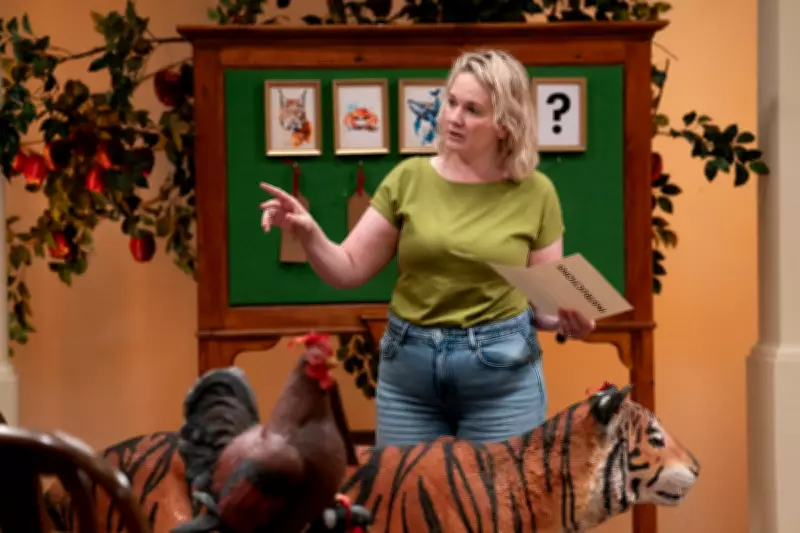
Secret Genius Exposes Women's Tendency to Underestimate Their Intelligence
The new Channel 4 hit show Secret Genius, hosted by Alan Carr and Susie Dent, has uncovered a striking pattern: women consistently and shockingly underestimate their own abilities. This revelation comes as the show searches nationwide for undiscovered intellectual talents through Mensa-designed puzzles.
Gender Disparity in Self-Perception
While the final episode features an even gender split of two female and two male contestants, the semi-final lineup was dominated by women, comprising two-thirds of participants. This contrasts sharply with Mensa's membership data, where self-selecting applicants are roughly 66% male and only 34% female.
Dr. Sonja Falck, a Mensa member and psychotherapist specializing in psychosocial issues related to high IQ, explains: "Statistically, men and women score very similarly on general intelligence. There is no substantial difference at all in average intelligence. However, there is a difference in distribution of specific abilities."

Confidence Gap in Action
The contestants on Secret Genius vividly illustrate this confidence gap. Ollie, an ambulance crew driver with a photographic memory, struggled with crippling nerves and only entered out of "morbid curiosity" about her intelligence. Sports management consultant Jo nearly lost a timed challenge because she couldn't believe she had answered correctly on her first attempt.
Finalist Amy, a pharmacist and mother of two, described her biggest weakness as "getting in my own way," with self-doubt stemming from childhood bullying. Her journey of overcoming mammoth self-doubt and growing in confidence has been one of the show's most poignant narratives.
Cultural and Psychological Factors
Dr. Falck identifies several cultural issues at play: "Culturally and historically, there's a huge slant towards favouring men in educational settings, seeing men as the ones who need investment in developing their abilities, because they are traditionally the breadwinner."
She notes that girls often receive messages to tone down their smartness because it might be perceived as unattractive or threatening in heterosexual relationships. This cultural conditioning contributes to what researchers identify as imposter syndrome, which affects approximately 70% of working women in the UK.
Research Supporting the Pattern
Research by Harvard Business School associate professor Katherine B. Coffman, published in 2024, supports this pattern. The study found that talented women are more likely to avoid applying for advanced, higher-paying positions because they fear they aren't sufficiently qualified. Meanwhile, men typically apply when meeting only 60% of job criteria, whereas women wait until they meet 100%.
Educational Achievements and Social Shifts
Ironically, women are now surpassing men educationally in many countries. In the UK, 13% more women than men pursue higher education, and 4% more men drop out during their first year. This educational gap is beginning to influence social dynamics, with "hypogamy" – women partnering with less-educated or less wealthy men – becoming increasingly common.
Emotional Intelligence as Both Strength and Limitation
Dr. Falck suggests that women's tendency to downplay their capabilities might itself reflect higher emotional intelligence: "Reading social cues and nuances, reading facial expressions – this can help them outperform men in situations where being able to correctly read a situation advantages their performance."
However, this sensitivity can become a disadvantage when women perceive disapproval or discomfort in others, causing them to hold back from demonstrating their abilities.
Transformative Impact of Recognition
For finalist Amy, participating in Secret Genius has been transformative: "I was good in school and all of that, but it was something I never really had the confidence to shout about. The imposter syndrome crept in."
Since progressing to the final, Amy has returned to university to pursue an independent prescribing qualification – a dream she had deferred for years. She hopes her journey will inspire her five-year-old daughter to believe in her own capabilities.

The show has reportedly been renewed for a second series, offering more opportunities to showcase unsung talent. As the saying goes, we cannot be what we cannot see. Secret Genius provides that visibility, encouraging more women to recognize that they might be the real secret geniuses after all.