Brummie Rapper Tony Bontana on Music as Catharsis for Grief and Genocide
In the aftermath of his mother's passing, Tony Bontana retreated to his studio apartment in Selly Oak, Birmingham, immersing himself in the creation of his album L'Humanité. Working through the night, he grappled with profound sorrow over manipulated gospel and quiet-storm loops, finding solace in the creative process. "I remember recording Sittin' on a Star (Freestyle), unable to get through a verse without crying," Bontana recalls during a London cafe interview. "It was literally all I could do. Writing and performing give me that instant outlet, and it really helped. It's vital to my survival, to be able to work through these emotions, to talk about them."
A Restless Creative Force
Bontana is an underground MC renowned for his emotional depth and vulnerability, a visionary beatmaker with a distinctive style who has produced tracks for US artists like Lil B and Billy Woods. His creative restlessness sees him fluidly shifting between genres, from hip-hop to punk, as his mood dictates. By 2024, with the release of L'Humanité, his Bandcamp page already hosted dozens of tracks and albums, each released almost immediately after completion. "Regardless of whether it was good or bad, because it's a journey," he explains. "Like, 'This is this, and the next thing will be the next thing; we'll keep on going.' It's precious to me, but I'm not precious over it." However, L'Humanité marked a departure, conceived as a cohesive body of work.
Musical Roots and Diverse Influences
Growing up in a household saturated with music, Bontana was exposed to his father's funk and Pat Metheny records, his mother's bashment and Anita Baker favourites, his sister's drum'n'bass, and his brother's allegiance to the Horrors and Enter Shikari. MTV introduced him to Missy Elliott, Busta Rhymes, and OutKast, but heavy music was his initial passion. "People didn't understand," he grins. "They'd be like, 'You listen to devil music!'"

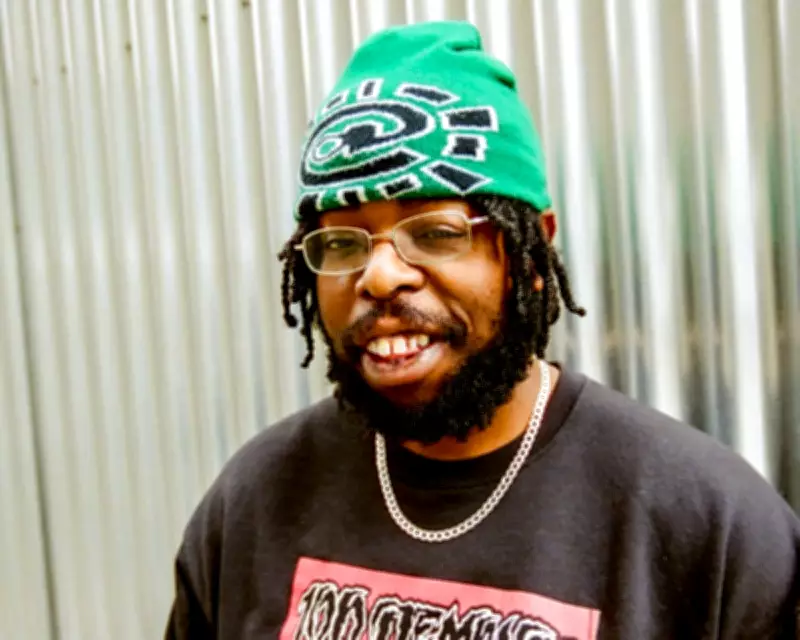
He began writing music early, picking up his first guitar at age nine after a hospitalisation for asthma and teaching himself to play. Today, alongside his hip-hop endeavours, he fronts the "grungegaze" group Pay the Stranger and the hardcore-punk band Spew, which he describes as "the outlet for my anger, the darker side of my emotions." One motivation is to demonstrate to Black youth that it's acceptable to embrace this music. "Seeing bands like Bad Brains, or Stout, or Suffocation," he continues, touching the graphic on his Suffocation t-shirt, "where there were Black guys in the band ... that was fuel for me."
Developing a Unique Sound from Birmingham
Bontana started crafting hip-hop after moving into an apartment above an office block, producing beats on his flatmate's MacBook. US outsider rapper Lil B served as a significant inspiration, showcasing artistic freedom. He established his own record label, Everything Is Perfect, and began releasing tracks via Bandcamp, developing a style he terms "splayed."
"Splayed is about vulnerability and honesty, genuine moments and genuine emotions," he elucidates. Early-2000s alt-rap pioneers Madlib and J Dilla are "the godfathers to me, for their unrestrained thought processes," though local influences also shape his work. "The music of Birmingham is undeniable: Black Sabbath, UB40, the Streets," he says. "I'd love to collaborate with Mike Skinner. And Birmingham hip-hop – when I was growing up, the Oddysee were amazing. But nobody knows about them."
The Oddysee's obscurity highlighted the challenges of building a career from Birmingham. "Things aren't set up like in London. There aren't the venues. Getting people out to see you is a struggle." Yet Bontana's determination remains steadfast, even as he manages his operation on a shoestring while balancing a day job as an assistant community manager. "I've got to make this happen from Brum," he asserts. "I've got to be the change I want to see in the world."

New Album and Broader Themes
His latest album, My Name, is his first pressed on vinyl and available in shops, another intentional release akin to L'Humanité (distinct from the eight or so albums and mixtapes released in between). This fully realised opus serves as Bontana's treatise on identity while continuing to explore grief and the genocide in Gaza, as heard on Soft Dreams where he declares, "I could never turn a blind eye."
"I'm not saying every artist should be writing protest songs," he clarifies. "But if we want a world where people can live in peace, we have to speak on those things, to get to that place." He emphasises that his intent is not to preach but to foster awareness and dialogue. "Witnessing the genocide has affected me, so I have to speak on it, the same way I have about my grief."
Catharsis remains central to Bontana's artistry. "I'll go to hardcore shows at the weekend, so I can be calm the rest of the week," he grins, before turning serious. "I've seen people go through the maddest shit and not even talk about it. I'm guilty of it as well. But the more I express, the more I'm honest about what I feel, the easier life is." My Name is currently available on Everything Is Perfect.