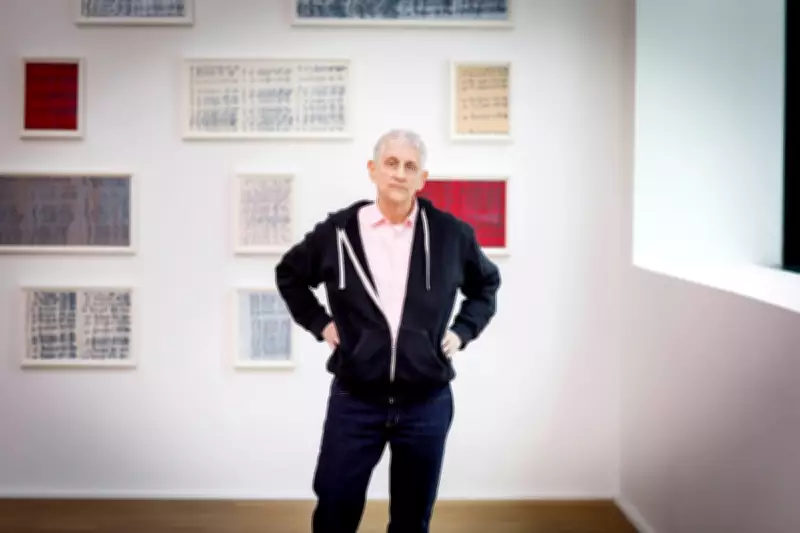
Roni Horn, the celebrated American artist known for her sculptures that blur the line between solid and liquid, has opened her first solo exhibition in London in a decade. Titled Seizure of Hope, the show at Hauser and Wirth on Savile Row features 76 graphite and wax pencil drawings repeating the phrase 'I am paralysed with hope', alongside a cast glass sculpture. The exhibition explores themes of horror, hope, and the absurdity of modern life, particularly in the context of what Horn calls the 'downfall of America'.
A Turbulent Journey
Horn, 70, recently experienced a bizarre incident on a flight from the US to Germany. A male steward, irritated by her polite refusal to adjust her seat further, had her removed from the plane before takeoff. She was escorted off by police, an event she recounts with characteristic dark humour. 'I was in business class, just for context,' she says. The incident led her to cancel part of her European trip and fly directly to London for her exhibition.
The Drawings: An Endless Silent Scream
The drawings in Seizure of Hope are rendered in very soft graphite and wax pencil, with the phrase 'I am paralysed with hope' repeated across the gallery walls. Horn describes the work as 'an endless silent scream feeling', inspired by a line from comedian Maria Bamford's 2020 routine. 'It started around the time of the political downfall of America,' Horn explains. 'I'd come home at night and this quote stuck with me, I couldn't get it off me. It was like that scene in Alien when the Facehugger gets stuck to John Hurt's face.' The drawings are smudged and varied in style, reflecting Horn's own admission that her handwriting has always been 'atrocious'.

Repetition and Ambiguity
Mirroring, doubling, and repetition are constants in Horn's work. The uneven gaps between the frames create lacunae where meaning slips and falters. Horn rearranged some frames at the last moment, emphasising the intuitive nature of her installation. 'Things do have their scale, though that's been heavily distorted in contemporary culture where bigger is better,' she says. 'This feels like a significant number, but it isn't wallpaper.'
The Glass Sculpture: What Happens to the Hole When the Cheese is Gone?
Alongside the drawings, Horn presents a solid cast glass sculpture that resembles a large, clear ice cube. The title is borrowed from Bertolt Brecht: What Happens to the Hole When the Cheese is Gone? Horn laughs at the idea of a disappearing hole. The sculpture, made by pouring molten glass into a mould that hardens over months, is a perfect articulation of her insistence on staying in the unknown. Glass, a liquid that appears solid, embodies ambiguity. 'The title is a nudge, not a sledgehammer,' she explains. 'Humour is very important to me.'
Political and Personal Reflections
The exhibition is deeply rooted in Horn's experience of Trump's America and the erosion of values. 'When you feel all your values are being eroded, and of all the things affected by that erosion, in my case, weather and nature, you never stop thinking about those things,' she says. The drawings became a way to find a zone less oppressive than 'just breathing the air'. Horn also reflects on the toxicity of recent years, including the discovery of PFAS plastics in rainwater, which she says has taken away the ability to make choices based on knowledge.
A Glimmer of Optimism
Despite the horror, the exhibition contains an essential glimmer of optimism. Horn recounts a story of driving off the road in Iceland and landing in a lake on her motorcycle. 'It was so shocking – the motorbike was still running. So I just drove out of the lake, but it was traumatising. I spent the night being traumatised by this memory but what I focused on was that this was just the most mundane act.' She concludes: 'With all the trouble that I've had, I feel very lucky. And I always take my luck personally.'
Seizure of Hope by Roni Horn is at Hauser and Wirth, London, until 1 August. A book of the same title is out now.