When Sally Wainwright's series Riot Women burst onto screens last autumn, the overwhelming critical acclaim was punctured by a few questions about authenticity. 'There is a fascinating TV series to be made about a menopausal rock band – Riot Women isn’t it,' opined Tiff Bakker in the Guardian, denigrating the fictional group as a 'bunch of middle-aged punk rockers who, until now, seem to have heard of only Abba'.
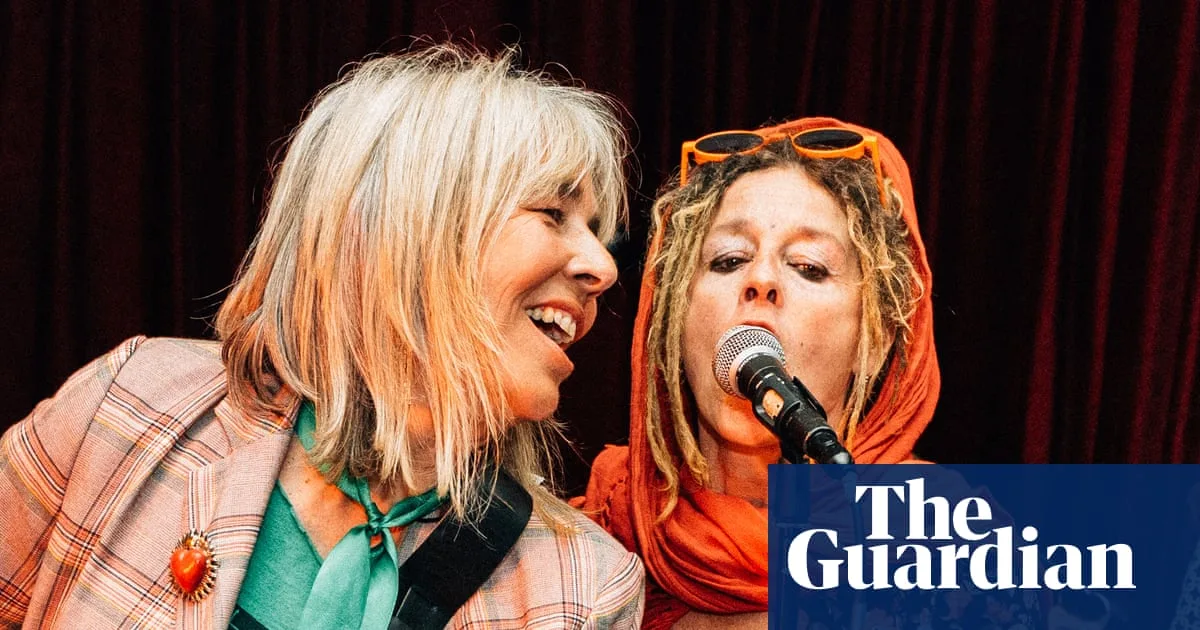
If Wainwright needs inspiration for the second series, she could do worse than head to south Wales to meet the real life version of the Riot Women. The NaNaz are a six-piece punk band formed last year by a group of women in their 50s and 60s. Their repertoire of songs tackles everything from unaffordable care home fees, to male attitudes towards older women, to the frustrations of recycling. And they are possibly the only band to have ever been featured on both the homepage of guitar.com and a poster campaign for Age Cymru.

I meet the NaNaz in the bat-cave gloom of the Cab, a hardcore punk club in Newport. Recent headliners include Murderburgers, Pizzatramp and Siberian Meat Grinder. To my uninformed eyes, this reads like a menu from the takeaway from hell, but it was within these walls that the NaNaz story began.
'After the first episode of Riot Women was on TV, loads of people got in touch with us, all saying: this is old news – you lot are already doing it,' says Anne-Marie Bollen, 60, bassist, vocalist and a former community nurse. Bollen had seen an advert on social media for 'Nana Punk' workshops at the Cab, which invited women over 50 to come and experiment with instruments and performing. 'It said no experience necessary, no instruments required, and it was on Sunday afternoons. So I thought, I’m going to give this a go,' she says with a grin.
A miner’s daughter, Bollen grew up in south Wales and as a misfit teenager was inspired by the first generation of female punk musicians. 'I used to love X-Ray Spex, Pauline Murray of Penetration, Siouxsie Sioux. I’d been in choirs and I always loved singing. Later, I was a backing singer for a local band. But I was never confident enough to perform on my own. I was too worried about being any good.'
The Nana Punk project was the brainchild of Jude Price, a community outreach worker and musician who had suffered from a stroke. She had experienced first-hand the isolation endured by many older women, particularly when faced with chronic ill health or care-giving.
'We like to write and perform songs that tell the truth about things we feel really strongly about,' says Bollen. The band’s first single was 60 Lies, a song in support of the Waspi women’s pension inequality campaign. OK, so a punk song about pensions might not immediately seem like an obvious choice but it sounds like a bona fide angry anthem, with beautiful B-52s-type harmonies.
You could be forgiven for fearing that a random and unpracticed group of ageing punks might sound dire, but you would be wrong. This is doubtless because they are all longtime music fans, several of whom have learned to play their instruments along the way. Deborah de Lloyd, the band’s viola player, has been playing since the age of eight. Not to mention that they are all fizzing with ideas and opinions and bring a wealth of life experience to the party.
Lead guitarist Ange Pearce, 62, grew up in Newport always surrounded by music. Her father was a jazz drummer who taught her to play from the age of three. She left school without sitting her GCSEs and signed up for a Youth Opportunity Scheme to work at the local Spar supermarket. 'As soon as I got my first wage packet, I rushed out and bought my first acoustic guitar.'
With her sharp haircut and confident swagger, Pearce looks the part but she admits that in punk’s heyday she was a devoted Elvis fan. That is, until she discovered Yazoo. 'I thought Alison Moyet’s voice was amazing, it changed everything. After that, I met my first partner, a woman, and we set up our own businesses. She had a plumbing shop, and I had a newsagent next door.'
When that relationship ended, Pearce threw herself into making a success of her business. But life was lonely. 'I was working all hours and never went out. I’d just bought a computer and a friend showed me this site GaydarGirls. This was before dating apps. There was hardly anyone online that first night, apart from this one little light in Texas. That was Liz.'
Within months, Liz moved from Austin to Newport and the couple have now been married for 18 years. Eventually, a major supermarket opened nearby and Pearce’s shop was forced to close. After that she bought an ice-cream van, which she worked in for a time. 'I gave it up,' she says. 'Probably just as well – I was giving away too many free cones to the kids who couldn’t afford to pay,' she adds with a laugh. Since then, she and Liz have been foster parents to 36 children. Although rewarding, the experience can be unpredictable and intense. Meanwhile, Liz is recovering from a stroke. The NaNaz has offered a welcome respite, and her eventful life will provide enough material for dozens of songs.
'From the start, I absolutely loved the community,' says Pearce. 'We started writing lyrics and that’s where I collaborated on my first song, Idiots Everywhere.' The result is a scathing but melodic love letter to Newport town centre.
For several of the women, the opportunity to play music came at the perfect time. 'I had hit a point in my life where I was leaving everything,' confides Marega Palser, 60, a former theatre performer, now multi-instrumentalist and vocalist in the NaNaz. 'I don’t know if you’d call it a breakdown, but I had lost a lot of things that had been stable – my relationship, my home, my studio. I’d also been working too much and was burnt out. I’d always worked in theatre but even that didn’t shine for me any more.'
The first workshop she attended was run by Cassie Fox, founder of Loud Women, the community that advocates for more opportunities for women and non-binary musicians. 'It was fantastic and I never looked back,' she says.
After a turbulent childhood, Palser discovered punk at the age of 11. 'It was something I could relate to strongly. In a funny way, although there were amazing female role models – bands like the Slits, the Raincoats and Kleenex – it also felt genderless. It felt to me that women back then were standing equally with men when it came to performing. Everything was about being anti-establishment, anti the status quo. It was very attractive for someone who felt that they did not fit in in any way.'
She started frequenting a punk pub owned by a friend of her parents. 'I got exposed to so much – musicians, people doing drugs, people sniffing glue. I think that’s why I never had kids because I could not cope with having to bring a child into the world, knowing what I used to be like myself. I had lived a lot. By the time I was 14, I felt ready to leave home.' In fact, she hung on until she was 16 and successfully applied to train with the London Contemporary Dance School. 'My audition piece was set to Bela Lugosi’s Dead by Bauhaus!' She cackles at the memory.
The experience of dance school was highly competitive and put her off the industry. Instead, she worked in experimental theatre and eventually returned to Cardiff to study art and build a career as a performance-based artist.
Palser has relished the opportunity to perform live with a group of women of a similar age. 'The thing about menopause is you are being chemically rewired, so of course you’re going to start experiencing the world in a different way. That might mean feeling withdrawn sometimes, but it is also amazing to balance it out with something like playing music which allows you to create this magical, spontaneous energy between you, other performers and an audience.'
The NaNaz, which formed out of the Nana Punk workshops, have no manager, no record label or PR agent, yet are booked solid at clubs and festivals every weekend until the end of the year. The band crossed my radar via the documentary-maker Laura Martin Robinson, who is filming a BBC Our Lives episode about the women.
Some band members are still struggling to comprehend the speed of their evolution. 'I’ve never had any urge to perform – I signed up for the workshop because I like novel experiences,' says Claire Symons, 52, who plays rhythm guitar. A former actors’ agent from Devon, she now lives in Newport with her husband and 16-year-old twin daughters.
Within weeks of Symons picking up a guitar for the first time, Nana Punk had booked her in for a gig at the Hope and Anchor in London. 'I told them, “No way, you’re mad!” I only knew two chords at that point,' says Symons. 'Then the next idea was: let’s start our own band. I said I’d join but on condition that I wouldn’t go on stage. Then somehow we had our first booking, which was to play at Anne-Marie’s 60th birthday. I thought: that’s not too scary. Except it turned out there were 80 people in her garden.' Symons has since written her first song, Harness the Darkness, which is surprisingly upbeat given that it’s about the unreasonable anger one can suffer during menopause.
She believes that a large part of the band’s appeal is the way they relish spontaneity and fun. 'Younger women especially seem to really like us. Maybe it’s because everything they see on social media is all about being perfect. They are inspired by seeing a show where they can watch older women making mistakes and just laughing about it and carrying on.'
Perhaps the most moving story about the life-changing magic of joining a band comes from the 'baby' of the band, 29-year-old replacement drummer Jade Ball. The band’s previous drummer, Nina Langrish, 65, left to go travelling in Thailand but still makes occasional appearances on the maracas. After gaining a masters in music therapy, Ball worked for many years as a professional musician. However, she has not had an easy ride.
At 18 she was diagnosed with a neurological condition called 'essential tremor'. 'That meant I had to relearn how to play the drums all over again,' Ball said. 'And then I contracted Covid and that ended up triggering a heart condition. For a year, I wasn’t sure if I’d ever be able to drum again. Fortunately, doctors found medication that at least helps to bring my heart rate down.'
Last year, Ball was in and out of hospital seven times. 'So I was in a weird state of mind when I got the call that the NaNaz needed a drummer. But I thought: even if this never goes anywhere, I might actually get a group of women I can hang out with. I’m not an outgoing person and I usually get along much better with people who are a lot older than me.' It wasn’t easy finding a replacement for Langrish who was based in south Wales, available to attend far-flung gigs, and physically strong enough to play full sets of loud, fast drumming.
One testament to the band’s impact is the number of women who approach them after gigs. 'For every person who says they loved us, and that they left with a big smile on their face, there’s another who will tell us that we’ve inspired them to pick up a guitar or write a song,' says Symons. 'And I think that is the whole point. Our job is not to get everyone to follow the NaNaz around. It’s to get them to realise: oh, I could start a band too. Fuck it, let’s do it.' Which, let’s face it, is the most punk idea ever.