Jonathan Blow, creator of Braid and The Witness, returns with Order Of The Sinking Star, a puzzle game so vast it contains more than 1,400 puzzles and reportedly takes more than 500 hours to complete. This is not the first time this year that a game's sheer scale has seemed incomprehensible, but here the volume is matched by exceptional quality and variety.
It has been 10 years since Blow's last major game, The Witness, yet Order Of The Sinking Star makes that gap seem trivial. Blow is best known for Braid, a seminal indie title with time-based mechanics, and The Witness, which centred on formalised grid-based conundrums. This new game offers much more variety, with four distinct puzzle types, all taking place in small, single-screen areas and involving sliding block puzzles to some degree.
A return to classic puzzle mechanics
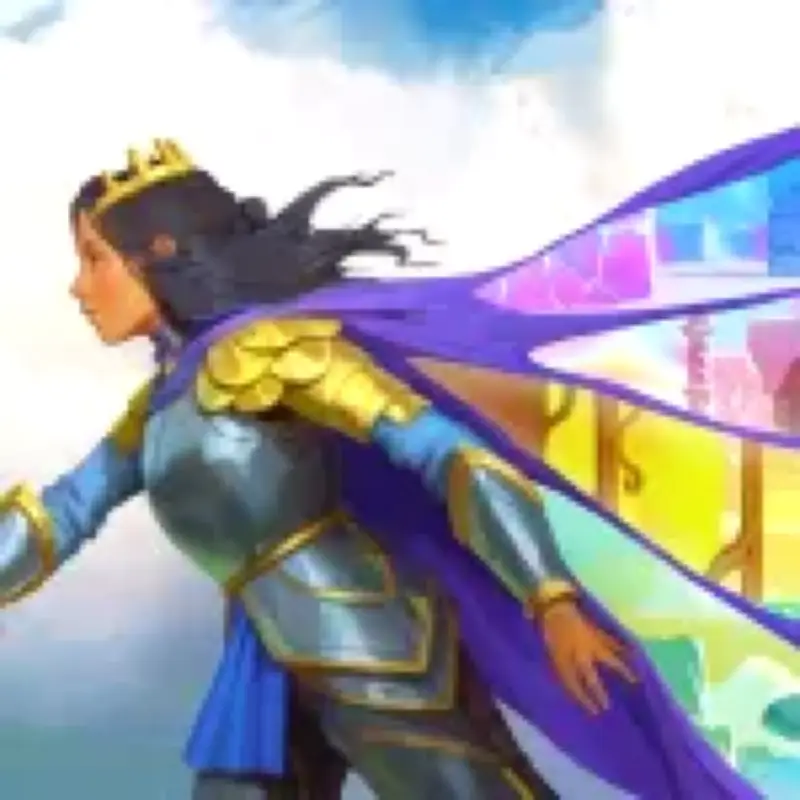
Sliding block puzzles date back to 1981's Sokoban, originally a fan-made indie game, and Blow has cited it as an inspiration. Order Of The Sinking Star has puzzles within puzzles, beginning with the setting and the identity of the character you control. You play as a cloaked, crown-wearing noble, seemingly as confused as the player, while audio recordings hint at interdimensional travel.
The game has a complex story with many characters and lots of spoken dialogue, but this is its weakest element. The script is verbose, and context for conversations can take a long time to emerge. The overarching plot does become clearer and deals with interesting subject matter, but the story's obscurity can be unnecessarily distancing. It can be ignored entirely, as the only essential knowledge at first is that the worlds to the West and South are considerably more difficult than those to the North and East.
Four worlds, four puzzle styles
The North area is the easiest of the four puzzle types and revolves around pushing blocks, usually crystals or rocks, to reach an exit. You start with three characters, each with distinct abilities: one pushes, one pulls but is forced to do so automatically when passing a block, and one swaps places with anything he looks at. More characters are added as you progress, including one immune to damage and another who can turn plants into rocks, but they never appear all at once, only in different combinations.
In the East, puzzles revolve around mirrors that teleport and clone you, quickly becoming extremely difficult. The whole game uses a grid-based map system, so positioning to push objects is a constant challenge. To the South, puzzles involve skipping stones across water and negotiating water flows, with connected maps rather than separate overworld puzzles. This emphasises that the game is really four games in one, each with its own rules and format. Eventually, the puzzle types cross-pollinate, combining mechanics and characters for even more variety.
The fourth world, to the West, is almost impossibly difficult from the start, even though it is the closest to a Zelda dungeon, with moving enemies and devices that let you phase through walls and destroy boulders. At any time, you can have dozens of puzzles to tackle, as the overworld also has its own puzzles, so a complete impasse is rare.
No hints, but immense satisfaction
The real sticking point is the lack of a hint system. There are subtle and clever hints of new mechanics in the overworld and the puzzles themselves, but you can never ask the game for help. Solutions will likely fill YouTube shortly after release, but the review process offered no such aid.
Despite the lack of hand-holding and the pretentious storytelling, what stands out is the sheer quality and variety of the puzzles. The rush of completing a puzzle is immensely satisfying. Order Of The Sinking Star could easily have been a quarter of the size and still be one of the best puzzle games of all time. The fact that its pleasures are almost without end makes it even better and, apart from anything else, the best value game of the year.
Order Of The Sinking Star review summary
In Short: An incredible achievement in terms of the volume and quality of puzzles, with a huge amount of variety and a reward around every corner.
Pros: Extremely well-designed puzzles and an impressive amount of variety, even when using similar mechanics. Subtle visual clues make solving puzzles on your own more rewarding. Huge volume of content.
Cons: The lack of any hint system will definitely frustrate some, although it'll be less of a problem post-launch. The dialogue can seem very pretentious and distracting.
Score: 9/10
Formats: Nintendo Switch 2 (reviewed), PlayStation 5, and PC
Price: £26.75
Publisher: Arc Games
Developer: Thekla, Inc.
Release Date: 8th October 2026
Age Rating: 3