Montpellier Danse Festival 2024: A New Era Under Four Directors
Launched in 1981, the pioneering Montpellier Danse festival transformed contemporary dance in France and globally. In 2024, the festival entered a new chapter when long-time director Jean-Paul Montanari was succeeded by a four-person directorship comprising Hofesh Shechter, Jann Gallois, Dominique Hervieu, and Pierre Martinez. Despite the leadership change, the programme continues its ethos of spreading dance across the city, mixing the recherché with the popular.
Imminentes: A High-Voltage Performance for Six Women
Jann Gallois' Imminentes targets a general audience with a one-hour dynamo for six women. The piece is never abstruse and always striking, if not always subtle. Its signature device, the long build-up, starts immediately: the women lean into each other in tender pairs, gradually melding into a dynamic and increasingly mobile group, bonded by linked arms and synced energies. A crescendo of sound and a bank of lights that glows as if powered by the dancers' voltage accompany them.
Some scenes shift tone: convulsive, isolated solos caged within a cone of light; an almost machine-like sequence of whipped arms and pumped torsos; a lineup where gestures suggest cleansing or purging. The overall feel is of fierce women working vibrantly together, burning through their own energy. If it sometimes gets a bit blockbuster—more stimulant than substance—it also captivates its audience.
Le Pas du Monde: Concrete Physical Poetry
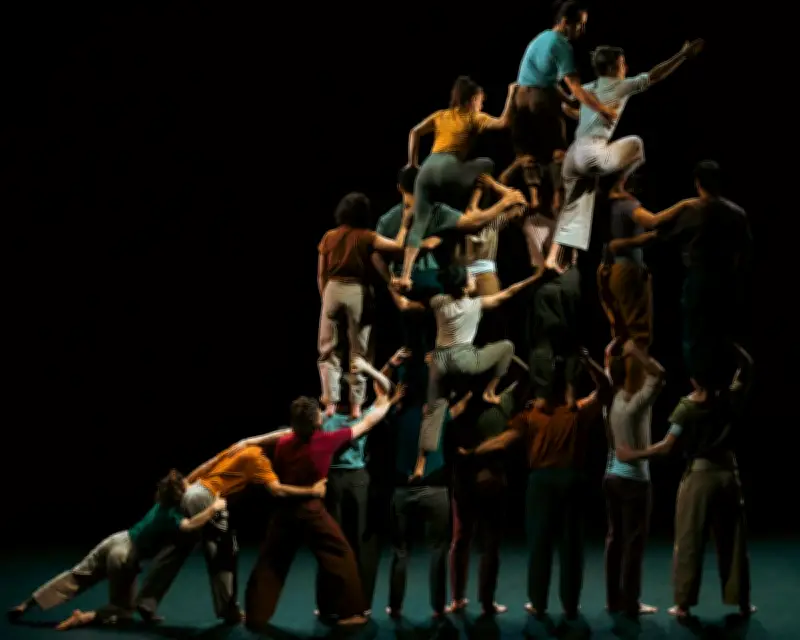
Landing in a sweeter and deeper spot is Le Pas du Monde by Collectif XY, a large-scale circus company that reached a vast audience via the 2024 Paris Olympics opening ceremony. The performance is spectacular—human towers, vertiginous dives, headlong tumbles, breathtaking aerial flips and catches—but never just spectacle.
The opening section's spires of bodies are impressive achievements, evoking a sense of people collectively reaching for the sky and the ephemerality of such earthbound aspirations as constructions are undone or topple. Another scene, where performers carry others on their shoulders while others lie on the floor, is both physical and metaphorical: we support some people while stepping over others. The imagery goes beyond the human, featuring surreally segmented creatures, a forest-like scene, and actions that feel windblown or sea-tossed. The piece becomes a kind of concrete physical poetry that touches both body and spirit.
Tempest and Twama Paradise: Baffling and Human Works
Every contemporary dance season has baffling works, and Montpellier is no exception. Tempest by Belgians Lisbeth Gruwez (dance) and Maarten Van Cauwenberghe (music) begins with Gruwez slicing around a glacial stage like a battery-powered toy to persistent drumbeats. It ends with a stunning set-piece of flashlights, rotating shadows, and saturated sounds that demand surrender, even if understanding remains elusive.
More human in aim, scale, and story is Twama Paradise by Tunisian-born, French-raised Héla Fattoumi, a duet with Tunisian actor-dancer Sondos Belhassen. Recalling scenes from their separate but parallel lives, it presents the two ageing women as twins, accomplices, rivals, ghosts, or reflections. Melding Arabic chant and French chanson, undulating curves with balletic lines, it avoids simplistic cultural references to build a nuanced portrait of lives twined through popular music, design, womanhood, ambition, and ageing. A mature work on many levels.
Montpellier Danse festival runs until 4 July. Sanjoy Roy’s trip was provided by the festival.