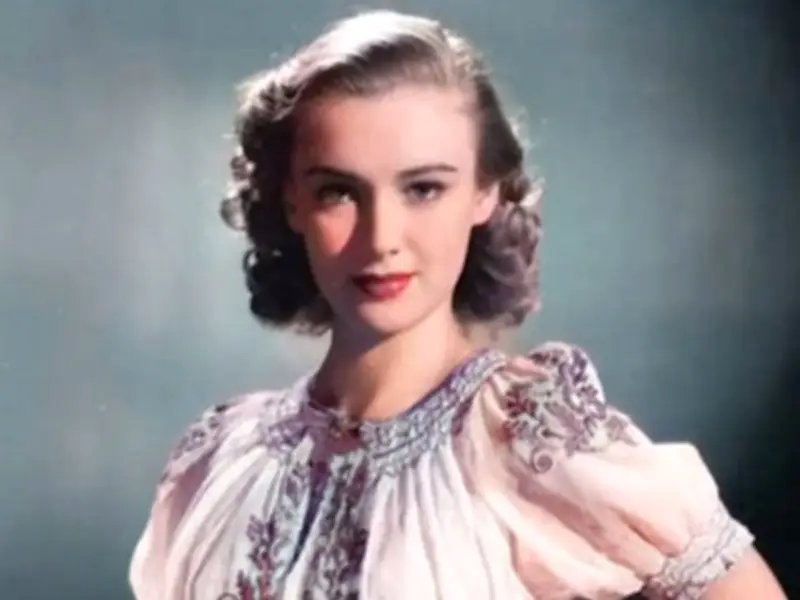
British actress Susan Shaw, who rose to fame in the 1940s and 50s, died penniless and alone in 1978 after a battle with alcohol addiction and depression that reportedly began following her husband's tragic death in a car crash.
Susan Shaw, whose real name was Patricia Gwendoline Sloots, had risen to prominence after starring in a series of iconic British films, television shows and acclaimed musicals. So bright was her star that in April 1951, in a poll of 2,000 Daily Mail readers, the young performer ranked as one of Britain's most popular actresses of the time.
Susan was born in London's West Norwood and came from humble beginnings. The Norwood Society reports she lived at No 6 Hamilton Road with her family, right above a hairdresser's shop in a small row of terraced houses.

Early Dreams and Career Beginnings
From a young age, Susan had dreams of becoming an actress and making it big. She struggled to find her footing initially, as she recalled in an article in Picture Parade, Film Annual 1950: “As I travelled up to London (to work) every day from my home in West Norwood, I used to read every film magazine I could lay my hands on. I was mad about cinema, but not about my work.
“I wanted something romantic, something glamorous, but had to comfort myself reading the success stories of others who’d risen from humble beginnings like me. Little did I realize that, within a year or two, I myself would become a star of British pictures! It all seems like a dream.”
Susan's acting career began shortly after World War Two came to an end, with the actress bagging parts in musicals like Walking on Air and London Town. She also managed to secure small supporting roles in films like Holiday Camp and The Upturned Glass at the start of her career.
Rise to Fame and Notable Roles
Her rise to fame began after she was signed on by The Rank Organisation, and the company ultimately paid for her funeral costs as the actress was virtually destitute at the time of her death.
Susan's most notable role came in the smash-hit film It Always Rains on Sunday, and the movie was reportedly one of the 'biggest winners' at the British box-office in 1948. She also bagged lead roles in films like To the Public Danger, It's Not Cricket, and Marry Me, and was part of the star-studded ensemble cast of Train of Events. Susan also famously appeared in the Carry On film series' second outing, Carry On Nurse.
By this time, Susan Shaw found herself as one of the busiest young actresses in Britain and began to receive plenty of coverage in the press.
Tragic Fall from Grace
She also had the lead in the movie Pool of London, in which she starred alongside her future husband, Bonar Colleano, whose untimely death would ultimately be the cause of her downward spiral and tragic fall from grace.
The South London actress married Bonar in 1954 and they had a son together, Mark. Bonar was her second husband, after Susan's first marriage to Albert Lieven ended in divorce the previous year. She had a daughter, Anna, from her marriage to Albert.
Bonar admitted in May 1958 that he led an 'extravagant' lifestyle, and the actor had a debt of nearly £10,000 due to it. On August 17 that same year, Bonar was tragically killed in a high-speed car crash. Susan was devastated after her husband's death and started drinking.
She reportedly began drinking heavily and became depressed, and unable to care for her son because of her battle with alcoholism and deteriorating mental health, she gave him up to his paternal grandmother to raise. Tragically, Susan struggled to improve her situation.
She married for a third time in November 1959, tying the knot with television producer Ronald Rowson, and just a year later, in November 1960, her third marriage officially ended.
Susan found herself impoverished and living alone in London's Soho, and eventually died at the age of 49 in Middlesex on November 27, 1978, due to cirrhosis of the liver. The once iconic British actress was cremated at Golders Green Crematorium in North London.
After her passing, her friends were reportedly going to pay for her funeral, however, the Rank Organisation stepped up and bore the costs instead. A Rank spokesperson said at the time: “When we heard of the circumstances of her death, we felt it was the least we could do.”

Charlie Stevenson, landlord of the Swiss Tavern in Old Compton Street, said: “She came in here every day. They say she died of cirrhosis of the liver and she lived next door to prostitutes in Soho. But this is Soho. We all live next door to prostitutes.
“We loved her and we weren't going to see her buried in a pauper's grave. Now we shall give the money to medical charities.”
Having risen to fame from a working-class South London background, Susan's story is one of great highs and lows, and the popular British actress is remembered fondly for her work.