Richard Dadd's 1853 Portrait of a Young Man depicts a figure with unkempt hair and ruffled clothes, hands nervously clasped on a twisted wooden bench amid lush greenery. The subject is likely Dr Charles Hood, superintendent of Bethlem Hospital, yet Dadd portrays him as frail-seeming, suggesting the fine line between sanity and madness.
Dadd crossed that line when he murdered his father, whom he believed was the devil, and attempted to kill a stranger while fleeing to Paris. He spent the rest of his life in Bedlam and Broadmoor. The Royal Academy's exhibition, Beyond Bedlam, urges viewers to see him as more than a "mad" artist—he was already remarkable, with fairies as his hit theme.
Early Fairy Paintings
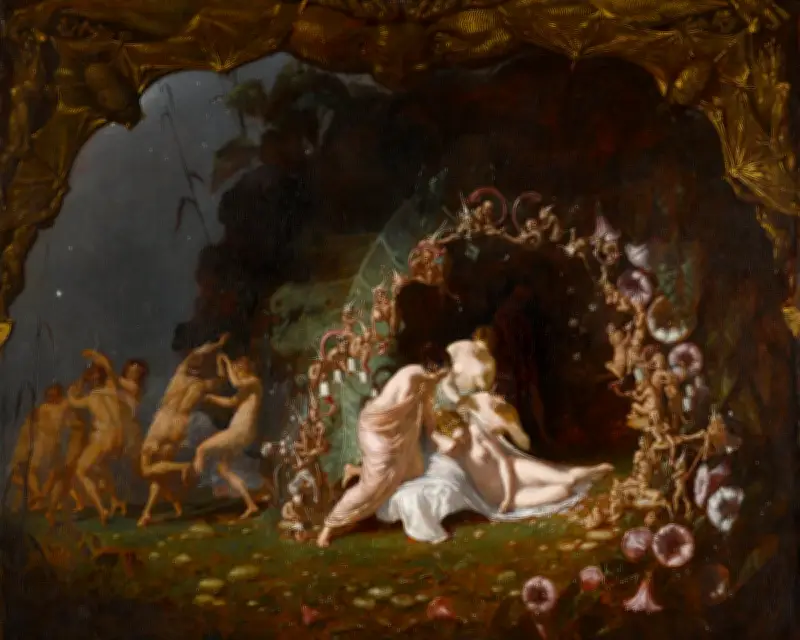
Dadd's fairies are not Disneyfied but drawn from British folklore, sinister and destructive as in Shakespeare. His early Puck shows the sprite as a giant baby bathed in moonlight. In Titania Sleeping, nude female fairies are glimpsed through parted curtains of bats. The Haunt of the Fairies features a female fairy—or naked woman—gazing at the viewer against trees in a red twilight landscape.
After a trip to the Middle East, where he filled sketchbooks with mosques and ruins, Dadd's paranoia worsened, leading to murder. His promising life cracked open.
Asylum Masterpiece
In Bedlam, his fairies became brutally different. The Fairy Feller's Master-Stroke, painted over nine years, disobeys pictorial rules. Tall strands of grass, daisies, and dock leaves block the view, forcing the eye through a tangle to see fairy society. Tiny folk gather to watch the strongest fairy raise his axe to fell a horse chestnut for Queen Mab's coach. The fairies are not beautiful: two have oversized legs; one has a bald blueish head. The painting is presented with conviction, as if showing fairies as natural history specimens.
Dadd became a great and modern artist in the asylum, overthrowing rules and reaching for unsettling truths akin to Manet and Whistler. Within the asylum, he saw nature afresh, painting flowers and weeds with savage reality. In Bacchanalian Scene, ecstatic faces peer through eerie vegetation.
When moved to Broadmoor, his passion for nature was unleashed again. Late watercolours, from fantastic fruits to an imaginary harbour for the hospital theatre's drop curtain, have an ethereal, profoundly sad beauty.
The exhibition includes some duller works, as if to prove not everything he did was charged with genius. But Dadd cannot be turned into a mainstream artist who just happened to be in an asylum. His life was pitiable and painful, yet he cut through the weeds to see monstrous tiny creatures and ecstatic revels that others couldn't.
Richard Dadd: Beyond Bedlam is at Royal Academy, London, from 25 July to 25 October.