There’s been a lot of chat recently about the state of musical theatre in Australia, much of it serving up late-capitalism doom and gloom. Several high-profile shows – Annie, Back to the Future, Beetlejuice, Waitress – have either closed early or cancelled the remainder of their national tours, casting a pall over the profession and potentially spooking future investors. But are we really in the death throes of an industry – and if so, why are there so many terrific homegrown productions on offer?
Grey Gardens shines as a small gem
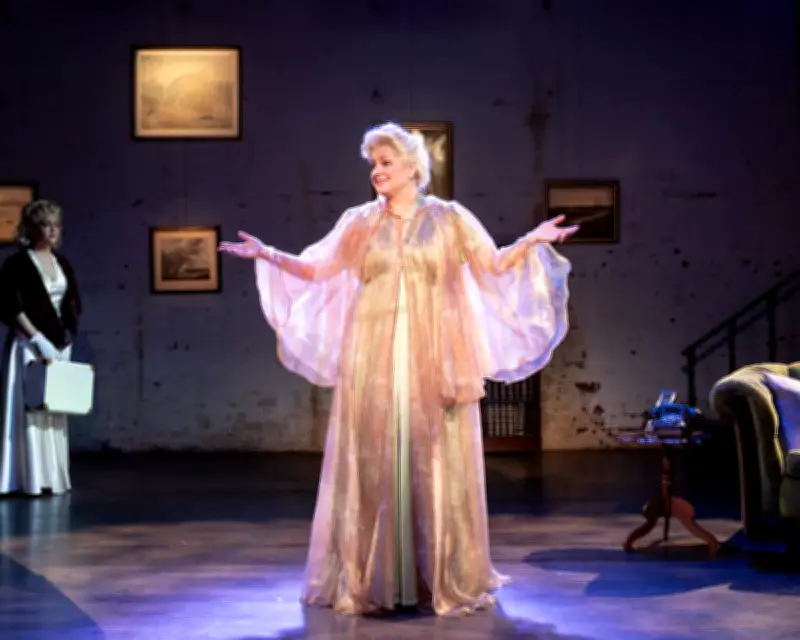
Grey Gardens, which opened Sunday night at Melbourne’s fortyfivedownstairs, is a case in point. Adapted by Scott Frankel and Michael Korie from a 1975 documentary about a reclusive mother and daughter living in squalor in a crumbling, cat-infested house in the Hamptons, the musical received mixed reviews when it debuted off-Broadway in 2006. Time has been kinder to the show than it was to its protagonists and it now glows like a rare gem, in a production that fully mines its wit and tragic impulse.
Tyran Parke directs with a granular attention to detail and sensitivity to the musical’s intricate effects, marshalling a uniformly excellent cast that includes David Hobson and Deidre Rubenstein – led by an extraordinary Helen Dallimore in dual roles as Edith Bouvier Beale in the first act and her emotionally trapped daughter Little Edie in the second. In fortyfivedownstairs’ intimate setting, each chord is considered, every phrase adds texture and emotional resonance. This is musical theatre as a profoundly moving chamber ensemble, rather than a crass commercial juggernaut.
Broader industry challenges
Which is not to say that all musical theatre needs to be serious, sombre or small scale. A healthy industry should be able to support populist work alongside deeper fare, and large-scale producers like John Frost and Michael Cassel generate huge volumes of work for artists, technicians and venue staff alike. When a big musical closes early, thousands of people are affected; dark theatres are like rotted teeth in a city’s otherwise dazzling smile, a blight on our cultural landscape.
Exactly who or what is to blame for the recent closures is hard to diagnose. Producers have cited the astronomical transportation costs as a major factor, perhaps unwilling to blame audiences’ increasing reluctance to pre-book. Industry-wide fixes are even trickier to identify; the Media, Entertainment and Arts Alliance (MEAA) has called for urgent, coordinated federal government intervention, whether that be in the form of tax concessions, government grants or “cultural passes” akin to those seen in France and the UK. All of which would be hugely welcome.
Global crisis and local resilience
But the crisis in musical theatre isn’t a uniquely Australian one; it may even be caused by conditions overseas. We may prefer to forget, but Covid’s global impact on the performing arts was devastating and is ongoing, shutting down the kind of development crucial to the art form. Musicals need two key things before they’re ready for audiences: development capital and artistic momentum. The complete cessation of these things has led to a dearth of quality musicals coming through the pipeline, so there are simply fewer of them available.
Broadway is itself reeling from recent closures – Andrew Lloyd Webber thinks it is in “dire danger” after his acclaimed queer reimagining of Cats announced it would close despite having just won three Tony awards – and the UK’s West End seems to rely increasingly on vacuous celebrity casting. If it’s true that things are dying, they are dying all over and not just on local soil.
And yet, Australian creatives continue to mount finely considered musicals and audiences continue to flock to them. The recent success of entirely homegrown shows like Mathew Frank, Sheridan Harbridge and Dean Bryant’s My Brilliant Career, or Queenie van de Zandt and Tiffany Noack’s Middle Raged (has there ever been a greater title for a musical?) prove Australians can create and produce work of rigour and relevance.
Audiences and ticket prices
Certainly, younger generations embrace musical theatre just as enthusiastically as we have in the past, and the world-class standard of performance in this country remains undiminished. We are ostensibly living in recession times, and given the theatre is the very definition of discretionary spending, we shouldn’t be surprised if audiences become more cautious. Ludicrously high ticket prices don’t help one bit.
The last thing producers should do is panic. As budgets tighten, there’s a temptation to conservatism and risk aversion, which explains the current proliferation of musicals adapted from teen films of the 80s and 90s. Some of these are ingenious – I would argue Eddie Perfect’s Beetlejuice justified its translation to the stage by the strength of its own vision – but most are trashy and exploitative. Often written by film-makers with no theatre background and zero understanding of the craft, they’re designed as dopamine hits of nostalgia, forgettable even while you’re watching. Most of them deserve to fail.
Grey Gardens is the opposite of this, an example of adaptation led by complexity, conviction and high degrees of artistry. Leaning away from the camp inherent in the material, this musical deepens and enriches its source rather than plundering it for easy cash. If theatre producers become lazy and cynical, they can’t then blame their audiences for following suit.
And good luck procuring a ticket to Grey Gardens – it’s already virtually sold out!