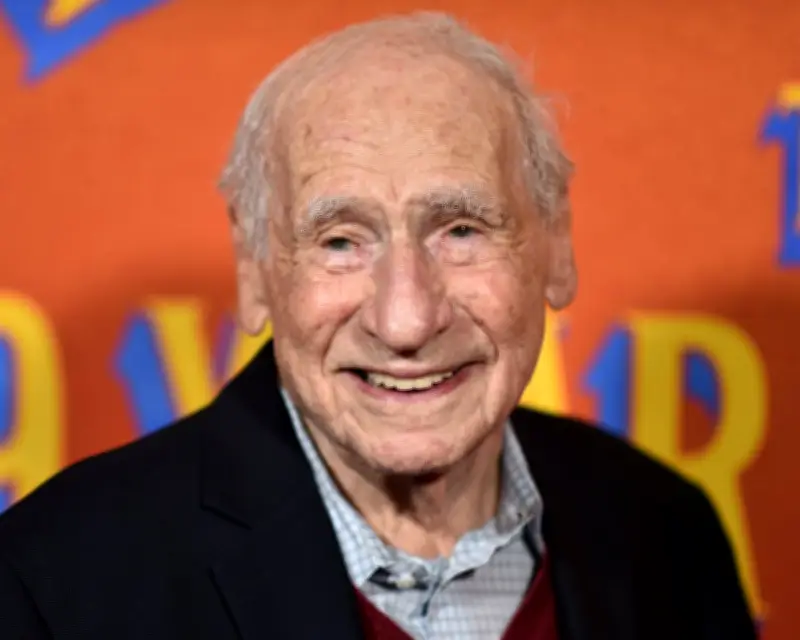
Mel Brooks, the legendary director of The Producers, turns 100 as a uniquely beloved entertainer who embodies his conviction that 'comedy is the opposite of death'. Born on the kitchen table of a tenement in Brooklyn a century ago, Brooks' story is that of the US and Jews and American Jewish comedy.
Early Life and War Service
Brooks was born in the same month Marilyn Monroe made her entrance on the opposite coast. The son of European immigrants, he was brought up by his mother after his father died when Melvin was just two years old. He was a small, sickly child and the youngest of four brothers, perhaps explaining an almost pathological desire for attention. In the words of his colleague Larry Gelbart: 'Mel thought when he got slapped in the ass by the doctor who delivered him that was applause, and he has not stopped performing since.'
In his youth, Brooks' preferred method of making noise was playing the drums, and he was taught by Buddy Rich. Neither could know they would both go on to have seismic effects on comedy and jazz. That youth was interrupted by Adolf Hitler. The teenage Brooks joined the army and participated in the Battle of the Bulge. Those war years explain his fearlessness and commitment to mocking Nazis, as well as his assertion that 'comedy is the opposite of death'.
Rise in Show Business
On returning home, Brooks drummed at Borscht Belt resorts in the Catskills for audiences almost exclusively comprised of fellow Jews. When the regular comic was ill, he filled in and discovered the joy of getting laughs. Soon he was recruited to write on Your Show of Shows, the Sid Caesar sketch show that assembled the greatest comedy writing team in television history. There he met Carl Reiner, forming a relationship that lasted until Reiner's death in 2020 at age 98.
The pair began improvising comedy routines. During one, Reiner asked what it was like to be present at the crucifixion of Jesus Christ. Thus was the 2,000 Year Old Man born, perhaps the greatest premise for a recurring sketch comedy character. The routines appeared on five albums between 1960 and 1997, but performances began in the 1950s. The humour and Brooks' accent were unashamedly Jewish, at a historical moment one might expect him to keep that hidden. The only concern was that gentiles would be baffled, but Cary Grant told Brooks he'd played the record at Buckingham Palace to the delight of the queen mother. In Brooks' words: 'If the biggest shiksa in the world loves it, we're home free.'
The Producers and Blazing Saddles
If the 2,000 Year Old Man was a risk near the war, Brooks' first feature film, The Producers, was positively dangerous. The film, about Broadway producers who make money with a flop, settled on Springtime for Hitler: A Gay Romp with Adolf and Eva at Berchtesgaden. Larry David called it 'possibly the greatest comedic premise that anybody has ever dreamed up'. The film came out in 1967, and some felt the horrors were too fresh. One punter berated Brooks: 'I was in world war two.' Brooks replied: 'So was I, I didn't see you there.'
Brooks' second film, The Twelve Chairs, is perhaps the most underrated in his oeuvre, showcasing a love of Russian literature from colleague Mel Tolkin. But his next two films, Blazing Saddles and Young Frankenstein, ensured 1974 was a banner year, ushering in the golden age of parody movies. Blazing Saddles was the highest-grossing western in history until Dances With Wolves in 1990.
Later Career and Legacy
Brooks continued making parodies in the 1980s and 1990s with diminishing returns. At times, his true calling seemed simply being Mel Brooks. He never ceased to break the fourth wall: being honoured by Barack Obama and pretending to pull down his trousers, wearing a prosthetic eleventh finger while adding his handprint to the Hollywood Walk of Fame, or pointing out the madness of the BBC's The One Show in his 90s. When presenters segued to a story about a woman tracing her long-lost father, Brooks remarked: 'What a crazy show this is.'
He produced The Elephant Man, selected David Lynch as director, and took his own name off the credits lest anyone assume it was a comedy. When executives asked for changes, Brooks replied: 'We are involved in a business venture. We screened the film for you, to bring you up to date as to the status of that venture. Do not misconstrue this as our soliciting the input of raging primitives.' Brooks is one of only 22 people in history to win an Oscar, Emmy, Grammy and Tony.
Enduring Impact
With Brooks, it all feels like instinct and a defiance of death forged from a traumatic youth. A friend once met a taxi driver who boasted about having Brooks in his cab en route to a speaking engagement. When Brooks discovered the cabby was a fan, he performed the entire speech for an audience of one. He is the son of immigrants who fought the Nazis and triumphed in every area of showbusiness. When asked the secret to a long life after a screening of Blazing Saddles, Brooks offered sage advice: 'Don't die.'