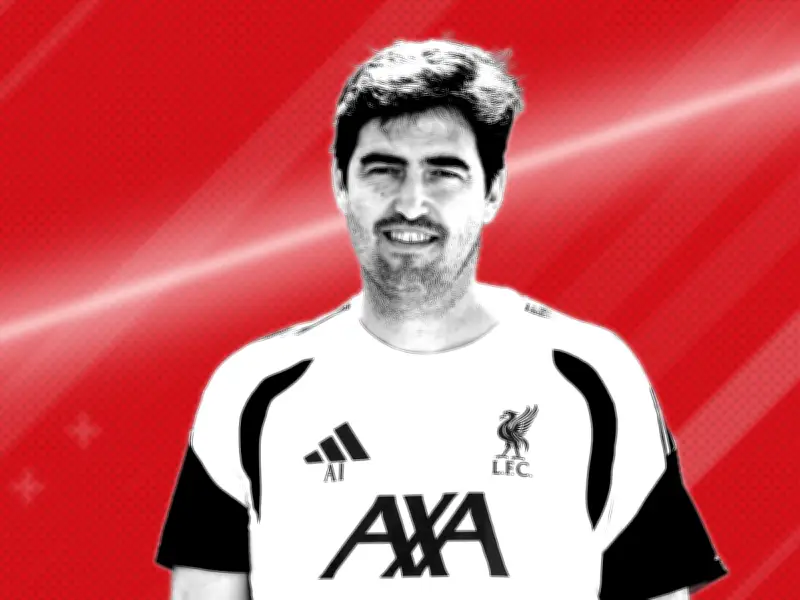
Andoni Iraola's first words to the press after becoming the new Liverpool head coach will have been music to supporters' ears. Asked for his message to the fans, Iraola's reply laid plain his understanding of the responsibility of leading not only English football's most successful club, but a city desperate for a team that represents its values.
"I would like to give them a team that they can feel proud of," Iraola said. "I think football - and especially Liverpool - for me, it's about connecting, connecting with the people, connecting with our supporters."
Last Season's Fractures
Connection was something sorely lacking for much of last season, a season in which aggravation not just with results, but the character of Liverpool's performances, spilled over from the online space into the stands for the first time in over a decade. It's easy to point to the chorus of boos that greeted Arne Slot's substitution of Rio Ngumoha in the 1-1 draw against Chelsea at Anfield, but perhaps no moment better summed this up than Dominik Szoboszlai's frustrated gestures to away supporters who had just seen their team thrashed 4-0 by their biggest rivals of the last decade, Manchester City.
The Szoboszlai furore was no isolated flare-up. The tension between players and supporters had boiled over during Trent Alexander-Arnold's protracted courting by Real Madrid the previous season, with the right-back seemingly venting his anger towards fans after scoring the winning goal against Leicester in April 2025. Mohamed Salah's outburst in the mixed zone at Elland Road in December, too, practically started a culture war between supporters who felt he had a right to express his anger at having been benched, and those who felt he had selfishly put his own interests above those of the team.
Slot's Detachment
For all of the credit he rightly earned from lifting the Premier League title in his first season and handling Diogo Jota's death with dignity and compassion, Slot was ultimately the wrong personality to mend the cracks that had started to appear. Like most, if not all, of his players, Slot lived outside of the city during his time at the helm, and this only further contributed to the perception amongst supporters that he lacked a proper understanding of what made Liverpool and the club's fans tick.
His refusal to properly criticise Gabriel Martinelli for the petulant shove on Conor Bradley - when the Liverpool defender was rolling in agony with what was clearly a serious knee injury - was indicative of Slot's reluctance to act as a representative for Liverpool supporters in his media appearances. Writing for The Athletic after Slot's exit in May, Simon Hughes reflected on this moment, comparing Slot's response to the outrage which followed the incident: "anyone leading Liverpool needs to know how to wield a sword and when to use a shield when the world around you is burning."
Iraola's Understanding
Iraola is no fool, and must have known what he was evoking when he was asked if he understood what it means to be Liverpool manager: "I want to think I understand. Probably until [I've been] here [a while] and until I go through certain experiences, I will not fully know, but I am here to experience those situations. I'm ready for it. I understand this is a massive club. Everything I am going to say now is going to [come under a lot of] scrutiny - you have to be very aware of mistakes - but I also wouldn't like to be too careful, you know? I would like to act quite normal. We were talking to Tony [Barrett - Liverpool's head of club and supporter liaison] now - I am not going to live in my bubble, just training ground, home. I would also like to go to the city, exploring the city. I know some places I will have to take some pictures - but it's part of the magic, no, of being the Liverpool manager? I would like not to change too much."
Iraola comes across as a quiet man, more of a thoughtful communicator than a grandstander, but he speaks from the heart and Liverpool fans will appreciate this if he stays true to himself.
Rediscovering Identity
Liverpool supporters, even more than those of most other clubs, need to feel understood - like they have a manager who 'gets it'. Klopp 'got it', but Klopp was also an expert speaker who could conjure one-liners out of thin air. Iraola might not reliably produce as many zingers, but whereas Slot's results in his first season spoke for him, Iraola's style of football will do most of the talking - and he should have an implicit understanding of the Liverpudlian mentality that makes up the culture of the fanbase.
His home province, Gipuzkoa in the Basque Country, is similarly football-mad. It is now a widely-known piece of trivia that Iraola played alongside Xabi Alonso and Mikel Arteta at youth team Antiguoko, and the region also produced Aston Villa manager Unai Emery. That means 20% of Premier League head coaches next season will hail from the same tiny province - the smallest in Spain. Localism is central to Basque footballing culture, too. Iraola spent the vast majority of his playing career at Athletic Club, the Bilbao-based side that famously only sign players from the Basque Country.
Restoring the Holy Trinity
This all feeds back into that holy trinity Bill Shankly once spoke of: the players, the manager and the supporters. Fans who see players who will give everything for the shirt as their representatives on the pitch, players who see their efforts rewarded by fans who support them to the bitter end, and a manager who will defend both to the hilt from outside scrutiny and be the uniting force that keeps the whole held together. Far from just a comforting thought, this is what makes Liverpool a 'bastion of invincibility' when all parts work in tandem.
Asked about how he hopes to restore Anfield's fear factor, Iraola summarised the importance of this connection perfectly: "I always talk about energy," he said. "I want my team to be energetic. I want to be dynamic, to play in a position half as much as we can, sometimes on the ball, sometimes without the ball, try to suffocate the opposition, especially at Anfield. We have to make Anfield a very uncomfortable place to come. Because sometimes I've come and it's a lovely stadium, lovely atmosphere, and you try to enjoy it. No. We have to make it so it's going to be nice, but it's going to be nice for us because you are going to have a hard time. This requires also the connection with the supporters. I think one of our biggest advantages is if we get this connection from the team to the supporters, from the supporters to the team, right? It's very difficult then to stop us, especially at home, because I felt it from the other side. [Regaining that connection] is probably one of the first things to do and achieve. Get this connection because this will help us. I think it's something that has to come from the team. I know if the team gives what we want, we'll have everyone behind us. And this is something that I would like also the players to acknowledge and accept this."
A Team That Plays the Liverpool Way
All fanbases need consistency. Something that defines their club, something they can hold onto through hard times as well as good ones. The greatest disappointment of the latter months of Slot's time in charge was not the drop-off in results or even performances, but that it felt like this intangible thing had somehow been lost along the way. In a landscape where football is becoming increasingly unrecognisable from the game we all fell in love with, this growing disconnect between players, fans and manager was by far the most troubling development.
The writer and comedian Andy Hamilton, a lifelong Chelsea fan, wrote maybe the most honest description of this feeling of slipping away from what made him fall in love with football in his 2023 book, 'Blue Was The Colour: A Tale of Tarnished Love'. Liverpool's identity is not in danger of being distorted anything like as immediately and irrevocably as Chelsea's was in the early 2000s, but owners FSG have nevertheless taken a string of decisions during their custodianship that have threatened the very fabric of the relationship between supporters and the club. The European Super League proposals, the attempt to copyright the word 'Liverpool', the partially-ditched multi-year ticket price increases.
Playing style is part of it - high pressing and direct attacking play is great, after all - but a team that plays the Liverpool way is not necessarily one bound by any overriding philosophy of how the game should be played. Instead, it is a team that embodies the spirit of the city on the pitch - fighting for everything and never giving up. The success of Liverpool lies in that mentality, and Andoni Iraola sounds very much like he has it already. The question is now whether his players can rise to it.