Olympia’s Transformation into a City Within a City
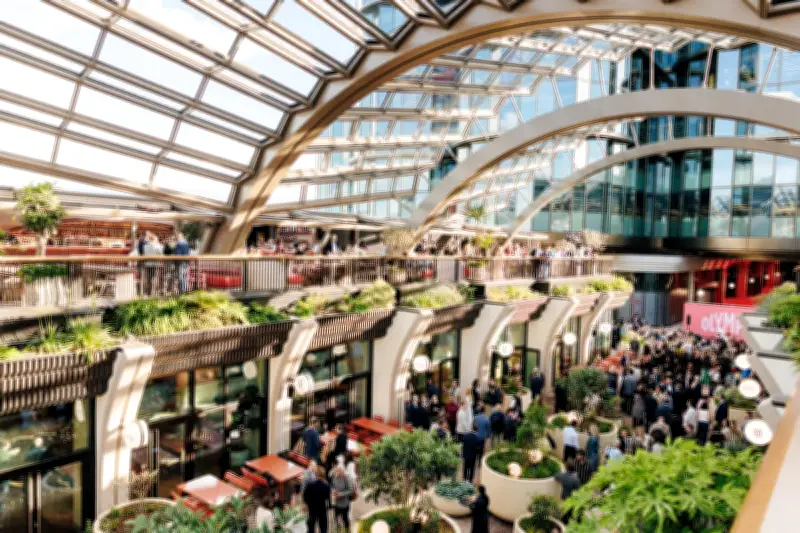
The redevelopment of London’s Olympia exhibition centre, costing £1.3 billion, has turned the historic venue into a multifaceted urban hub. The centrepiece is a bank of staircases and escalators soaring Aztec-temple-style to an elevated concourse between the original barrel-vaulted halls. This concourse is crowned by a glass vault with origami pleats, described as a “tiara of cubic zirconia among the heritage diamonds.” Behind it rises a stepped office block offering panoramic views from Wembley to Crystal Palace, already housing the Premier League’s media production arm, complete with a mini football pitch on its terrace.
From Miss World to the Chemical Brothers: A Historic Venue
Olympia has hosted diverse events since the Grand Hall opened in 1885, including Miss World, the Chemical Brothers, cat fancies, dog shows, concerts, and trade fairs. The Ideal Home Show, founded in 1908 by the Daily Mail, remains a fixture. In the 19th century, impresario Imre Kiralfy flooded the Grand Hall for a Venetian-themed spectacle with barges and gondolas. The venue’s architecture evolved over time: the Grand Hall and Pillar Hall by Henry Coe, the National Hall (1923), and the Empire Hall (now Olympia Central) by Joseph Emberton in 1929, with its jazz moderne facade.
Revitalising a Lost Crown
By the 21st century, Olympia had lost ground to newer venues like the Excel centre. Acquired by Yoo Capital in 2017, the redevelopment by Heatherwick Studio and SPPARC involved stripping away grungy accretions, restoring historic structures, and adding new elements. The site, covering an area similar to Westfield, was previously insular. “When we first visited in 2017, it was a kilometre of perimeter and if you didn’t have a ticket, that was it,” said Heatherwick Studio’s Eliot Postma. “And so all of our early discussions were around how do we create public realm where there is none?”
New Amenities and Public Spaces
The redevelopment includes over half a million square feet of office space, 30 restaurants and bars, two hotels, a conference centre, a gym, a 3,800-capacity music venue, and London’s largest purpose-built theatre in 50 years. A new secondary school, Wetherby Pembridge, opened in September 2023 in the refurbished shell of a 1937 multi-storey car park by Emberton. The elevated concourse, named Emberton Walk, is designed as a public street linking to Hammersmith Road. “It’s a new public street,” said Postma, “sitting on the shoulders of these Victorian buildings, literally building on what the Victorians did, with the same level of ambition.”
Heatherwick’s Distinctive Design
Thomas Heatherwick’s design features pleated motifs throughout: zigzag roofs, concertina balustrades, and crinkle-cut door handles, inspired by the faceted glass gable ends of the Grand Hall. While some critics find it hectic, the historic architecture of Coe and Emberton provides a calming contrast. A new logistics centre streamlines operations, and Olympia Way has been reconfigured as a landscaped boulevard, revealing restored Italianate facades and a sculptural tableau of Demeter and Persephone.
Impact and Future
The redevelopment aims to transform Olympia into a destination, attracting the Chelsea set with its array of food and beverage outlets. As Tatler mused, “Will it be enough to entice the Chelsea set?” The theatre is due to open next year. Statues of Demeter and Persephone now gaze out on a very different London, but Olympia remains synonymous with spectacle. “In some ways, nothing has changed,” the article concludes.