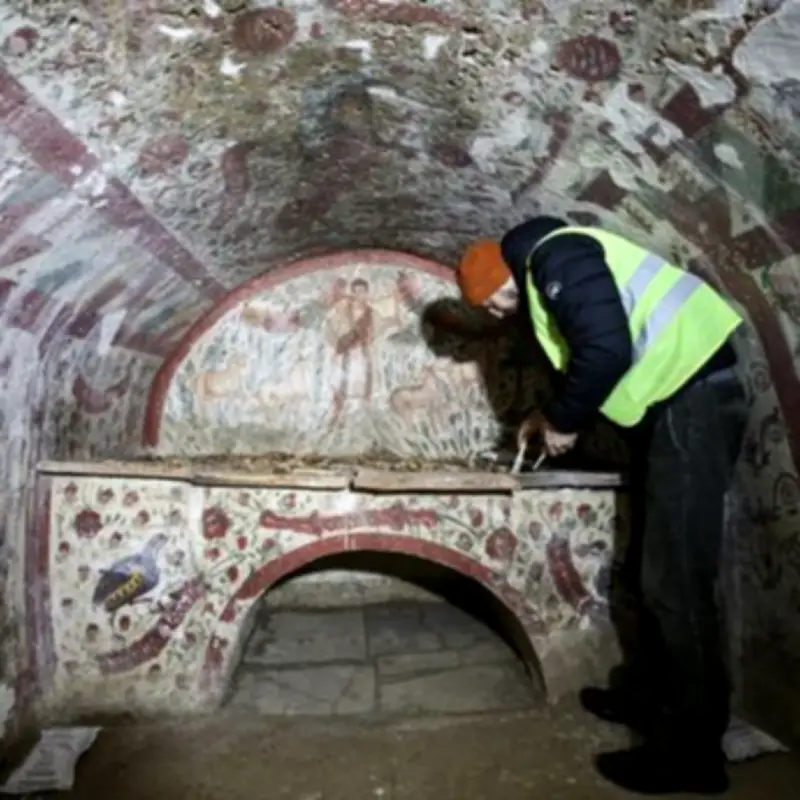
Archaeologists have made a groundbreaking discovery, unearthing what is considered the best preserved image of Jesus Christ. The painting, found in an underground tomb near Iznik in northwestern Türkiye, depicts a young, clean-shaven Jesus as the 'Good Shepherd,' carrying a goat on his shoulders.
The Discovery
The mural was discovered in a tomb not far from Iznik, historically known as Nicaea, a town renowned as the birthplace of the Nicene Creed. This creed, established in A.D. 325 when the region was part of the Roman Empire, helped shape early Christianity. The painting offers valuable insights into the lives and practices of Christians during a time of persecution.
Artistic Details
Jesus is portrayed with Roman features, wearing a toga and carrying a goat. The goat rests on his shoulders with its head turned to the left. At his feet, four more goats roam among abstract flowers and greenery. Researchers note that this is one of the rare examples in Anatolia (modern Türkiye) where Jesus is depicted with distinctly Roman characteristics.
Before the cross became the most recognizable symbol of Christianity, the Good Shepherd concept was used to convey ideas of faith, symbolizing salvation, divine guidance, and protection. Lead archaeologist Gulsen Kutbay described the artwork as likely the 'only example of its kind in Anatolia.'
Other Findings in the Tomb
The tomb's curved walls are adorned with depictions of birds, plants, and portraits of noble men and women, some accompanied by slaves. Eren Erten Ertem, an archaeologist from Iznik Museum, stated that the murals show 'a transition from late paganism to early Christianity, depicting the deceased being sent off to the afterlife in a positive and fitting manner.'
Excavations also revealed the skeletons of five individuals, including two young adults and a six-month-old baby. Anthropologist Ruken Zeynep Kose noted that due to poor preservation, the ages of two others could not be accurately determined.
Significance of the Discovery
Professor Candida Moss of the University of Birmingham, a leading authority on early Christianity, emphasized the importance of recent discoveries in Turkey. 'The large number of recent early Christian archaeological discoveries in Turkey are of very substantial significance,' she said. 'Anatolia was in many ways the cradle of early Christianity. The region, visited by the apostles Peter and Paul and other very early missionaries, is of huge importance in the religion’s early history.' She added that when Christianity became the official religion of the empire, the Romans moved their capital from Rome to what is now Istanbul.