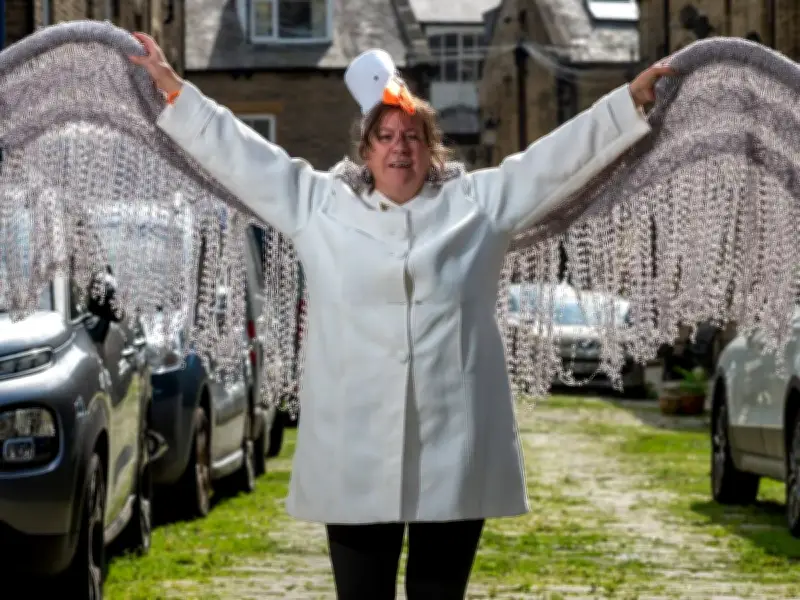
Trish Clemit, 59, has been crowned the UK's best gull impersonator at a contest in Weston-super-Mare, Somerset. The seagull mimic extraordinaire insists the birds are “much misunderstood” and has been perfecting her technique over many years. She first discovered her talent at Butlins, aged eight.
But she is not the first person to find fame by passing for a critter. Here we take a look at some of the others.
Thomas Thwaites: The Goat
Thomas Thwaites spent three days living as a goat. Explaining he wanted “a holiday” from being a person, the Brit designer spent most of 2014 researching his idea. He persuaded prosthetics expert Dr Glyn Heath, from Salford University, to build him a set of realistic goat legs. He paired them with a helmet, perfect for butting heads, then jetted off to the Swiss Alps to join a herd.

He fitted in nicely for the most part, he says, until he almost started a massive caprid scrap. “I was just sort of walking around, you know chewing grass, and just looked up and then suddenly realised that everyone else had stopped chewing,” he says. “There was this tension which I hadn't kind of noticed before and then one or two of the goats started tossing their horns around. I think I was about to get in a fight.”
Thomas was awarded a 2016 Ig Nobel Prize – a parody of the Nobel Prize – for his efforts.
Charles Foster: That's the badger!
Another Ig Nobel Prize winner, naturalist Charles Foster, picked up his gong for stints living as various wild animals. He tried being a badger, eating earthworms in a Welsh dirt hole. As an otter, he swam in rivers and hunted for fish. And he scavenged through the bins in an East London garden as a fox.
Charles, a Cambridge-educated ex-barrister, says he was trying to “perceive landscapes more accurately” than human beings can. “I didn’t do very well,” he admits. “But it was well worth a try. Have a go. It’s rather embarrassing, so wait until you’re next in a quiet wood. Drop onto all fours. Sniff the ground, lick a leaf, let your highly sensitive fingers play over the earth. See if you can hear a bird over the cognitive tinnitus that will be hissing in your head.”
Toco: Collie power
The YouTuber, an anonymous Japanese man, went viral in 2023 with his efforts to transform himself into a perfect Rough Collie. He dropped more than £10,000 on a hyper-realistic costume, sharing videos of himself playing in the park, performing tricks and going for ‘walkies’.
Last year he opened the Tokotoko Zoo, where visitors could pay £250 to spend three hours dressed as a lifelike Alaskan Malamute. “Have you ever wanted to be an animal?” the attraction’s website asked. “Have you ever imagined yourself as something other than yourself and felt excited? We offer a service that can help make that wish come true, even if only a little, by having you wear a costume.” The role-playing paradise, in Saitama Prefecture, just north of Tokyo, has since closed.
Percy Edwards: Chick magnet
Ornithologist Percy Edwards made a living from his uncanny ability to impersonate animals. The Brit, born in Ipswich, Suffolk, in 1908, could imitate more than 600 birds and dozens of four-legged friends. Percy started working for BBC radio in 1930, later becoming a household name as the voice of Psyche the dog in sitcom A Life of Bliss. He went on to a string of movie roles, playing a husky in Call of the Wild (1973), a bear in Man in the Wilderness (1971) and Peter O’Toole’s parrot in Man Friday (1976).
His most iconic part came in 1979, when he gave us the voice of the angry extraterrestrial in Alien. Percy also appeared on The Morecambe and Wise Show – and even supplied the bird song for Kate Bush’s album The Dreaming. He was a broadcasting legend by the time of his death, aged 88, in 1996. In 2006, Sir David Attenborough presented a special BBC radio panel game, The Percy Edwards Showdown, dedicated to his life and career.

Tom Leppard: Spot the difference
When Tom Leppard decided to turn into an animal, there was nothing temporary about it. Famed as the “Leopard Man of Skye,” he covered 99.2% of his body in leopard-pattern tattoos. The London-born, former special forces soldier spent 20 years living in a home-made shelter on the Isle of Skye, with no electricity or furniture. When he needed food, he had to canoe three miles (4.8km) to the nearest shop.
Tom admitted had no particular interest in cats. His £5,500 look, which saw him named the world’s most tattooed senior citizen, was just a way of making some cash. “I had a spare set of dentures, shaped like fangs, that I'd put in for the publicity shots,” he admitted. “But it was a necessary evil to supplement my income support, or latterly my pension. It's not something I enjoyed.” He finally moved into more conventional housing in 2008, then died in a nursing home, aged in his 80s, in 2016.