A mother has had a full keyboard tattooed on her arm so her non-speaking son is never without a means of communicating with her. When he saw it for the first time after returning from school, his first words left her in tears.
Son's First Words Using the Tattoo
Jessica Fletcher's son Hunter, 11, was diagnosed with autism at the age of three. He relies on Augmentative and Alternative Communication (AAC) devices, along with gestures and some sign language. But when the technology failed one day, Jessica devised an ingenious solution.
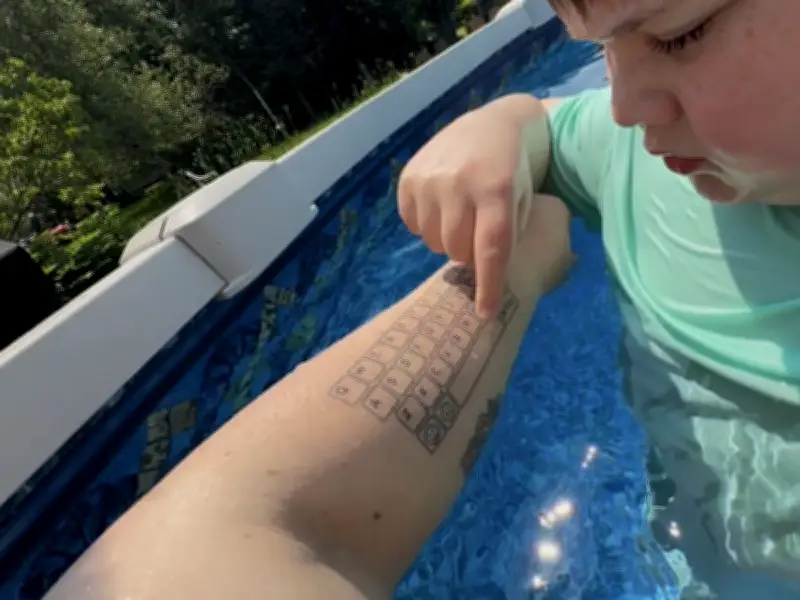
The 32-year-old mum asked a tattoo artist to ink a keyboard onto her forearm, enabling her son to spell out whatever he wants to say. His first words upon seeing the tattoo reduced her to tears.

"As soon as I showed it to him after picking him up from school, he immediately grabbed my arm and typed 'Mama'," Jessica said. "Later that evening, before bed, he used it to say, 'I love you mama'. I just knew in my heart at that moment that he understood it was permanent, like my other tattoos, and that it was all for him."
How the Idea Came About
The children's author and autism and AAC advocate came up with the concept after Hunter's communication device died while they were having breakfast at a restaurant. He normally uses it to tell his mum whether he wants sausage, bacon or ham with his meal. However, the device had failed to charge properly overnight, and its battery went flat as soon as they sat down.
"Hunter got upset," said Jessica. "I knew he could point to the menu, but he needed a way to ask for other things or communicate other questions and thoughts." Jessica asked a waitress for a pen and paper and started writing out the alphabet. Before she could finish, Hunter turned the page over and wrote "Q W E R T Y" – the first row of letters on a standard keyboard. Jessica helped him complete the layout before he used two fingers to "type" what he wanted to eat and carried on communicating with it throughout his meal.
"I decided then and there that I would get it tattooed on me," she said. Shortly afterwards, Jessica was introduced to tattoo artist Farnaz at Main Street Tattoo Company. Farnaz designed the keyboard and spent two hours applying it to Jessica's forearm. The shop's owner covered part of the undisclosed cost as he felt the tattoo was "meaningful and important".
Wider Impact and Response
A video of Hunter using the keyboard tattoo has since been viewed more than 100 million times. Other parents have been moved to get similar tattoos, while artists have offered their services and accessible clothing has even been designed. Jessica said: "The response has honestly been overwhelming, but in the best way."
Jessica deliberately positioned the tattoo where Hunter could reach it easily while still allowing her to see which letters he selected. She said: "This tattoo was the least painful tattoo I have ever had. I hardly felt it at all, almost as if it was always meant to be there."
Hunter initially began communicating through pictures before moving on to an AAC device. Though he was reluctant to use it at first, his literacy skills flourished at school and he now spells, types and has recently started handwriting messages to his mum. He can also sign words including "mum", "home", "drive", "shower", "more" and "eat". However, Jessica – who is from New Brunswick, Canada – explained that he cannot yet communicate extensively through sign language.
She added: "The biggest misconception I want to challenge is that non-speaking means non-thinking. Hunter understands, learns, remembers, has opinions and has so much to say. He loves swimming and music, collects marble runs and enjoys building them." His mum revealed he also has a mischievous sense of humour and "the most contagious laugh".
The tattoo recently proved its worth when Hunter's AAC device broke and its replacement took a week to arrive. He used Jessica's arm to spell out the names of shops and places he wanted to visit – including words she had never seen him type before. She said: "It made me realise that he has been reading and remembering signs as we drive around and go about our everyday lives. I think limiting him to technology when technology can fail is not fair to him, because communication is a human right."

Some family members had cautioned Jessica that the keyboard might not translate well as a tattoo. However, she added: "Looks mean nothing to me if it means giving my son another option for communication. I hope other families see our story and realise they don't have to wait for spoken words to start listening."