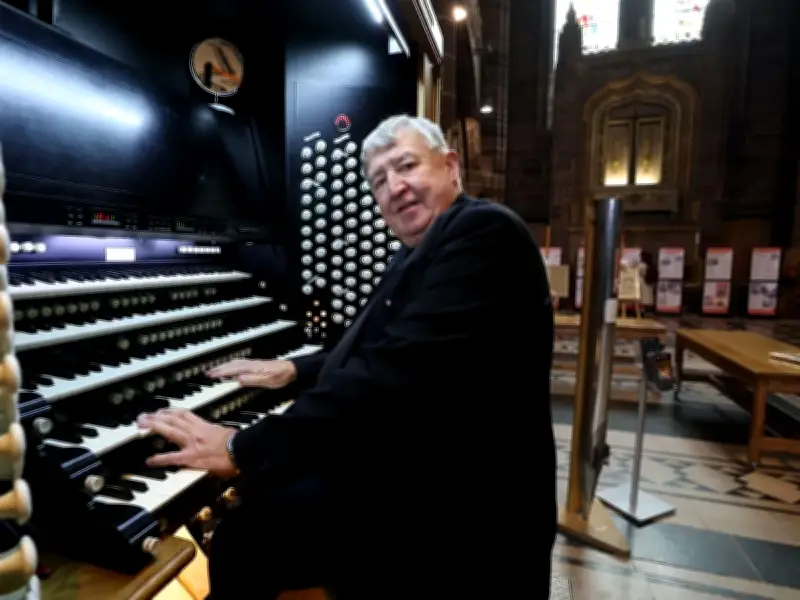
Professor Ian Tracey, aged 71, is preparing to play his final Centenary Organ Recital at Liverpool Cathedral on Saturday, October 17, bringing to a close a 46-year tenure as organist that began in 1980 when he was just 25.
Ian's connection with the cathedral organ started long before his appointment. He first played the famous instrument on September 6, 1966, when he was 11. His lesson was meant to take place on the organ in the cathedral's Lady Chapel, but its blower had broken down. Instead, his teacher, then the cathedral's assistant organist, told him they would have to use the main cathedral organ.
He told the ECHO: "I thought, 'Yes!' All my Christmases had come at once. That was the first time I played it, and I've been playing it for 60 years since."
Early Inspiration and a Grandfather's Influence
Ian's love of the organ began even earlier, thanks to his grandfather Herbert Charles Harris, who was also an organist. His grandfather started him on the piano before he went to school, but Ian quickly became fascinated by the larger instrument. His reward for practising the piano was being allowed to accompany his grandfather to church on Saturday afternoons and play his pieces on the organ.
Ian said: "If I had done enough piano practice at home, in his estimation, then I could go to church with him on a Saturday afternoon and play my piano pieces on the organ, which is what I really wanted to do. If, on the other hand, as in some weeks, he reckoned I hadn't done enough piano practice, then I couldn't. So it was a big carrot."
He remembers going with his grandfather to St George's Hall to hear City Organist Dr Caleb Jarvis playing recitals, and being captivated. He said: "It was the sheer power of the thing. I think I was just so taken with this little man making all this noise on the organ. I was just so enthralled by the sounds it made, much more interested in it than the piano."
A Career Rooted in Liverpool
Ian's career at Liverpool Cathedral began as an organ boy making coffee, tidying music and turning pages. He later became an organ scholar and then assistant organist before taking over from his predecessor, Noel Rawsthorne. He said: "I'd already got the other side of knowing what it did and what it could do and couldn't do, and I'd been assistant for four years to my predecessor, so I was well versed in it. So there was no surprise that afternoon when I took over. I just took over."
For Ian, the organ's appeal has never simply been its size. Built by Liverpool firm Willis, it remains the largest organ in the British Isles, but he believes its real magic lies in its quality and the way it fits within Sir Giles Gilbert Scott's cathedral. He said: "It's not just the size of it, it's the variety and the quality. Everything in the organ is top quality."
He added: "Somebody once said that the best stop on any organ is the building it sits in, and this sits in Sir Giles Gilbert Scott's masterpiece and in a sense, the organ fits this building like a glove. It's beautifully voiced for the building so it's the marriage of the organ and the building which makes the success of it."
Ian has played some of the world's great organs during his career, travelling through Europe, America and Australia, but none has changed his mind about his Liverpool home. Born and bred in Liverpool, he has held roles including Liverpool City Organist, Organist to Liverpool John Moores University and Organist to the Philharmonic Society. He said: "I haven't ever come across anything in this order anywhere else. I was born and bred in Liverpool, and I've never wanted to stray from it. I think it's a wonderful place. It's been my home in every sense of the word: my musical home and my physical home. I wouldn't have swapped it for the world, really."
Final Recital and Retirement Plans
Over his 46 years as cathedral organist, Ian has played for huge occasions including royal visits from Queen Elizabeth and the visit of Pope John Paul II. He has also played to thousands at the cathedral's annual organ anniversary recitals, but some of his favourite memories are far quieter. He said: "For me, I think the special services have been the quiet nights with the cathedral dimly lit, hardly anybody here, apart from the angels, and the choir just singing at its very best. But with all the lights on, and brass fanfares, and the choir singing descants, and the cathedral packed, and everybody singing corporately, that's always thrilling, too."
Now Ian is preparing for the final recital of his 46-year tenure, saying that playing to more than 1,000 people is still an "awesome" experience. He said: "I'm at the moment doing my last six nights' practice for the recital, which is always an awesome occasion. You keep on chipping away at the odd note and hoping that you've got them all in place and it's going to be all right on the night."
Ian said the decision to retire was not an easy one but it felt like the right time. He said: "You can't carry on forever and I would hate people to remember me as this bright young thing who eventually just gradually went off."
Retirement will not mean sitting at home doing nothing, as Ian is writing and arranging more music and is working on an organ tutor which he originally began with his predecessor. He promised he would finish the project and publish it as a joint work. He has also agreed to remain on the organist deputies list, meaning he will still be able to return to the instrument he has known for most of his life.
He said: "In a sense I'm being freed up to do other things but I'll still be sitting here keeping in touch with my old friend. I think I'll miss the daily rhythm of worship the most as I won't have to be here every day apart from Wednesday but I shan't be listening to daytime television with my pipe and my slippers and gradually vegetating in front of the television. I've got far too much to do."