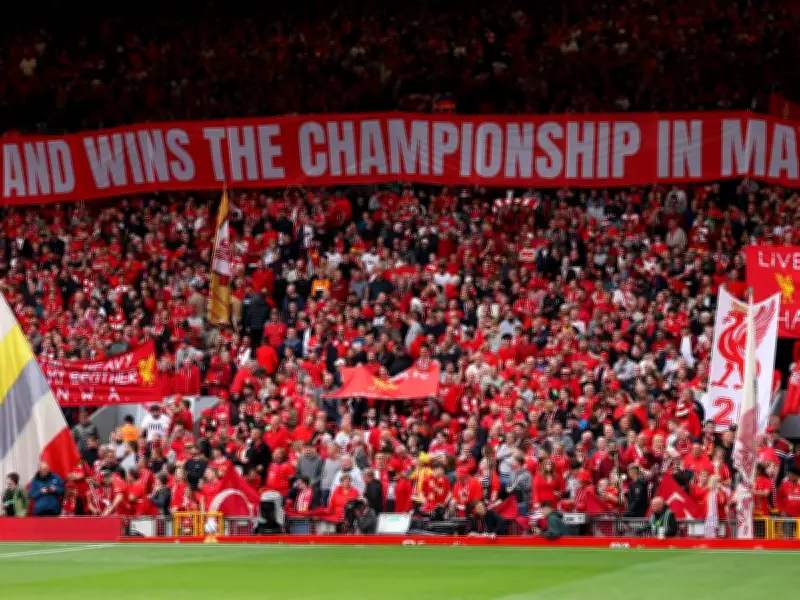
As Liverpool FC celebrates the 120th anniversary of Anfield's iconic stand, the Kop, Mirror columnist Brian Reade tells its remarkable story in an exclusive extract from his book, The Kop.
The Power of the Kop
Before England faced Mexico in the daunting Azteca Stadium during this summer's World Cup, manager Thomas Tuchel was asked how his players would cope with the fearsome atmosphere. He smiled knowingly, recalled his Borussia Dortmund team collapsing in front of the Kop in 2016, and said the lesson had taught him how to mentally prepare his players for the most ferocious of cauldrons.
“We conceded three late goals at Anfield and it was just coming, you could just feel it. The Kop just sucked the ball into the goal from their end,” he told the world's media. Dortmund's captain Mats Hummels recalled the night more succinctly: “We started sh*tting ourselves.”
There lies the very definition of the power of the Kop on the biggest of occasions. Living testament to how when the fog of war descends at Anfield the best warriors in the world can be blinded.
Great European Nights
Reade missed the first Great European Night, against Inter Milan in May 1964, through being too young, but when he interviewed Bill Shankly a decade later for his school magazine Shankly told him: “It was hysteria, pure and simple. You should have seen the faces of the Italians when they heard the Kop. They were petrified.”
Shankly's men ripped apart the then world champions, winning 3-1, the Kop serenading them off the pitch by singing “Go back to Italy” to the tune of Santa Lucia. Italian paper Corriere Dello Sport declared: “Our world champions felt the earth tremble under their feet.”
Reade was in the heart of the Kop for the second Great European Night against St Etienne in 1977. The French champions were a skilful side but had never played at Anfield under the lights and after two minutes, with their players looking bewildered amid the cacophony, Kevin Keegan overhit a cross and in it went. Victory, and passage to the European Cup semi-final seemed inevitable. Not so.
Six minutes after half-time, their star man Dominique Bathenay beat Ray Clemence with a swerving beauty from 30 yards, and the 5,000 French fans went wild. The Kop answered the French chants of “Allez les Verts” with ripostes of “Allez les Rouges,” and the Reds soon equalised. As the clock approached full-time with Liverpool needing one more goal, local lad David Fairclough muscled off his marker and as he glided towards the Kop it felt like the air was being sucked out of the stadium.
With an icy coolness he took one deft touch with his right foot before steering the ball low into the net and taking off like a pole-vaulter, before coming back to earth and laying under a pile of team-mates. When he made it back to the centre-circle, 20-year-old Fairclough found it hard to breathe. “I had a burning sensation across my chest. It felt like my heart was on fire. It seemed like the entire ground was singing and bouncing,” he told Reade.
On the Kop it was sheer bedlam. Bodies clasped hard on bodies, faces contorted with joy as fans were sucked towards the goal and back up the terrace. One journalist described the scene as a mass human trampoline. And they kept trampolining for the remaining six minutes, which left the ears ringing and the pitch appearing to come at Reade's eyes through a camera that was held by someone having a bad attack of the shakes. The Reds then went on to lift the European Cup.
The Loudest Anfield
The loudest Anfield has ever been was the 2005 semi-final against Jose Mourinho's Chelsea. It was as if everyone realised they had a duty to bring their A-game to help defeat a far superior team. People were screaming at the pitch when the players came out. It was the closest Anfield had come to a baying colosseum.
“You could feel an energy all round the ground and it wired you. It wasn't just because it was a European semi-final, it was about Chelsea and Mourinho. You could sense fans had gone to Anfield that night thinking, 'They're going to get it tonight',” Jamie Carragher told Reade.
There were frantic whistles whenever a Chelsea player touched the ball, euphoric howls when the Kop sucked in Luis Garcia's “ghost goal” and choruses of The Fields of Anfield Road and We Shall Not Be Moved ringing out towards the end. In added time, when the wall of sound coming from the Kop appeared to repel Eidur Gudjohnson's goalbound shot, and the final whistle went, everyone just slumped, drained of emotion. After 20 years of frustration Liverpool were back in the biggest final of all and within touching distance of their fifth European Cup. Even Jose Mourinho had to admit afterwards: “I felt the power of Anfield tonight. It was magnificent.”
Barcelona 2019
Then came Barcelona in 2019, when Liverpool needed to overcome a three-goal deficit against the best team in the world to reach another Champions League final. The Reds started as they had to, with an early goal after seven minutes from Divock Origi. The Barcelona players appeared confident as they emerged for the second-half still two goals ahead but as they headed towards the Kop they were met with a level of noise that made many of them do a double-take.
All it took was a manic two minutes for the Reds to pull the score back to 3-3 on aggregate. When the third goal went in and the Kop exploded, bewilderment was writ large on the faces of the superstars in the yellow shirts. Lionel Messi, hand on hips, rubbed his face in disbelief. Luis Suarez shook his head and stared wide-eyed at the Kopite hordes and Coutinho walked around with zombie eyes. Those two ex-Liverpool players knew this horror movie script and how it would end.
With 12 minutes to go Trent Alexander-Arnold won a corner which he went to hit long, then realised the entire Barcelona team had switched off. He spotted Origi in a square yard of space and he swept it home. For a split-second the Kop was a stunned chamber of disbelief as 12,500 brains attempted to process what their eyes had witnessed. Then it was utter delirium. The Barcelona team just looked like ghosts, the miracle was complete.
European football was left stunned. We had witnessed another extraordinary comeback against all odds. We'd been handed another unexpected gift from the spirits of Anfield past. Afterwards, Pep Guardiola told Catalan newspaper Diaria ARA why he felt sorry for Barcelona's players, telling them they were just the latest team to freeze before the Kop: “There's something about it that you will find in no other stadium in the world. They score a goal and over the next five minutes you feel that you'll receive another four. You feel small and the rival players seem to be all over you. It's a bugger of a ground.” Liverpool went on to win their sixth European Cup.
The Kop: A Fan's History of Football's Most Famous Stand by Brian Reade (Quercus, £25), published October 8. Copyright (C) 2026 Brian Reade.