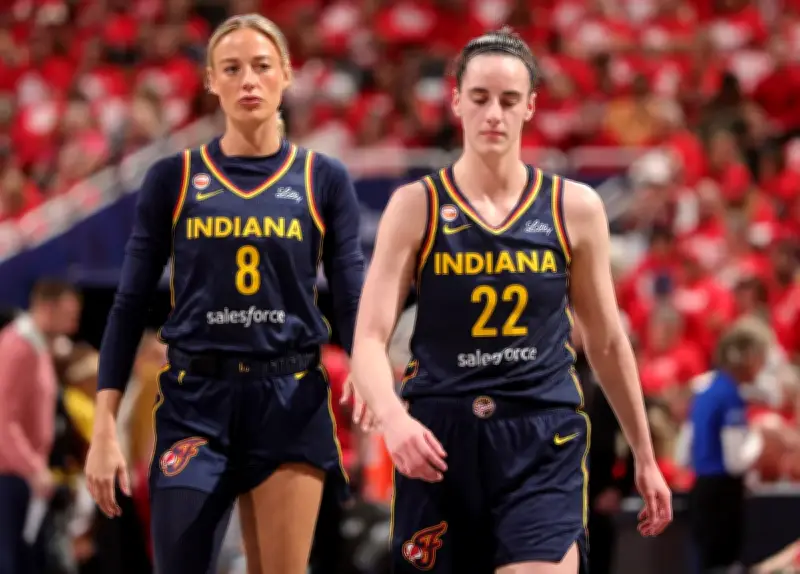
The Indiana Fever's season ended with a playoff exit to the defending champion Las Vegas Aces for the second consecutive year, but no professional sports team drew more attention to itself this season. The Fever became the WNBA's canary in the coal mine, embodying both the obvious and unintended consequences of rapid growth while serving as a season-long distraction: part-time professional basketball team, part-time right-wing culture war centerpiece.
Less than a decade ago, Atlanta and Minneapolis were praised for their unified political stances. Today, Trumpism has replaced social justice as the defining characteristic of the league, and as the curtain closed on the 2026 WNBA regular season, Indiana stood at its epicenter.
Clark and Cunningham as avatars
The Fever were the most polarizing team in professional sports, known less for their basketball than their culpability in pulling the league from its old cultural identity as a Black/queer league into the current ugliness of the Magasphere. Their two most recognizable players, Caitlin Clark and Sophie Cunningham, were in a constant state of churn, always in the news, always embroiled against an other, symbolizing and pandering to America's fractures.
Clark remains the league's biggest name and its chief avatar. She is an avatar for the money at a time when broadcasters and venture capitalists are making their bets on women's sports. She was an avatar of weaponization, the speculator's proof that the WNBA is doomed by its own hand for not recognizing her overall importance to its future. Most obviously and explosively, Clark was an avatar for whiteness, a Christian, hetero whiteness that holds the pervasive belief that it is straight, white America that is under assault.
The opportunistic and racist White House and the Trump administration repeated this fiction. Republican members of Congress earlier this season insinuated Clark was being discriminated against by the league because she is white, threatening the WNBA with a Department of Justice investigation if the league did not take steps to protect her.
Cunningham's role in the culture war
The other half is Cunningham, who spent much of the season building the scaffolding for her second act by driving a wedge into the heart of the league, positioning herself at the center of the attention-fueled culture war against trans women. She has been the subject of more attention than she's ever had in her decade-long career, with public appearances and lengthy profiles.
With the avatars tabled, Clark emerged as an excellent player with enormous upside and serious deficiencies. She is a volume scorer but not yet a great one – her career field-goal percentage is just 42.3, below the league average, and her career three-point percentage is a below-average 34.2. She shot 36.1% from three this season, below the Fever team average of 38.6%. She was second in the league in assists and first in turnovers. She is an apathetic defender.
Season ends with grievance
Superstar petulance is nothing new, and if Stephanie White doesn't return as coach, it won't be the first time a star player will be accused of getting the coach fired. Teams have also symbolized division, as with the Boston Celtics in the 1980s and the late-stage Brady/Belichick Patriots.
The season over, the Fever closed 2026 not by celebrating their best record since 2015, or by marking the first time since the 2009-2012 season the franchise posted three-straight 20-win seasons, but with more grievance. General manager Amber Cox read a statement blaming outside media for the odious reputation of Fever fans. “The attacks on our fan base have no basis in reality, and must stop,” she read from the podium. Mitchell's own words painfully contradicted Cox, as did rival players around the league.