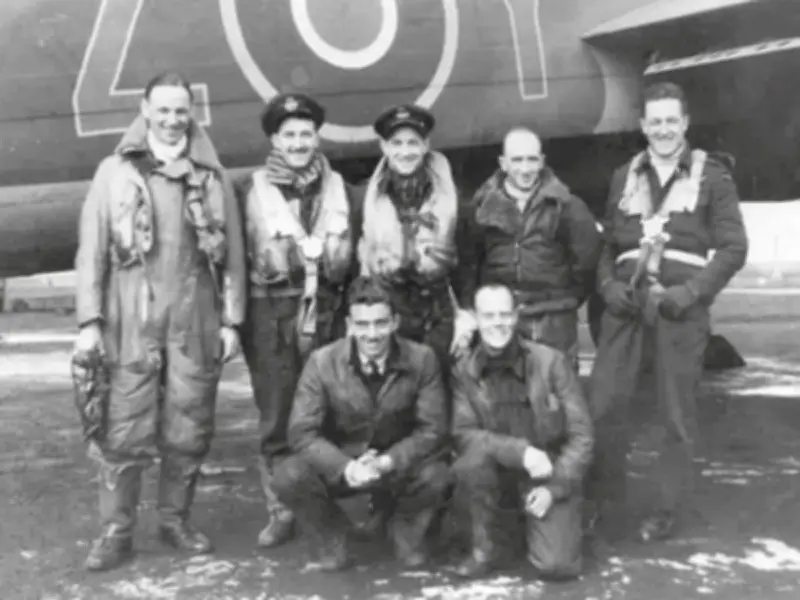
A rare signed menu from the 1943 Dambusters victory dinner, complete with a famous spelling mistake, has gone up for auction as part of a historic World War Two collection. The menu, printed as a souvenir for the dinner celebrating the legendary Lancaster bomber operation, forms part of a collection linked to two decorated RAF bomb aimers - Flight Lieutenant Leonard 'Len' Sumpter and Squadron Leader Donald 'Don' Falgate - that has come to light after 83 years.
It will go under the hammer later this month, with the menu alone and its famous mistake set to fetch up to half of the entire trove's total value.
Pair's RAF memorabilia expected to fetch £12,000
The pair's hoard of RAF memorabilia is expected to fetch more than £12,000 combined when it goes under the hammer at Gildings Auctioneers in Market Harborough, Leics., on October 13. The menu comes from a celebratory dinner held for the legendary 617 Squadron after their daring bouncing bomb raid on Germany's Ruhr dams in May 1943.
It was kept as a souvenir by F/Lt Sumpter, who attended the celebration at London's Hungaria Restaurant the following month on June 22, 1943, shortly after being decorated by King George V at Buckingham Palace.
Menu headed 'Damn Busters' with lavish food
The menu is headed 'Damn Busters' - possibly a printing error or a twist on the nickname of 617 Squadron - and shows the lavish food they enjoyed that night in comparison to their usual simple rations. The party was served a meal of crab cocktail (Crabe Cocktail), duckling (Caneton Farci a l'Anglaise) with minted peas (Petit Pois a la Menthe), new potatoes (Pommes Nouvelles) and asparagus with hollandaise sauce (Asperges Vertes, Sauce Hollandaise).
The dessert was strawberries soaked in Maraschino liqueur (Fraises au Marasquin). The keepsake also bears the signature of famed raid leader Wing Commander Guy Gibson, fellow Dambuster Terry Taerum and other RAF figures and entertainers, including Arthur Askey.
Veterans' service records and additional lots
F/Lt Sumpter flew 35 operations and is one of only two men recorded as taking part in both the Dambusters raid and 617 Squadron's final WWII mission, targeting Hitler's mountain retreat, Berchtesgaden, on April 25, 1945. F/Lt Falgate flew 32 operations and was awarded the Distinguished Flying Cross for his service, which included a key mission targeting the Colombelles Steelworks raid near Caen on July 18, 1944.
F/Lt Sumpter's course and speed calculator used in a Vickers Wellington bomber during the Thousand Bomber Raid on Cologne on 30 May 1942, is also included in the sale and expected to fetch £200-300. The auction also includes the war medals, log book, paintings and reconnaissance and bombing photographs belonging to F/Lt Falgate (1921-2013). The log book documents key missions such as the Colombelles Steelworks raid. F/Lt Falgate, who unusually favoured daylight raids, served as the lead bomb aimer ahead of the Operation Goodwood ground offensive in Normandy.
Both men's accounts of their wartime experiences are held in the Imperial War Museum's online archives. Gildings director Mark Gilding said: "It's a privilege to offer these incredible items, with such strong links to key RAF bombing campaigns of World War II."
"The menu is vanishingly rare, while the sheer depth of the Falgate collection offers a unique opportunity for a collector to acquire the wartime and post-war archive of a remarkable RAF career."
Also in the sale is a wing fragment of Lancaster bomber ED586 'F for Freddie', damaged on a bombing raid over Berlin on the night of 3 September 1943, when BBC journalist Wynford Vaughan-Thomas was on board. His broadcast, which can also be heard online, captures the crew preparing to bomb, releasing their bombs, coming under attack and shooting down a German fighter. The fragment is mounted on a display box detailing its missions, along with a cassette of the recording. It has a guide price of £300 to £400.
Mr Gilding added: "Objects like these transport us back to one of the most extraordinary periods of our history, and when we consider the fact we can access oral histories of the men involved, that connection becomes very real indeed."