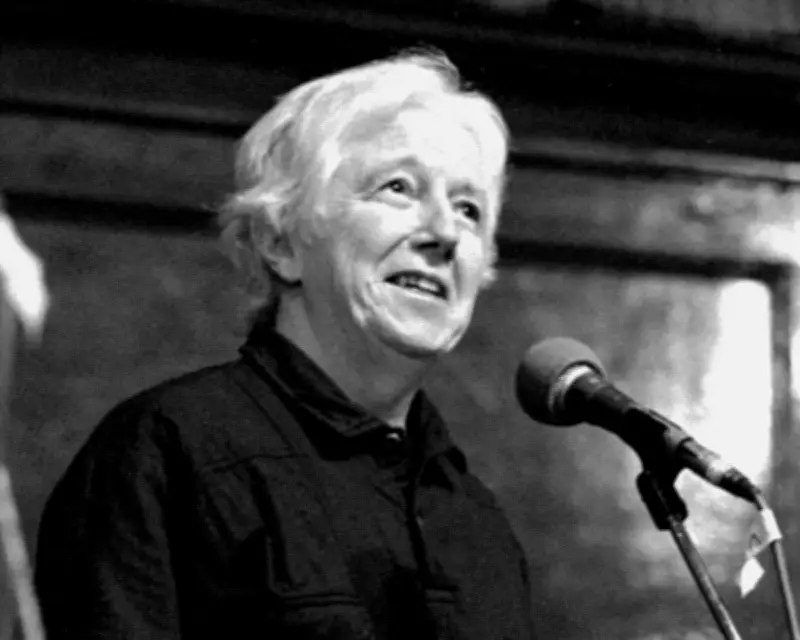
Bob Davenport, the unaccompanied folk singer and a key figure in the British folk revival from the 1950s to the end of the century, has died aged 94. He possessed a powerful tenor voice that could silence the noisiest of bars. In 1963, he performed alongside Bob Dylan and Joan Baez at the Newport folk festival.
Davenport would not have welcomed the description "folk" singer. He rejected the definitions of folk music put forward by early 20th-century collectors such as Cecil Sharp, who dismissed music-hall songs and parlour ballads and largely ignored what members of the urban working class were singing. For Davenport, folk music was for the middle classes; he preferred the term traditional music.
A champion of working-class music
Function rather than form was paramount to Davenport. Some of the songs in his repertoire were more typical of a Saturday night free and easy (open mic session) or a pre-1960s working men's club concert room. He championed bands such as the Boldon Banjoes, from a pit village in Co Durham, and, as production adviser, made his statement about traditional music in working-class Britain in John Tchalenko's Arts Council-funded film The Boldon Lad (1980).
Above all, it was the immigrant Irish community in London from the 1950s with whom Davenport had the greatest affinity. Labouring on building sites and elsewhere by day, Irish workers found a welcoming and familiar atmosphere in the pubs around Camden Town. Davenport recalled those days in his song Wild Wild Whiskey.
Early life and musical awakening
Davenport was from the north of England. Born in Gateshead, he was brought up by his mother, Sadie (Sarah, nee Fenwick); his father, Tommy, and grandfather, William, were killed in a domestic gas explosion before his first birthday. His earliest musical influences were the radio programmes they listened to – Jack Armstrong's Northumbrian Barn Dance and Radio Athlone's Ceilidh Hour. They turned up the volume so that the Irish family upstairs could dance to the music.
During national service in the RAF, Davenport spent his leave in London jazz clubs, and settled in the capital after demob in 1953. He relished the bohemian atmosphere of jazz and blues clubs, coffee bars, French films and African music. "It was buzzing, vibrant," he said.
At the Bedford Arms, in Camden, he heard the music of the Irish fiddle player Michael Gorman and the singing of Margaret Barry, and immediately recognised the music from his childhood Ceilidh Hour and songs at family parties. One night, he gratefully accepted the drinks that came along the bar, until he discovered they were from members of a London gang, who had been told Davenport had a good voice. They wanted to hear him sing; he had no choice. From Barry, he learned popular Irish songs such as The Blarney Stone and The Star of the County Down.
Career and collaborations
In 1958, Davenport met up with the Rakes, a trio of like-minded traditional musicians, Reg Hall, Michael Plunkett and Paul Gross, with whom he recorded a succession of albums and performed at concerts and festivals. For two years from 1964, they ran a groundbreaking club at the Fox, Islington, where the guests went far beyond the typical folk club performers. Reflecting Davenport's eclectic tastes in music, guests included Greek Cypriot musicians from north London, Ravi Shankar and the New Orleans jazz trumpeter Kid Sheik.
Davenport appeared on a couple of Topic Records' celebrated themed albums, The Iron Muse (1963) and Farewell Nancy (1964). He recorded with the Marsden Rattlers from South Shields and the Boldon Banjoes. Then, Topic released a trio of albums: Down the Long Road (1975), Postcards Home (1977) and Bob Davenport and the Rakes (1977). At festivals, he sometimes performed with the London band Flowers and Frolics.
In 1963, Davenport was recommended by Pete Seeger to perform at the Newport folk festival in the US, where he shared a stage with Dylan and Baez. Davenport already knew Dylan from when they had met in London the previous year, and his singing of the traditional song Nottamun Town was reputedly a source for Dylan's tune for Masters of War.
Davenport made further visits across the Atlantic in 1967 to sing at the Smithsonian Institution in Washington DC and at the Mariposa folk festival in Canada. He recalled that, in the 1980s, Dylan made an incognito visit to the club Davenport was running in the Empress of Russia pub, Islington.
Later life and legacy
He never relied on his singing to make a living. He worked for the Post Office and then, after a bout of tuberculosis, for a bookshop, before studying for a sculpture degree at St Martin's School of Art. He taught sculpture, ran a record shop and ended his working life as a chauffeur for the Guardian. Some years ago, asked if he had retired from the folk scene, he responded: "I never joined it in the first place."
In 1969, Davenport hosted concerts for six nights at the Sunderland Empire. The bill included a multitude of local performers plus, at the last one, the Kinks. Davenport sang with Ray Davies that evening, and Sunny Afternoon became a standard number in his performances. His repertoire was as likely to include the traditional Byker Hill as a song from Bessie Smith (Nobody Knows You When You're Down and Out) or Bob Marley (Get Up, Stand Up). To him, it was all music. He was a stern critic of intellectualising about traditional music, arguing that an evening of music should be entertaining, not a further education class.
After a recording gap of several years came The Red Haired Lad (1997), although by that time his hair had turned grey, and then The Common Stone (2004), on which he was joined by many long-standing friends including Richard Thompson and Martin Carthy. He later performed with the concertina player Roger Digby.
Davenport was married three times; first in 1958 to Erica Hay, with whom he had a daughter, Fiona; then in 1963 to Margaret Parker, known as Tarby, and they had three children, Sarah, Joel and Ben. Both those marriages ended in divorce, and in 1978 he married Jean Oglesby, with whom he had a daughter, Katharine; Jean died in 2001. He is survived by his five children. Bob (Robert Henry) Davenport, singer, born 31 May 1932; died 27 September 2026.