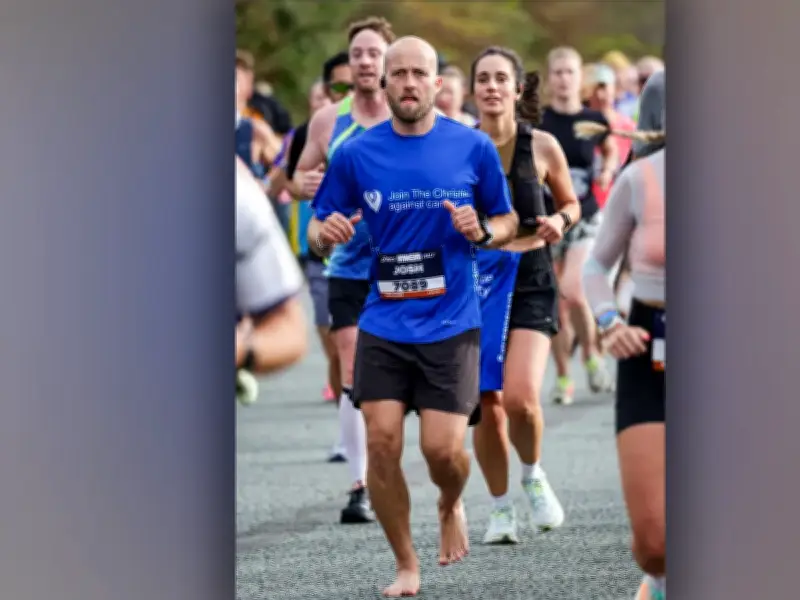
Josh Tweedale, 33, ran the entire Manchester Half Marathon barefoot to raise money for The Christie Charity, inspired by his mother-in-law Linda's cancer journey. The Wythenshawe gardener completed the 13.1-mile course without shoes to draw attention to his fundraising effort.
Personal motivation behind the barefoot run
Linda has been receiving treatment at The Christie NHS Foundation Trust for around five years after being diagnosed with neuroendocrine cancer, a rare cancer that starts in nerve and gland cells. She has also had breast cancer and undergone a mastectomy.
Josh told the Manchester Evening News: "It has been four or five years of never-ending tests, scans, and then the hope and then being told it's grown again and that treatment's not working anymore."
He added: "It's an endurance test. The only way I can relate to that is endurance through running. But it's like nothing else. I can't really understand."
How the idea came about
The idea for the barefoot run came from a family conversation about the phrase "put yourself in their shoes." Josh said: "I wouldn't want to be in their shoes. I can't be in their shoes. But one thing I could do is I could take mine off. It just came from there."
He described the race as "amazing" and hopes his story will champion the appeal by the Manchester Evening News and The Christie Charity for a new scanning centre at The Christie in Manchester.
Appeal for a new scanning centre
The appeal aims to raise £42.5m to build a new scanning centre at the specialist cancer hospital. The existing centre was built nearly 50 years ago for around 20 patients a day but now supports more than 60, with demand continuing to rise.
Dr Pavan Najran, Consultant Clinical and Interventional Radiologist at The Christie, said imaging "underpins the entire treatment journey" for cancer patients. He explained that the current department is limited by its infrastructure, which was designed for a quarter of the patients it sees today.
Dr Najran said: "We need to really not only catch up with where we are at the moment, but actually future-proof. We need to make it bigger, enabling more patients to be treated appropriately."