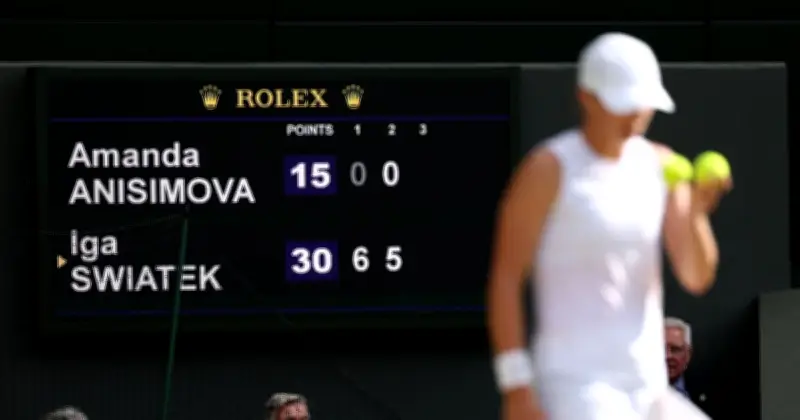
The tennis scoring system, with its seemingly arbitrary numbers 15, 30, and 40, has long puzzled casual viewers of Wimbledon. However, its origins are believed to date back to medieval France, according to historical analysis.
The Clock Face Theory
The most widely accepted explanation is that early French players used large clock faces to keep score. A quarter turn of the minute hand represented points: 15, 30, and 45. Reaching 60 would indicate winning the game.
Why 45 Became 40
The shift from 45 to 40 is attributed to linguistic convenience. In French, 45 is "quarante-cinq," a three-syllable word, while 40 is simply "quarante" with two syllables. Referees and players likely shortened it to 40 for quicker and easier shouting across the court.

Additionally, the change helped resolve a scoring issue. In tennis, a player must win by two points. If the score was tied at 45-all, the next point would push the clock past 60. By dropping 45 to 40, a tied game could sit at 40, an "advantage" point could move the hand to 50, and the winning point would land perfectly on 60.
Origin of 'Love'
The term "love" for zero likely comes from the French word l'oeuf (egg), which resembles a zero. Another theory suggests it derives from the English phrase "playing for love," meaning playing for no money.
Origin of 'Deuce'
"Deuce" is thought to come from the French phrase à deux le jeu (the game is tied) or simply deux, meaning two consecutive points are needed to win.