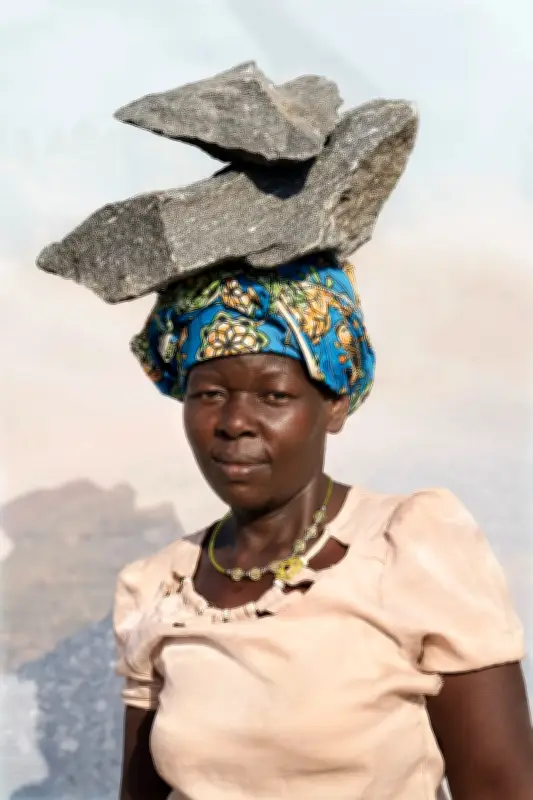
Dan Nelken's best photograph is a portrait of Janet, a Ugandan quarry worker who had been breaking rocks for 10 years to support her eight children. Her husband, a former boda boda taxi driver, had lost a leg in an accident, leaving her as the family's sole provider. “I am now the husband in this home,” she said, “and I have to do whatever I can to keep this house standing.”
How the project began
In 2017, Nelken's wife, Adele Brown, was invited to spend three weeks at an NGO in Gulu, Uganda, teaching critical thinking skills to blind high school-age students. Nelken was asked along to document the organisation's activities. He became fascinated by the town's main market, where vendors sold goods such as used clothes, fruit and firewood. He asked Ugandan teachers how he might approach someone to take their portrait, and they suggested offering a modest “model fee” after seeking permission.
One of the students, Emmanuel (Emma), assisted him. They visited the market together, with Emma approaching vendors to seek consent. Most agreed, but after returning home to New York, Nelken was disappointed with the results. “The images weren't working because I felt the vendors were getting lost in their own environment – the backgrounds were too distracting,” he said.

Finding the right backdrop
The couple were invited back to the NGO the following year, giving Nelken the chance to resolve the issue. His eureka moment came when he decided to use mosquito-netting as a backdrop. This allowed the women to stand out from their working environment while still letting their surroundings come through. The netting also added symbolism of malaria, one of Uganda's biggest health problems.
Nelken and his wife noticed that women seemed to be doing nearly all the work, and that became the theme of the project. Emma mentioned a quarry about 10 miles outside town, where women broke rocks all day, reducing them to gravel size and being paid for each jerrycan they filled. Some had small children or babies with them, yet most dressed as though they were going to market – some even wore jewellery.
Portraits of dignity
Nelken encouraged each woman to choose her own pose, giving her full control over how she wanted to be seen. The oldest woman he photographed at the quarry was 74, and another had lost an eye as a result of working there. But like all the women he photographed, they projected real dignity and a strong sense of self.
He was keen to photograph as wide an economic spectrum as possible – women with their own businesses, as well as those at the bottom of the economic ladder. He collaborated with Ugandan author Beatrice Lamwaka, who interviewed each participant about her circumstances: what had led to her doing the work she did, her hopes and dreams for herself and her children. Northern Uganda is still dealing with the trauma of the civil war, and this came through in several of the women's narratives.
The HeadStrong project
Janet had been working in the quarry for 10 years when Nelken photographed her. Many of the women had started working at the quarry as children because that's what their mothers were doing. His portraits also included one of 10-year-old Jovia, who had been working there on weekends for four years to help pay her school fees – she wanted to become a doctor.
Nelken called the project HeadStrong and was overwhelmed at how enthusiastic many of the women were when he went back to them with prints. “I think photographers had sometimes shown interest before and then never been seen again,” he said. He expressed gratitude to the 116 women who trusted him to take their portraits, calling them the heroes of the project.